If 2011 was the year of overoptimism for electric-car sales, and 2012 was Sophomore Slump after the inevitable shortfall, will 2013 be the year of realism?
That really depends on what the world's leading electric-car maker, Nissan, sells this year.
Let's recap. Several years ago, Nissan said that its Oppama plant could build 50,000 Leaf electric cars a year in each of 2011 and 2012.
Now that those two years have ended, how'd Nissan do? And, for that matter, General Motors too?
The latest statement, in a release on the updated 2013 Nissan Leaf, is that the company has sold "nearly 50,000 worldwide" through December.
A thread on the MyNissanLeaf forum discussing a January 8th forum Nissan hosted for owners in Scottsdale, Arizona, appears to support that.
It shows one of the earliest 2013 Leaf models assembled in Smyrna, Tennessee, with a Vehicle Identification Number of 55173--meaning that IF Nissan is continuing a VIN series from Oppama to Smyrna, it has built 55,000 Leafs so far.
Nissan's 2011 shortfall could be excused for a combination of startup slowness and the devastating earthquake and tsunami in March of that year, but 2012 should have been better.
But in fact, it looks like Nissan delivered 20,000 Leafs globally in 2011 and about 30,000 in 2012. In the States, Nissan narrowly increased Leaf sales in 2012--selling 9,819 against 9,674 the previous year--but failed to double sales as it had earlier predicted.
Mind you, sales of almost 50,000 modern plug-in electric cars is more than any other maker in the world. It gives Nissan a slight lead over General Motors, which likely logged 35,000 to 40,000 deliveries of the Chevy Volt and derivatives.
There were 31,458 Volts sold in the U.S. through December, but we're still waiting for non-U.S. figures to come in.
This compares to GM's projections of 10,000 Volts in 2011--it delivered 7,671, a fact used to proclaim plug-in cars a failure for much of the next year--and 45,000 U.S. deliveries in 2012, which it obviously didn't meet.
For the record, 53,000 plug-in cars were sold in the U.S. in 2012, which is three times the 2011 total.

2011 Nissan Leaf SL
Just as GM stepped away from its 45,000-unit projection in 2011, saying it would sell what the market would bear, Nissan hasn't made any future projections for quite some time.
While CEO Carlos Ghosn predicted in 2010 that Nissan and Renault together would be selling half a million battery-electric cars a year by the start of 2014, that now looks highly unlikely.
And its executives have adopted a more humble tone. Al Castignetti, its vice president of North American sales, told Automotive News, "We were arrogant" in the beginning.
After a lengthy interview with Castignetti last summer, in which he tried to explain why Leaf numbers were so low, we're pleased to see what look like seeds of a new approach.
Are the slower-than-projected sales a disaster for electric cars? Nah.
What they reflect is the reality of the global carmaking business: New technology is always adopted slowly, and despite advantages offered by advances in any part of a car, the buying public is conservative, cautious with its dollars, and often quite willing to let other buyers pioneer.
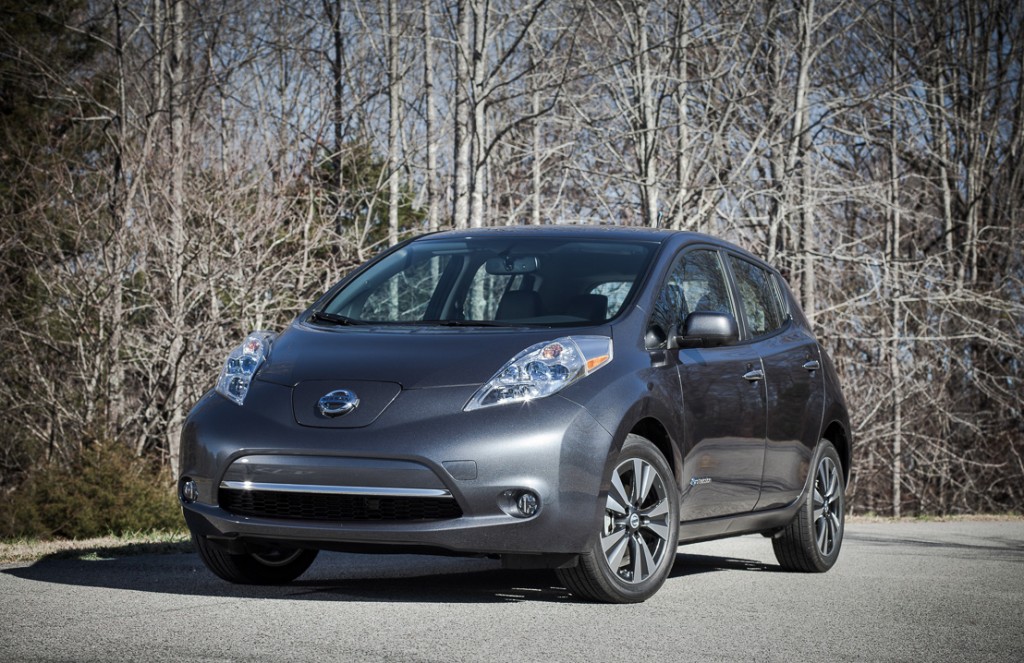
2013 Nissan Leaf
Add to that the high costs of all plug-in cars in the early years of large lithium-ion cell production; the added effort required to install a charging station at home for battery-electric vehicles; and both range anxiety and the highly variable range of electric cars, depending on driving style, temperature, and many other factors.
Then there's figuring out how to market cars with such a radically different propulsion and energy storage system--Hint: "It's good for you and the planet" won't cut it--and the disinterest and occasional cluelessness of many franchised dealers.
Oh, and media eager for headlines who seize on headlines about Fires! Range Anxiety! Disappointing Sales! Fear! Uncertainty! Doubt!
It's enough to make any pioneer sigh.
Here's where we stand: We think plug-in cars will increase their U.S. sales every year, but that adoption will be slow. But the more "butts in seats," the more people will start to understand the allure.
As former IHS Automotive analyst Aaron Bragman said last March, "It may be that the cars are slow sellers, but so was Prius when it first arrived as well."
To underscore the point, the author of this piece has a bet with electric-car advocate Peder Norby that by 2020, conventional gasoline-engined vehicles will still make up more than 50 percent of U.S. sales.
That means that battery electrics, plug-in hybrids, regular hybrids, diesels, and natural-gas vehicles together still won't add up to 50 percent of the U.S. market, which will likely be at about the same 15 million vehicles a year as it is today.
What do you think?
Will Norby win the bet--will gasoline engines be less than half the market--or will I?
Leave us your thoughts in the Comments below.
+++++++++++