2013 Nissan Leaf: Driven Through Tennessee...
Could Small 2015 Chevy City Express Van Offer...
Nissan Slashes Leaf Price To Sell Electric Car...
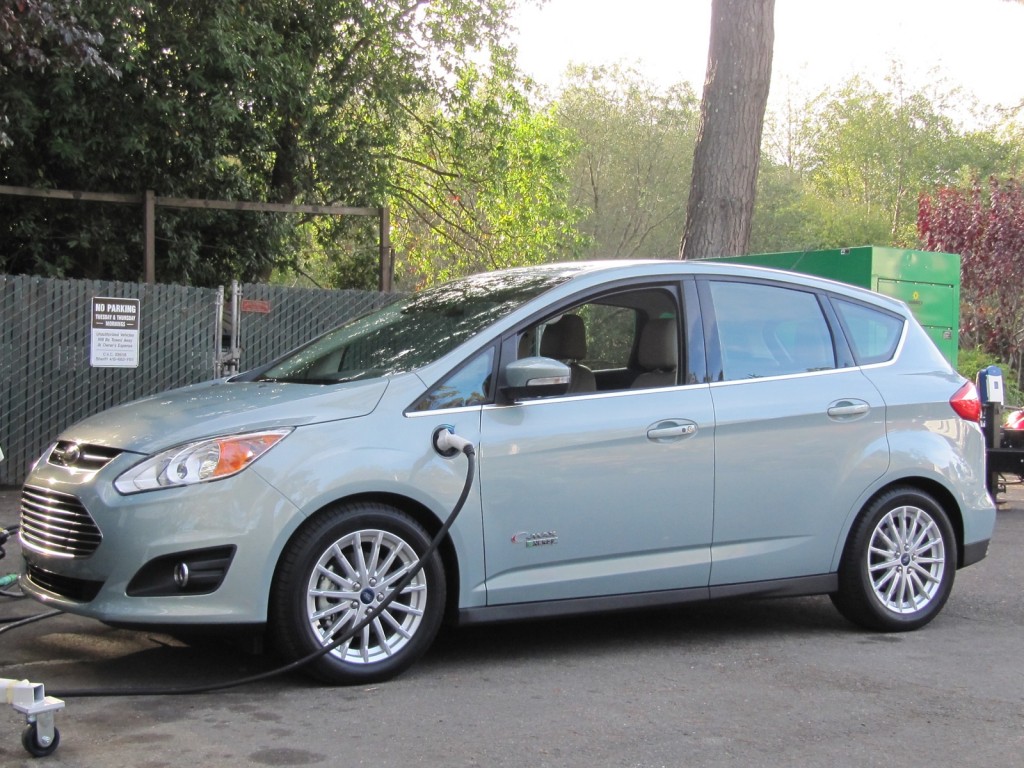
But higher in the chart are surging sales of the Ford C-Max Energi plug-in hybrid, which hit the market in October.
It logged November sales of 1,259, meaning its 2012 total could be 2,500 or more--after just three months on the market.
Ford will also have the Ford Fusion Energi plug-in hybrid sedan coming onto the market next year, so its 2013 plug-in hybrid sales should be substantial.
As for Mitsubishi, whose 'i' or i-MiEV was actually the fourth modern plug-in car to go on sale in the U.S. (in November 2011), it sold 77 of the tiny battery electric cars in December.
That brings its total for 2012 to 588 sold, making it a distant also-ran in the sales volume sweepstakes.
Compliance cars
The Volt, Leaf, and Prius Plug-In make up by far the bulk of the electric-car market for 2012.
Other vehicles added during 2012 include a handful of so-called compliance cars, among them the Toyota RAV4 EV and Honda Fit EV.
Toyota sold 52 RAV4 EVs in December, bringing the year's total since September to 192.
In December, 19 deliveries of the Honda Fit EV were made, for a yearly total of 93 units of the battery-electric conversion that can only be leased.
Unknowns: Tesla Model S, Fisker Karma
We won't find out how many Tesla Model S electric luxury sport sedans were delivered until Tesla Motors submits its fourth-quarter results to the Securities & Exchange Commission, most likely in early February.
While it insists that it's a fully competitive automaker, Tesla won't discuss its monthly sales figures, saying that its owners and potential buyers don't care about them, and its investors are content with quarterly reports.
Until then, we're estimating that about 3,000 of the all-electric luxury sport sedan found buyers.
That's lower than Tesla's original goal of 5,000, but enough to put the Model S into fourth place in the plug-in sales chart.
Production of the Fisker Karma has been halted for several months, since its lithium-ion cell supplier A123 Systems declared bankruptcy.
The company has never commented on production or sales figures--always a bad sign--but we estimate that more than 2,000 Karmas had been built by last summer.
If so, and netting out the 300-plus destroyed by Hurricane Sandy, we figure perhaps 1,500 have been sold in the U.S. market.
Coda and Wheego each have likely sold only a few hundred cars apiece, if that, and aren't a major factor in the market.
Positive signs for the future
While U.S. Department of Energy loans to Tesla, Fisker, and other green-energy companies came up during the presidential and vice-presidential debates last fall, modern plug-in electric cars are here to stay.
Last year, we summarized our takeaway on the 2011 plug-in sales figures as follows--and it applies just as much this year:
It's started. It's going to be slow, and the cars cost more than gasoline cars of similar performance. Plug-ins may not reach even 1 percent of global production (or 1 million vehicles of 100 million built worldwide) until the end of the decade.
But they're here to stay.
Mark our words: This time ... it's real.
Have you driven one yet?
+++++++++++

Follow GreenCarReports on Facebook and Twitter.
Have an opinion?
I'm relatively pleased and expect to see similar increases in the next 3-4 years for a start. No, sales won't triple as quantities increase, of course, but 17k to 52k to 120k to 200k to 350k or so should be possible.
Overall 150k plugins US sales in 2013 should be reachable.
Hopefully even more.
Neil
A Leaf that uses significant Heat in the winter and hwy cruising speed of 70mph will only realistically produce a range of 50 miles or less. That is a real issue.
I hope Tesla will prove the world wrong with their version of the 200 miles $35k BEV...
If changing your lifestyle to meet a car spec is a requirement, then it will NEVER take off as a popular product.
With new offering from Honda, Ford, Chevy and VW, I expect the total numbers of plugins in 2013 to double again.
Of course, that predication is subject to variation caused by gas price sensitivity. The biggest impact would be if gas price dips below $3/gallon...
Porsche 918 Spyder-Plug in, release in 2013
Porsche Panamera-Plug in, release in 2013
Porsche Cayenne-Plug in, 2014
VW Golf, Plug in, 2014
VW Passat, Plug in, 2014
Audi A3, Q7, A6 & A8, Plug ins coming, but 2015 or later.
So you are correct for 2013, the new PHEVs from the VW Group will start selling in N. America in 2014.
GM is vague about it, but under some circumstances the ICE can be connected to the drivetrain. But if I can believe what I've read, this only happens when you are driving at some speed over 70 MPH when the battery is operationally depleted, which never happens in my case as I keep my speed at around 65 (much to the annoyance of many Type-A BMW drivers).
In extended range mode and speed above 70mph.
Fisker also turn on the engine in "sports" mode even with a full battery.
NOT true. In hwy cruising the eCVT doesn't use power from electric motor when it is drained.
To me, PiP is more EV than a hybrid.
The PiP is, of course, a truly "blended mode" hybrid.
I take it you're proposing that many cars with plugs are NOT "electric cars"?
EREV will be a subset of PHEV, once SAE J1715 standard is final. See page 10.
http://www1.eere.energy.gov/vehiclesandfuels/pdfs/merit_review_2011/veh_sys_sim/vss052_duoba_2011_o.pdf
Volt's ICE come up for "maintainence" reason such as battery temperature, opening hood, gas maintainence, troubleshooting, engine repair.
They are NOT your typical "driving" mode.
Of course, the 2013 model allows a "hold" mode. But still, in its EV mode, it is a full electric. NO other PHEV can operate as such in their respective EV mode.
Volt is the ONLY one that can operate to its top speed, keep up its heat, same performance in EV mode as in extended mode. Also, Volt's electric motor is the main drive since it is FAR MORE powerful than its ICE. Just about every PHEV is the other way around where ICE is far more powerful than its electric motor.
http://www.motortrend.com/roadtests/alternative/1010_2011_chevrolet_volt_test/
Just because it has different set of conditions does not make it an electric car. As long as it has two fuels on-board, it is a hybrid.
Learn to read dude, in that test it happened b/c it already went through a high speed test which limited battery output. If the battery was at "FULL POWER", then its electric power output is at max. In ICE mode, the ICE can NOT provide more than what electric motor requires at full power.
The same can happen on a Leaf. When Leaf's battery is in "peservation mode" or "limp mode", it limits output as wel.
Learn some real engineering before you argue about it again.
What is your engineering background again?
I suggest you be more humble and stop trying to sound big and act macho.
Actually the clutch only engage directly for power at speed above 70mph. So, for 0-60mph, it makes NO contribution at all. The torque is ONLY coupled in at speed above 70mph.
Now, the "power sag" that you mentioned aren't the same for EV mode or hybrid mode. In Full Power EV mode, there is no sag until the power is drawn down. So, at least for the first few runs, as long as battery has peak current, it will be fine. Now, for hybrid mode, that is generally when the battery power is already sagged to a low point. Unless you engage Mountain or Sports mode AND wait for the ICE to charge up the battery, it will NEVER produce enough power to supply the electric motor. I know that from Personal Experience, not from heresay
Note that Volt's gas engine can come on to warm up the battery. Driver can press the HOLD button and gas engine will come on. Engine Maintenance mode and lifting up the hood will turn on the gas engine as well. When the engine is on, it can mechanically drive the wheels at constant cruising speed.
In Volt, its EV mode performance is same or even better than its "extended" range. Volt is a "fully" functional EV in its EV mode.
What are you smoking? Volt's EV mode has the same performance as its range extended mode. Its top speed is the same as its extended range mode.
B/c its electric motor is FAR MORE powerful than its ICE.
100MPH is the FASTEST EV top speed for just about everything except Tesla (that includes Leaf, IMIEV....etc).
Dennis Chin, please get a clue, your ignorance about the Volt and your tireless hate is getting stupid.
Volt EV mode takes 6.8 seconds longer to reach 100 mph. You need to get a clue.
I just love how you "game" your arguement. No different from how Toyota games the EPA test with PIP. I guess you and PIP are just two from the same SCAMMING school.
Where did you get your degree again? I should send all the marketing engineers to that school for some training on "scamming".
Read more: http://www.motortrend.com/roadtests/alternative/1010_2011_chevrolet_volt_test/viewall.html#ixzz2HOR9QCPX
http://priuschat.com/photos/screen-shot-2013-01-05-at-3-18-17-pm-png.9757/standalone
At full power, Volt's EV performance is better than its ICE performance. Here is why, you keep mentioned the stupid fact that if the battery is "perserving" mode, then its controller is limiting power. But if you are in ICE mode without the extra battery buffer, then your max speed is capped at 40mph on the hill, FAR WORSE than any EV mode. If you want to compare, compare the MAX PWR EV mode vs. MAX power ICE mode. It is just stupid to think that 80hp ICE can keep up with 149HP electric motor. Stop gaming your argument.
Now, trying to quote a 8.8 sec vs. 8.7 sec in two test is silly. they aren't compared at peak power.
Also, a 2013 model is improved as well.
You are becoming a bigger "hater" by the day... Losing more and more respect from me.
Please review how the Volt works in hybrid mode. You lack the fundamental understanding of how a planetary great set works. If need to, check out how Prius works -- has better materials explaining it, to help you.
I also know exactly which part of the power train drives which gears. The clutches doesn't engage at all the time. It various by CAR speed and mode. The ICE doesn't engage to drive the wheel until it is 70mph AND in extended mode. Completely different from Prius Synergy drive. If they were the same, wouldn't you think Toyota would have sued for IP violation?
Also, the clutches for the generator also spins up at 60mph in EV mode to reduce the speed of Electric motor. That is why if you drive the Volt carefully enough you will detect slight vibration when those clutches engage at 60mph, and again at 70mph in extended mode.
I think they speak for themselves...
Good luck with your home solar research.
C-Max Energi has smaller cargo space (different from the hybrid version) than PiP.
It also has the LOWEST rated safety rating as well..
2012 Volt: http://www.cars.com/chevrolet/volt/2012/safety-ratings/
2012 PiP: http://www.cars.com/toyota/prius-plug-in/2012/safety-ratings/
For Rollover Test, both got 4 stars. For Passenger Frontal crash test, Volt got 4 stars but Prius got 5 stars. Yet, overall frontal is 4 stars for both plugins.
In overall of overall, Volt got 5 stars and PiP got 4 stars. Puzzling!
Here are the links directly from NHTSA's webpage.
Volt and PIP are both 5 star for drivers and 4 star for passenger (female size).
Volt and PIP are both 5 star for the side.
However, Volt is 5 star for roll over where PIP is 4 star for roll over.
That is why PIP is a 4 star rated overall.
http://www.safercar.gov/Vehicle+Shoppers/5-Star+Safety+Ratings/2011-Newer+Vehicles/Vehicle-Detail?vehicleId=6508
http://www.safercar.gov/Vehicle+Shoppers/5-Star+Safety+Ratings/2011-Newer+Vehicles/Vehicle-Detail?vehicleId=6758
PIP is more likely to roll over. I am NOT surprised with that finding since PIP has skinny low rolling tires, higher center of gravity and poor handling...
Considering the skinny tires, pathetic handling and terrible brakes, I would understand why Prius drivers are such "slow" drivers. It is just NOT safe to drive Prius in any kind of "sporty" fashion.
Dude, give it a rest, just enjoy your boring high mpg, 5 passenger transportation box...
I couldn't be any happier (and having fun) with 128 MPGe on electricity and 55 MPG on gas.
There are plenty of cars that have more weight than small SAV (different from SUV, but probably okay for you since you are more a "marketing" type instead of engineering type".
There are also plenty of light cars with much wider tires as well.
All cars are about "trade off". In your Pip case, it trade off safety, performance and EV range for space, MPG and EPA gaming MPGe numbers.
Your numbers are good b/c you are a typical "no fun" Prius drivers. It is okay, that is what most PIP buyers are anyway...
I did. You just don't get it. I listed the condition of which each MPGe and MPG with respect to the speed and condition.
You just don't get it. Feel free to drive your PIP like a turtle. Turtles are "fun" too, for turtles. They are far more efficient than just about all faster animals.
So far, you still FAILED agains and again at understanding the speed vs. efficiency equation. I don't blame you since you aren't an engineer...
There are four basic numbers that anyone can derive everything from.
1) Total number of miles driven with plug electricity
2) Total kWh consumed from the wall (charging loss would be included)
3) Total number of miles driven with gasoline
4) Total gallons pumped in.
My latest figures.
1) 1,049 miles
2) 276 kWh
3) 1,566 miles
4) 29 gallons
You drive like a turtle and you shall have great turtle efficiency.
You like to twist facts without giving out the truth.
It would be meaningful if you provide your average speed, driving condition, accleration pattern with those efficiency numbers.
But you don't. B/c you claim that is your "efficiency". That doesn't mean anything without the condition of which those efficiency is achieved.
This is no different than saying that my co-worker only got 40mpg in his Prius (which is poor for a Prius). But if I had said he got that 40mpg while setting a cruise control at 80mph and with 4 people for an entire trip, then it is great.
I have stated in other comments that my Volt's efficiency at various speed. But overall, in extended mode, I am getting 39mpg (mixed driving). On long trips where most of it are hwy, I am getting 41-43 mpg. But that is with 100% gas.
My co-worker's recent SF/Vegas trip (CC set at 75mph) confirms that too.
In electric mode, I can't tell you the exact amount of electricity going in. I can only tell you that my Volt gets on average 38 miles per full charge.
Your Prius battery is air cooled with fans and no power used for conditioning.
So, I would think my efficiency number per full trip is more applicable in this case.
You can argue about extra power drawn, I can argue for your battery life loss due to lack of conditioning...
Again, we all know speed affects efficiency.
Again, I am just asking what you are getting in electric miles and gas miles.
In our engineering world, facts are facts. But they are meaningless without the "context" or condition of those facts are measured. Facts aren't truth.
3,004 miles are in the extended range miles (aka gas/hybrid miles). In those miles, 77 gallons of gas has been burned. of which 0.4 gallons were burned when the car were in service. 0.2 gallon burned during the initial check up at new and 0.2 gallon just burned in my first oil change/full check up. Dealer provided me the first tank of gas. I have put in 79 gallon of gas into the car (some of it are still in the tank).
The electric miles are 7407. I don't have the total electricity usage for those miles since there are no way to account for those "pre-condition" electricity charges. But it shows an average of efficiency of 3.63miles/KWh. You can assume a charging loss of 15%.
Have an opinion?Join the conversation!