The 2013 Nissan Leaf that will go on sale in January will be a slightly different car from the 2011 and 2012 models sold in the U.S. so far.
We already know the electric car will offer leather seats and a 6.6-kilowatt charger as options, along with a more efficient heating system.
Now a report from Japan suggests that Nissan will offer a 2013 Leaf with longer range, as well as a lower-cost model with a smaller battery pack (which could be restricted to sales in that country).
The improvement in usable range is attributed to improved performance from the battery's lithium-ion cells and a more efficient electric motor.
Today's Leaf is rated by the EPA at 73 miles of range. Owners report usable range of 60 to 90 miles in real-world use, depending on their speed, the outside temperature, and how much they use air-conditioning and/or heater.
A report in SankeiBiz, a Japanese newspaper, says the new Leaf model will offer more than 250 km (155 miles) of range--though that figure is undoubtedly based on the Japanese test cycle, which produces figures far more optimistic than the U.S. EPA tests do.
The current Leaf is rated on that same Japanese cycle at 200 km (124 miles) of range.
But the 25-percent improvement discussed in the news report could bring the U.S. range rating of the 2013 Nissan Leaf to something like 90 or 91 miles.
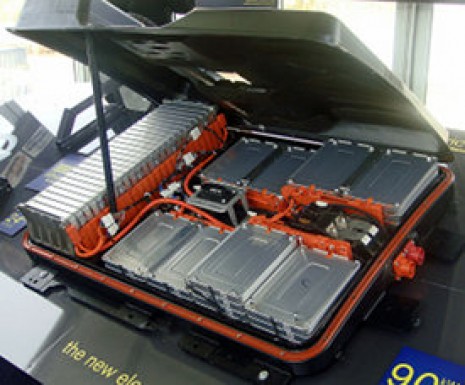
Lithium-ion battery pack of 2011 Nissan Leaf, showing cells assembled into modules
If so, that would put the 2013 Leaf ahead of the Ford Focus Electric (76 miles), Honda Fit EV (82 miles), and Coda Sedan (88 miles) in rated range.
The less expensive 2013 Leaf with lower range may be limited to buyers in Japan, which has different tax subsidies and buyer incentives. Mitsubishi already sells a lower-range model of its i-MiEV electric minicar there.
The Sankei report also says that Nissan will "dramatically change the appearance" of the Leaf's design. In fact, we suspect the changes will be evolutionary updates rather than a completely new style.
Colin Lawther, Nissan's VP of engineering for Europe, said in April that when U.K. production of the 2013 Leaf starts early next year, it will have its styling "fine-tuned" to the tastes of European buyers.
Sankei reports that the changes to the Leaf were pulled forward a year, due to lower-than-expected global sales of the Leaf. Nissan Leaf sales in the U.S. have been flat this year, for a variety of reasons, as explained by the company's VP of sales.
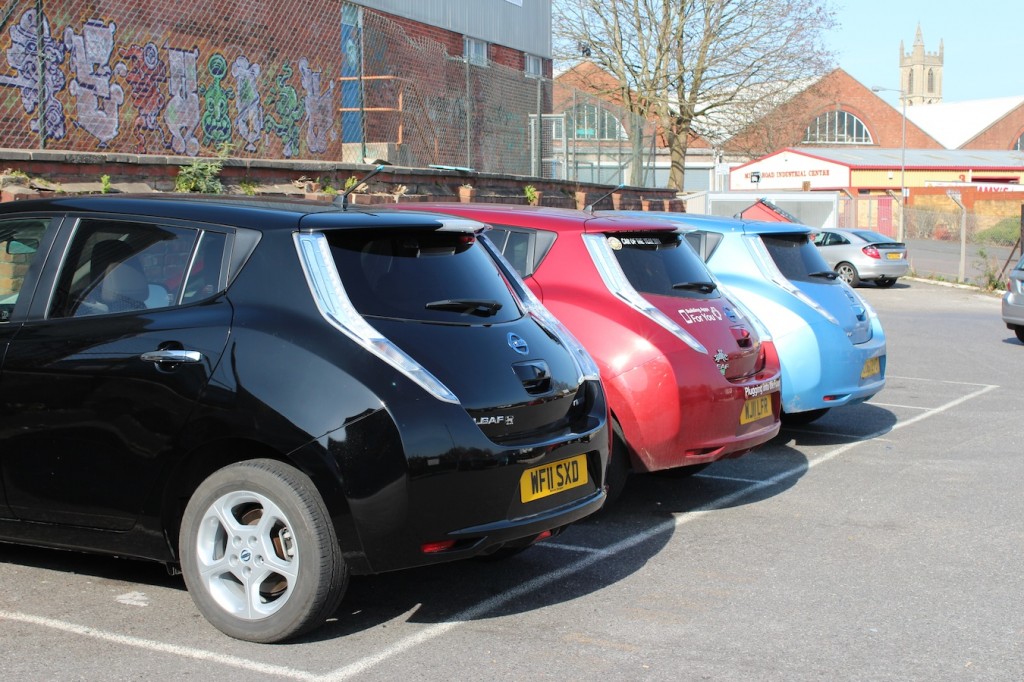
Three Nissan Leafs
The 2013 model will have to produce far higher sales to justify Nissan's investment in Leaf assembly--and construction of a lithium-ion cell fabrication plant--in its factory in Smyrna, Tennessee.
U.S. assembly of the Leaf and its battery cells was funded, in part, by a $1.6 billion low-interest loan from the U.S. Department of Energy. In the end, Nissan used only $1.4 billion of those loan proceeds.
Changes for the 2013 Leaf were predicted by Nissan executive Mark Perry as far back as 2010, well before the first Leaf was sold in December of that year.
+++++++++++