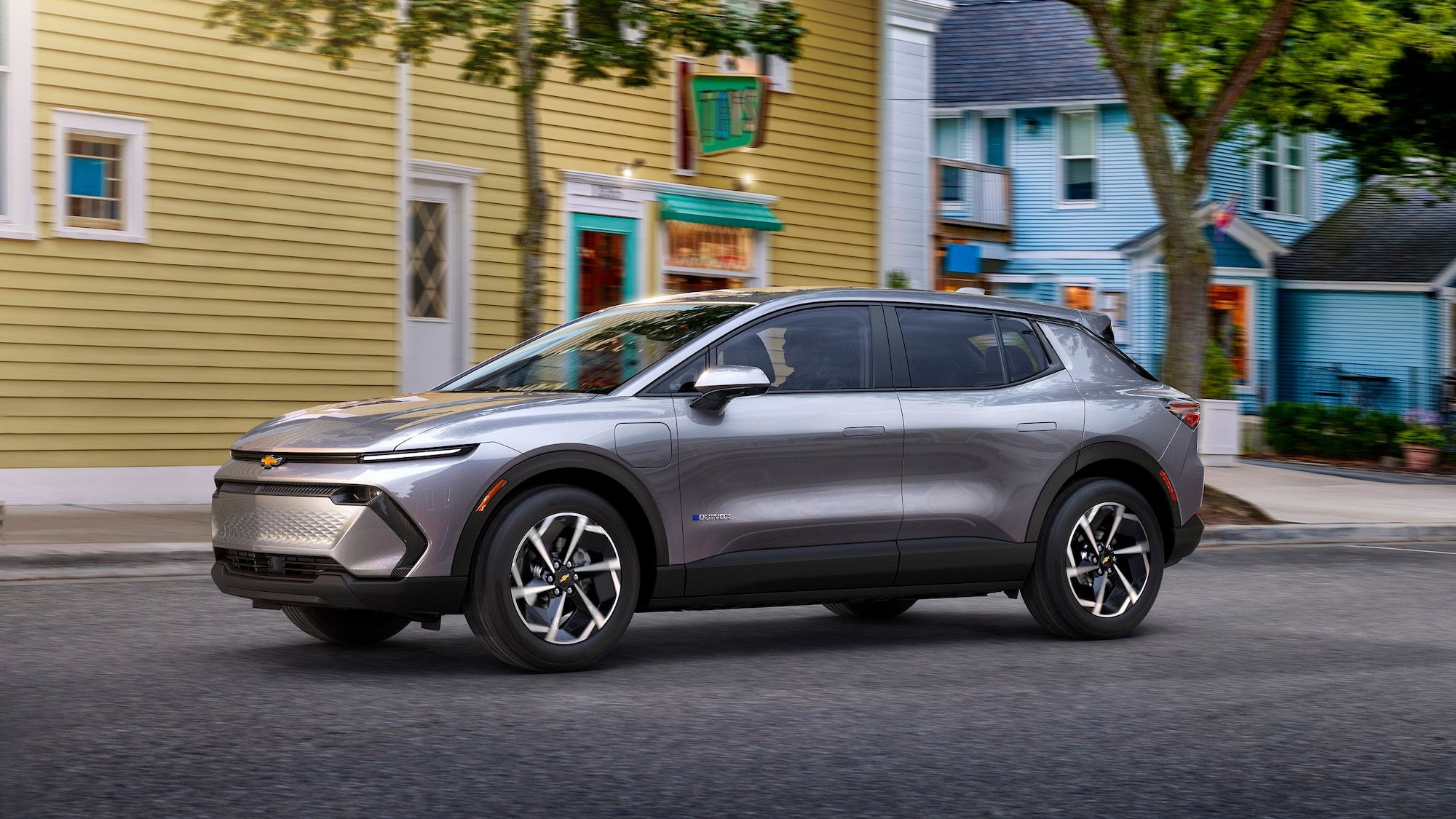
Since November 2006, our family has always owned at least one plug-in car and one powered by gasoline.
For almost two years, our fleet has been a Nissan Leaf electric hatchback, and a used 2008 Toyota Prius.
After two years and nearly 42,000 miles of driving the Leaf, however, our once high-tech Prius had begun to feel like little more than a gas-guzzler.
It also became the subject of a good-natured daily fight over who would would have to drive it, versus who would get to enjoy the comfort and performance of the all-electric Leaf.
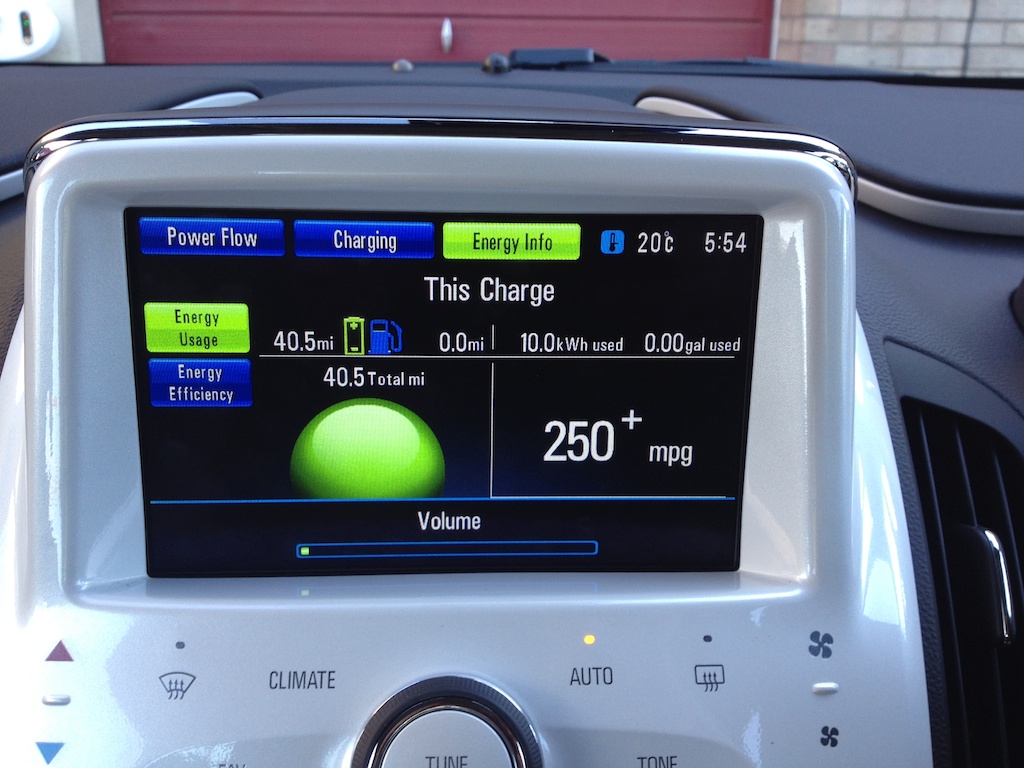
With a few high repair bills looming on the horizon for our little gas-guzzler, we did the only logical thing we could: We traded it in for a Chevrolet Volt.
But if we hate buying gasoline and love electric cars so much, why go for the range-extended Volt over a pure battery electric car? I’ll explain.
Daily driving
For the most part, my personal transportation needs are fairly simple: I need a car that can handle daily errands.
Those include taking the children to after-school clubs, visiting friends, and doing the weekly shopping.
Because I work from home, I drive less than 15 miles in an average day--something our Nissan Leaf handles perfectly.
the remaining 20 percent of the time, I’m attending press launches, visiting friends out of town, or teaching the occasional music class in a local school.
The Leaf handles most--if not all--of these duties, but occasionally, I need to venture beyond the 74 miles or so the Leaf can muster on a full charge.
Thanks to a growing network of CHAdeMO quick-charging stations in the UK, it’s now possible to drive hundreds of miles a day in the Leaf. But while the network is rapidly growing, driving the Leaf long-distance requires extra planning and extra time.
When I’m working on a tight schedule and have to be back home in time to pick up the kids at school, taking the Leaf isn’t always an option.
My wife, a contracting software engineer, commutes daily from our home to ... well, wherever she happens to be working at the time.
For the past seven months, that’s been a company based 40 miles from home--though her commute in the past few years has been as short as 20 miles and as long as 100 each day.
Have an opinion?
An alternative would be to buy another Leaf (or Spark, etc.) and then rent a Prius (or other appropriate vehicle) for longer trips.
I'm preaching to the choir, of course - but maybe someone is listening...
Neil
Really no conundrum at all. IF one is driving more than around 70 miles a day, the Prius will be better in terms of saving $. OTOH, the Prius will NEVER have the ride, performance, or handling of the Volt. We have owned both a 2004 Prius AND a 2006, so we know that platform quite well.
The Volt is more economical if the daily drives are less than that 70 mile total, and many Volt drivers are getting more than 40 mpg with their cars. We ALWAYS get between 41-44 mpg during gas ICE operation with our early production (VIN #679) Volt. And the Volt rides more like an Audi than even the Camry Hybrid (which we also have owned). One additional point for the Volt in our experience, is that GM's support is simply incredible!
We have also owned Acura, Audi, BMW, Lexus, Infiniti, and Porsche among the "higher end" brands, and the GM support for the Volt is better than anything we have ever had from any of those "prestige" lines.
The Prius has one big advantage (pun intended!) over the Volt: I am 6-4"and my 15yo son is 6'-5"+ and still growing. My family can't fit in the Volt - but the Prius is quite comfortable.
That's why I'm building a 5 seat EV that I hope will have a 300-400 mile range. :)
Neil
You've got a good memory. The Twizy was also sold, because of its unreliability. The Volt and Leaf are now our only two cars!
On "short" commute days, my partner drives 30 mi to work each way to Auburn. For that, he can take the Leaf, and by leaving it in a wall plug (no Level 2 at his work) all day, he has plenty of range to get home.
On some days, he has to make a 3rd stop in to Tacoma, another 15 miles down the road. For that, he needs the extended range of the Volt. He leaves fully charged and plugs in where possible (again, just Level 1 available). Typically, these are 85-90 mile days, with all but maybe 10 miles on electric.
We've reduced our gas use by 90% compared to our prior cars (a Volvo S40 and an Acura TL). And our electric is cheap. Our "eGallon" cost is $0.84, so it totally pencils out, too.
This always shows why Volt is an important product to bridge the technology. Volt doesn't require "planning". Mose household has busy lives. Sometimes the unexpected happens and the extra range of the Volt makes a big difference.
Of course, a 200 miles BEV will make up for many of the trips that Volt is designed for. But there are NO sub $45k 200 miles BEV yet.
As far as those people who are concerned with Volt's extended MPG, it is way overblown.
Volt is rated 40mpg in hwy driving. That is usually where you need the extended range. With EV hold, you can easily save the EV miles for city drving and 40mpg for the hwy.
Next, with most households having more than one vehicle, and (hopefully) not requiring all of them for longer trips like family vacations, for all but the longest commutes, one of them could easily be a full EV.
All current EVs start each day with 80+ miles (62 for the i-MiEV). That covers a LOT of weekday routine + crazy unanticipated errands already.
Charging at work or destination, and/or quick-charging if the vehicle allows it (great feature to have) would push this to 150 electric miles.
That's available today, and at ~200$/mo it's a no-brainer (for the Fiat 500e you must find the right dealer though).
I strongly disagree with that statement.
Volt has 38 miles EV range that is more than 3x the EV range of Prius Plugin. Yet, its 40mpg highway miles is only 10 less than the 50mpg of Prius which is only only 20% less than the Prius Plugin (NOT significant). Not to mention the fact that Volt drives way better than the Prius. If you really care about the 35mpg city miles vs. 51 for the Prius, then you can easily avoid it with EV hold mode to minimize that.
Not to mention that the difference between 40mpg and 50mpg over 6,000 miles (half of your yearly driving) is only 30 gallons.
20'000 miles (Nikki's yearly driving) at 27 MPG (about current US avg) would burn about 740 gallons or 2.4 to 3k$/year.
Same distance with a Leaf: 5~6 MW*h. With solar,
20'000 miles (Nikki's yearly driving) at 27 MPG (about current US avg) would burn about 740 gallons or 2.4 to 3k$/year.
Same distance with a Leaf: 5~6 MW*h. With solar, less than 400$/y.
Just like that, even at today's US gas prices which are less than half of UK's, for a single but heavily-used vehicle, we're looking at 2 grands saved every year already.
And yes, tons of CO2 and other junk too.
Regarding plug-in vehicles' impact on climate (and more on costs), nothing like the UCS report on the topic:
http://www.ucsusa.org/clean_vehicles/smart-transportation-solutions/advanced-vehicle-technologies/electric-cars/emissions-and-charging-costs-electric-cars.html
Just curious that you mentioned that you would have considered a C-Max Energi if it was available when you bought your Volt. Would you have done the same thing on an Outlander PHEV with 4WD? Isn't a crossover with 4WD, more space and decent EV range also just as appealing to a family buyer as the Volt?
I am just curious. B/c if the outlander is available by next year, I might have to take a serious look at it if the price is right.
Now forgive me, but I have to go to work in my 100% gas powered "economical" Suzuki which will need filling before the weekend at a cost of €60. :(
https://www.facebook.com/photo.php?fbid=10151730722685982&set=a.10151730712745982.1073741829.644130981&type=3&theater
My wife and I both went electric in 2009, a few months after trying our first EV. Gas cars feel broken now. EVs are so much nicer! It seems most EV skeptics miss that point (because they haven't driven one).
Welcome to the Volt+Leaf family car club! We were the second such household in the US back in February of 2011, and though we still "own" the 2011 Leaf, our garage is now hosting that original crystal red Volt and the multicoat red Tesla Model S rather than the Leaf. The Volt "cures" one version of "range anxiety and the Model S (85kw battery) addresses another!
1. Most Hybrids/Plug-ins currently use nickle-based battery technology. Requiring environmentally injurious open-pit mining China (the bastion of environmental stewardship!); finally, assembly in Japan...add in all the diesel-powered shipping...how can these vehicles be helping the environment?
2. 60-70% of electricity produced in the US is produced by Coal-powered plants! Really good for the environment, huh?
3. What is gonna happen to all those batteries in 10 years when they are worn out? Landfill? Great, right?
Congrats on saving gas...but please don't try to say you are saving the environment.
(2) As we cover often, the carbon emissions per mile driven on plug-in power have been analyzed for each state's grid. Even in the *worst* most coal-heavy state, a plug-in is equal in carbon emissions to be BEST (non-hybrid) gasoline car--and much better in cleaner-grid states like CA.
(first of two ... continued)
(3) Used battery packs will be recycled, just as 12-Volt batteries are now (they're the most recycled consumer good on earth). EVERY hybrid & plug-in maker already has recycling programs in place; the contents of the packs are far too valuable to junk.
All three points have been covered on Green Car Reports--and other outlets too. I encourage you to use our "Search" box to do a bit of research.
Here are a couple of links to get you going:
http://www.greencarreports.com/news/1085997_teslas-musk-promises-deep-dive-into-electric-car-emissions
and
http://www.greencarreports.com/news/1044372_who-knew-a-car-battery-is-the-worlds-most-recycled-product
My house is powered by renewable energy from my local green energy provider in U.K. (Yes, I'm in England.)
While the electrons themselves may come from a mix of sources, my local utility company promises that for every kilowatt-hour of electricity I consume, it will buy an equivalent amount of renewable energy from local wind and solar farms. :)
So we really are lowering emissions!
1) Completely unaware of battery chemistry for PHEVs (plug-ins).
2) Completely clueless about the growth of non-coal usage for power plants. Again, did you stop paying attention years ago? Again?
3) Completely clueless yet again about the fact that EV/PHEV batteries are already reused and much of them can be recycled, in addition.
I won't claim to be saving the environment but please don't claim to know anything at all about EVs. You not only know nothing, what you thought you knew is wrong.
I wonder, though, if the Volt is using petrol so rarely, wouldn't the fuel go stale? My Subaru was off the road for a few months and after that the trip to get it repaired used two or three times the fuel it should have. All because the fuel had sat in the tank for so long. The volt would still have far better fuel economy, but not as good as it could have.
Have an opinion? Join the conversation!