VW Talks Future Tech: Plug-Ins, Natural Gas...
2013 Nissan Leaf: Driven Through Tennessee...
Could Small 2015 Chevy City Express Van Offer...
Gird yourself: It's possible we're about to see a new wave of attacks on electric cars that ignore battery science.
This time the culprit is the troubled Boeing 787 Dreamliner aircraft. The FAA has grounded all 787s after a string of fires in their lithium-ion battery packs; other countries have done the same.
Which has led at least one supposedly authoritative commentator to say that Boeing is having the same battery problems as those "that have shown up in electric cars."
The problem is that the two types of batteries are, in fact, quite different.
Here's the offending quote, from Paul Czysz, professor emeritus of aeronautical engineering at St. Louis University, as cited in a Boston Herald article this morning:
"Unfortunately, what Boeing did to save weight is use the same batteries that are in the electric cars, and they are running into the same problems with the 787 as the problems that have shown up in electric cars."
The author of the Boston Herald piece then went on to describe a 2011 fire in a Chevy Volt crash-test car that occurred several days after it was wrecked and rotated through 360 degrees by the National Highway Traffic Safety Administration.
In January 2012, the NHTSA closed an investigation into Volt fires, concluding that "no discernible defect trend exists" and that "modifications recently developed by General Motors reduce the potential for battery intrusion resulting from side impacts."
Here's the problem: While the battery cells in Boeing 787s and, say, Chevrolet Volts are both in the lithium-ion family, they use very different chemistries.
You can think of lithium-ion cells rather like motor vehicles: They all do some variation of the same thing, but there are many different types, sizes, shapes, and different technologies to make that happen. Consider the difference between gasoline and diesel engines, for example.
The cells in the 787, from Japanese company GS Yuasa, use a cobalt oxide (CoO2) chemistry, just as mobile-phone and laptop batteries do.
That chemistry has the highest energy content, but it is also the most susceptible to overheating that can produce "thermal events" (which is to say, fires).
Only one electric car has been built in volume using CoO2 cells, and that's the Tesla Roadster. Only 2,500 of those cars will ever exist.
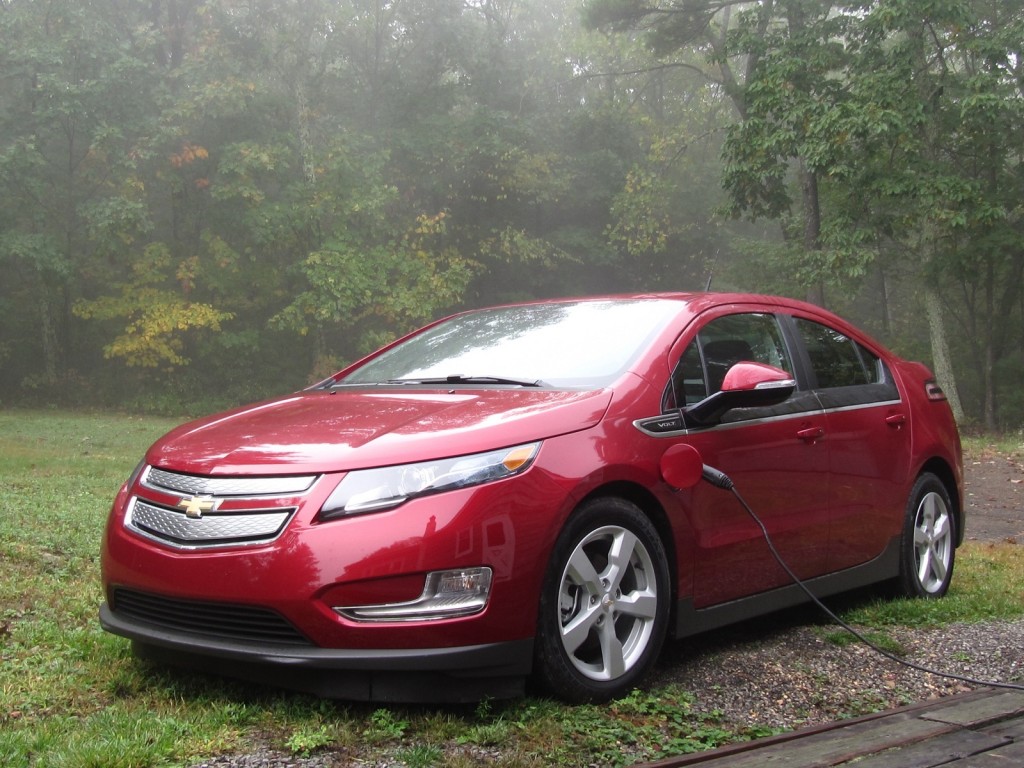
The Chevrolet Volt range-extended electric car, on the other hand, uses LG Chem prismatic cells with manganese spinel (LiMn2O4) cathodes.
While chemistries based on manganese, nickel, and other metals carry less energy per volume, they are widely viewed as less susceptible to overheating and fires.
So if you see coverage of the Boeing 787 battery fires that says anything at all about electric cars, do consider dropping a friendly note to the reporter involved.
It may be unreasonable to expect every reporter in the world to know that "lithium-ion batteries" are a family of very different chemistries.
Science reporters, on the other hand--let alone engineering professors--really should know better.
You have been warned.
+++++++++++

Follow GreenCarReports on Facebook and Twitter.
Have an opinion?
But I can't say for certain since I'm no chemical scientist or engineer or other expert. (Oh, wait... ;-) )
The point is that for the billions of Li-Ion (cobalt) batteries sold, incidents of fires are rare.
I am not sure if enough Li-Ion (non-cobalt) batteries have been sold to say whether or not they are a problem.
Incidentally, the Dell battery fires that occurred were due to internal contamination in the battery with other metals. Seems like that would also be a possible problem with non-cobalt batteries as well.
has learned more about battery tech over the last year or so. Like Fox News, will they interview real battery experts on what kind of battery we're dealing with? Or are they just going to report, batteries + fires = all things with batteries are bad and scary? I'm going to sit back and see who has become better educated and who is going to go with what they know, which is nothing at all.
On the other hand, I keep hearing "leaking" related to the 787 battery issue. I wonder if that tells us anything.
http://www.popularmechanics.com/cars/alternative-fuel/electric/dont-worry-about-the-volts-reported-battery-woes-11423298
But the chemistry in the 787 IS the same is what is in our cell phones, laptops, cameras, tablets, etc, and they don't suffer the same "thermal events" and "leaking" as the 787.
I don't think this will come down to an issue of battery chemistry, in the end. It will be some details in the chargers, wiring, or environment that is making Li-Ion a problem in the 787.
http://www.theinquirer.net/inquirer/news/1042700/dell-laptop-explodes-japanese-conference
It's one of the reasons airlines now require all equipment with Li-ion cells to be carried in the cabin, not in checked luggage--so that if something catches on fire, it will be seen earlier and can be extinguished.
At a battery conference I attended 5 or 6 years ago, one production expert said that the rate of internal shorts in CoO2 cells was roughly 1 in every 5,000,000 cells--and makers hadn't been able to improve on that. May be more current data now.
A failure rate of 1 in 5,000,000 cells would make the Boeing failures much rarer than they are. I suspect that a failure rate of 1 in 5M would mean zero 787 issues given how few have been shipped.
On the flip side, what is the failure rate in non-cobalt Li-Ion batteries? Is it better, is it worse, or is it too soon to tell (how many have shipped?).
If you have data that shows definitive evidence of higher rates of thermal events in Li(cobalt) versus Li(non-cobalt), then I think your case is much stronger. But I don't see that data here.
Also, I think it unlikely that Li(non-cobalt) batteries will have Zero thermal events.
There are many specifics to using Li-Ion batteries in 787 that only Boeing engineers know design details. Being one of the first applications in commercial aviation, there are still domain specific details we are learning about.
With portable electronics, the number of Li-Ion batteries is approaching a Billion. The number of Li-ion batteries so far used in aviation is less than thousand. (Only ~50 787's in service)
That makes sense.
So indeed, this may not be simply an issue of chemistry (as Voelcker suggests) but more of an overall system issue.
I suspect it is the "battery management" system at fault or inproper managing of the battery that cause the problem.
The Boeing 787 entered service in Dec 2011, so is interesting that ths issue is coming to light a year later. From a speculation point of view there are many potential causes: pressure cycling as the airliner climbs & descends many time a day to/from 10km (6 miles) in height, extreme temperatures from -60° to +40°C, issues with battery management circuits, or software, … , etc.
The battery OEM, GS Yuasa also supplies batteries for numerous uses, including satellites & the International Space Station.
That is an interesting claim.
So even if it is Li (cobalt) you are suggesting that the electrolyte is different than what is in most consumer cells and more flammable.
What makes this guy an expert? He got his degree from Parks College and used to work MD (which Boeing destroyed as competition). Also, he is an AE/ME professor and what makes him an expert on battery? Just b/c he had working experience on Airplanes (of which the company went bankrupt)?
Sometimes, we have "experts" blasting their ignorance on airwave that end up as "truth" or "facts".
Until the investigation is over, we don't know for sure what was the cause of the fire.
Can Li battery start a fire? Absolutely! if it is used incorrectly or manufactured incorrectly. In fact, any high energy density product can, jet fuels and hydrulic fluids.
Charles Whalen:
"LiMn2O4 [Nissan LEAF / GM Volt] reaches a peak combustion rate of 2.5C/min, while LiFePO4 reaches a peak combustion rate of 3.4C/min. Contrast those to the combustion rates of the batteries that Tesla uses -- in the Roadster, LiCoO2 reaches a peak combustion rate of 360C/min, and in the Model S, LiNi.8Co.15Al.05O2 reaches a peak combustion rate of 280C/min..."
http://gm-volt.com/forum/showthread.php?5243-Volt-thermal-management-system-temperature-band&p=43732#post43732
On the ground though, Tesla have never had a battery fire while the Volt has. This is despite choosing a chemistry that's supposedly 100x less thermally stable.
http://gm-volt.com/forum/showthread.php?11328-LiFePO4-battery-packs&p=116175#post116175
Naturally, no battery temperature control on the LEAF creates a new problem with LEAF batteries in hot climates that lose their capacity more quickly than those in cooler areas.
I drive the Tesla... almost! 2012 Toyota Rav4, Telsa motor serial number 331.
So this means that the cobalt li ion battery in my pocket will burn fast if anything happens to it(thermal events). I guess the reason it is not much of a problem is that its charging is well managed and thus thermal events do not happen.
Let's review production EV/PHV fires so far shall we:
* Chevy Volt: short-circuit 3 weeks after crash-test caused by leaked coolant crystalizing and NHTSA failure to follow post-crash procedures.
* BYD e6: short outside battery compartment after 100mph+ collision.
* Fisker Karma: two fires in engine bay, unrelated to batteries.
* Fisker Karma: short in electronics after immersion in seawater.
Extremely good track record if you ask me. No fire ever started in the battery, nor was their chemistry relevant at all btw. Heck, the stupid lead-acid one in ICEs causes problems far more often. And that's nothing compared to house wiring and appliances (140'000 cases/year in the US)...
Unlike that one wrecked and rotated Volt, none of those cars made news. ;)
I've definitely heard of 12v lead acids blowing up, usually when jump starting something... backwards.
The regulator apparently failed and was applying 17 VDC directly to the battery. Overcharged, outgassing hydrogen, then bang. Thanks the engineers for putting it on the other side of the firewall (unlike my Prius that has the battery in the passenger compartment).
Surprisingly, I still was able to continue to drive home.
http://www.greencarcongress.com/2013/01/ntsb-20130124.html
Neil
This is not correct. Not all thermal events produce so much as a bit of flame. I've conducted many dozens of severe tests in which cells underwent strong exothermic decomposition with large volumes of gas venting and not had as much as a single bit of flame/fire/plasma etc.
There is a difference, and a profound difference between a "thermal event" and a battery fire. Many "thermal events" lead to fire if there is an ignition source (and there often can be), but it doesn't mean there isn't still a clear separation between thermal events and fire events.
cobalt oxide is (CoO)proper name oxocobalt
- and has many other common names such as cobalt monoxide
cobalt dioxygen on the other hand has the chemical formula (CoO2)
-ref. chemspider database
Have an opinion?Join the conversation!