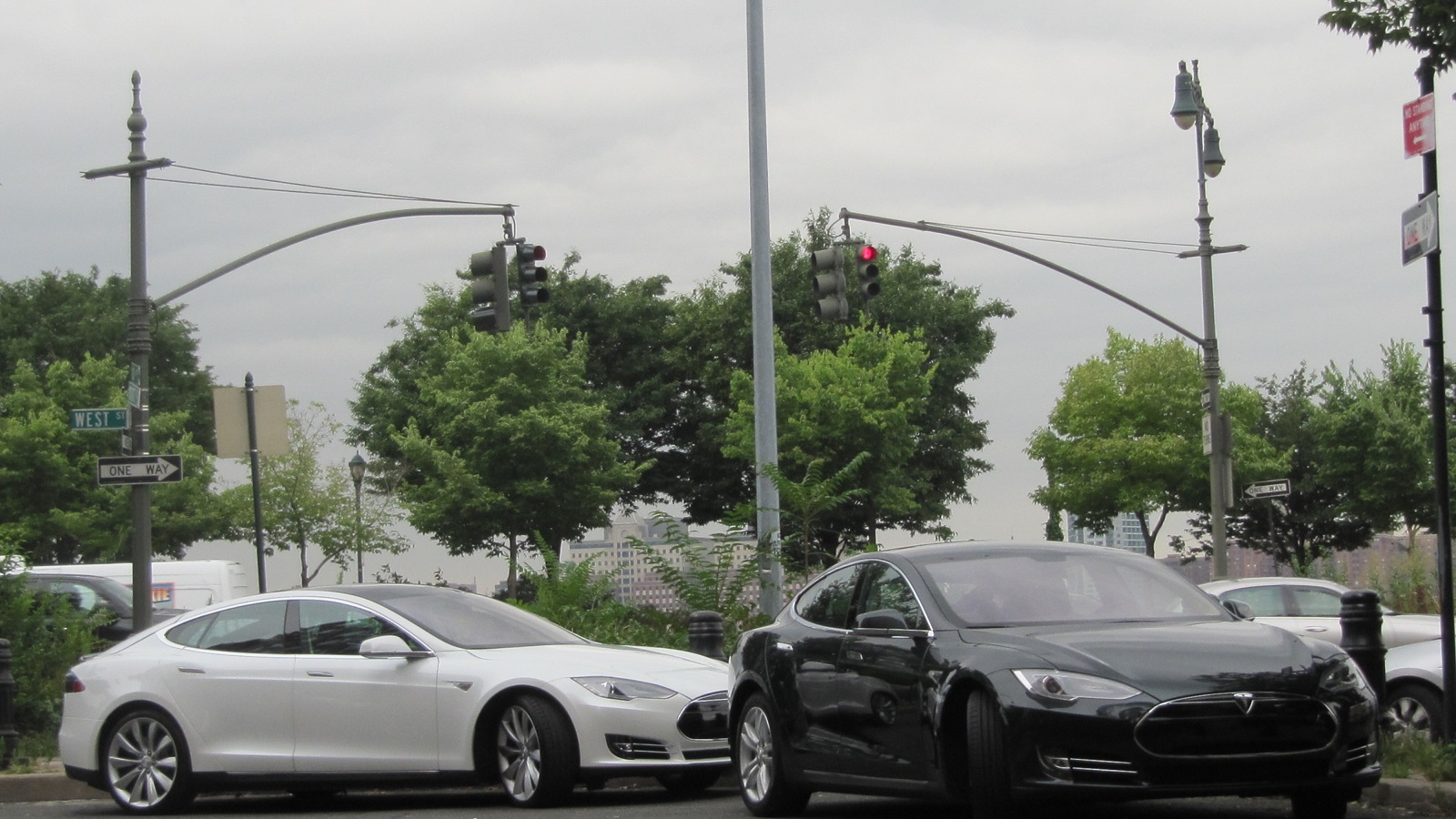
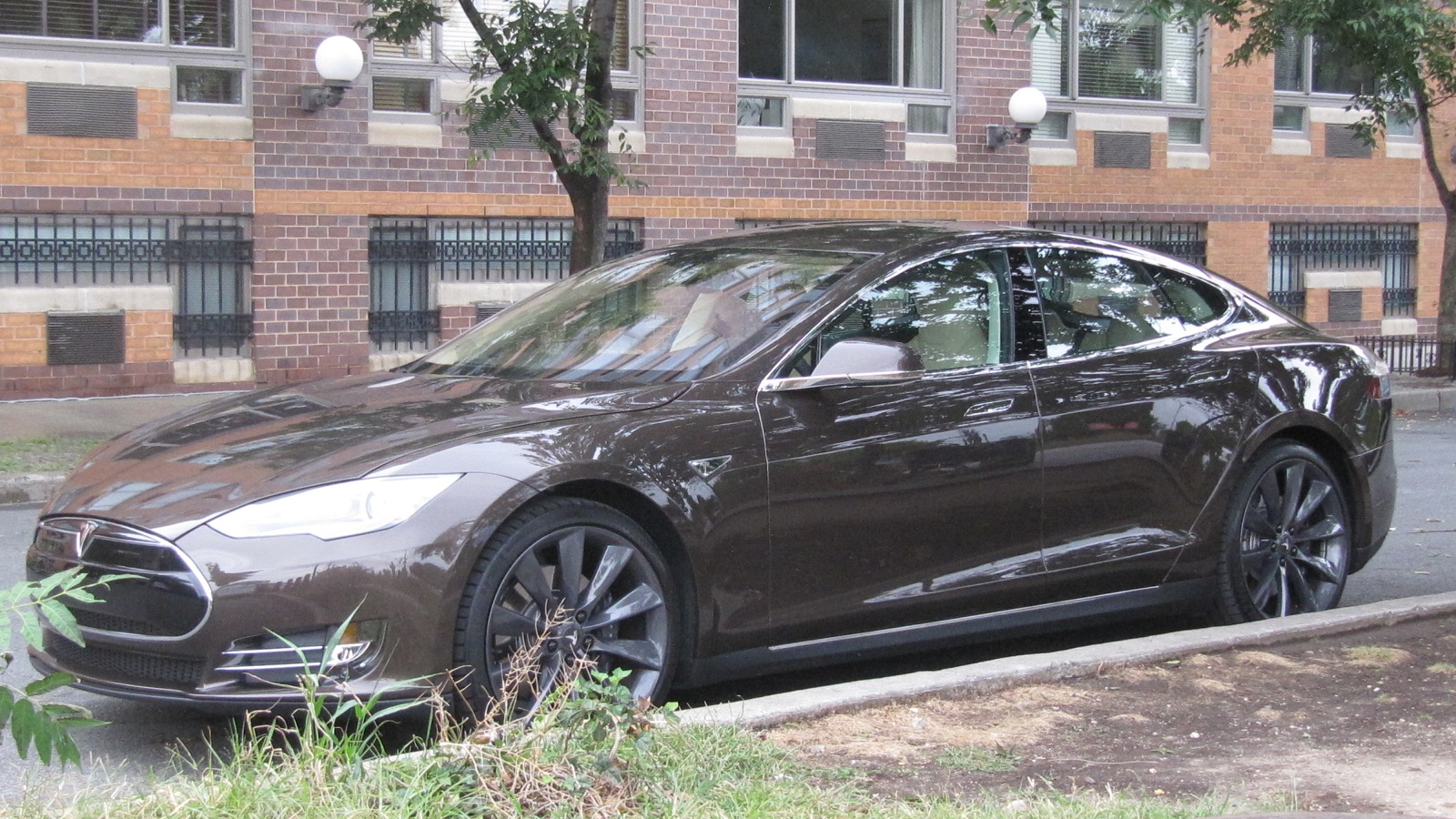
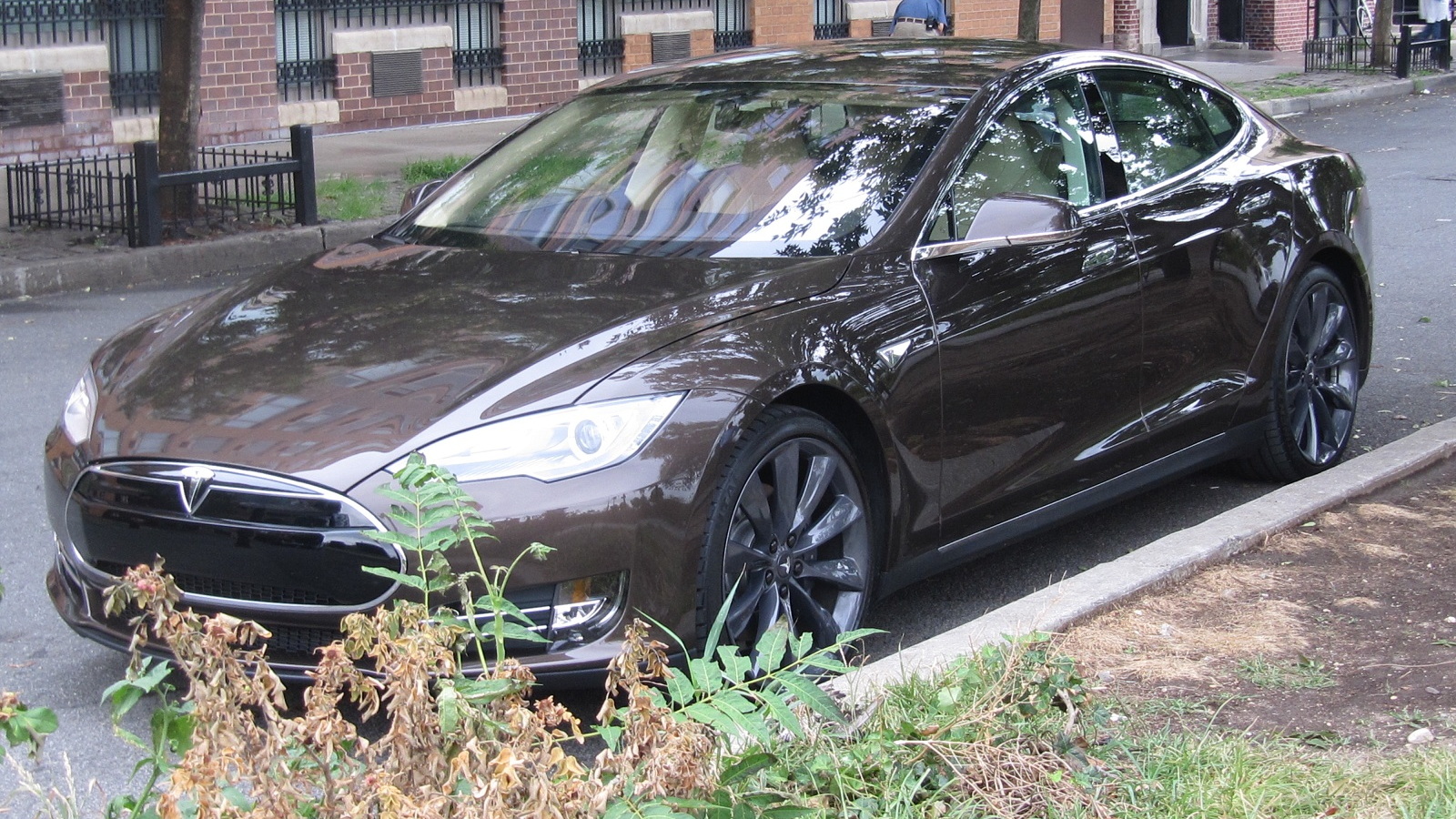
After an hour in a 2012 Tesla Model S all-electric sport sedan, one thing became clear: It's a viable car.
The Model S gives Tesla Motors a shot at turning into a real car company.
That's a provisional judgment; as many journalists have noted, 10-minute drives or an hour driving and riding in limited New York City traffic hardly provides the time or mixed conditions for a proper review.
But the Model S can make the case for electric cars in a way that the odd-looking Nissan Leaf or the politically controversial Chevy Volt never will.
It's good-looking, in a Jaguar vein. The performance of the top-end Model S Signature Series Performance model we drove was quietly spectacular.
We saw no major quality flaws or obvious manufacturing defects (unlike the 2012 Fisker Karma we tested earlier this year).
And with EPA-rated range of 265 miles and an 89-MPGe efficiency rating, the Model S should eliminate any trace of range anxiety for regular daily use (outside of long road trips).
So the 2012 Tesla Model S sedan is about as promising a new product as the industry has seen for many years.
Now Tesla Motors [NSDQ:TSLA] has to get the car into volume production, fill the portion of almost 11,000 reservations that turn into paid orders--and generate enough cash to do all that plus develop its next models.
Sleek but not radical styling
If you're going to echo a luxury-car shape, you could do considerably worse than the profile of the Jaguar XF and XJ. Those were by far the most common comparisons from journalists and passers-by at this morning's Tesla event.
The proportions of the Model S are those of its competitors--the BMW 5-Series, the Mercedes-Benz E-Class, the Audi A6, and the Jaguar XF--though with a slightly longer wheelbase and shorter rear overhang.
Overall, the Model S isn't as noticeable on the street as the Tesla Roadster or the low, swoopy, curvaceous Fisker Karma. But it's also far more practical than either of those cars.
Deceptively fast
Tesla made its mark with the Roadster sports car. It was a crude, basic, all-electric open two-seater whose sins could be forgiven because its stunning performance was so addictive.

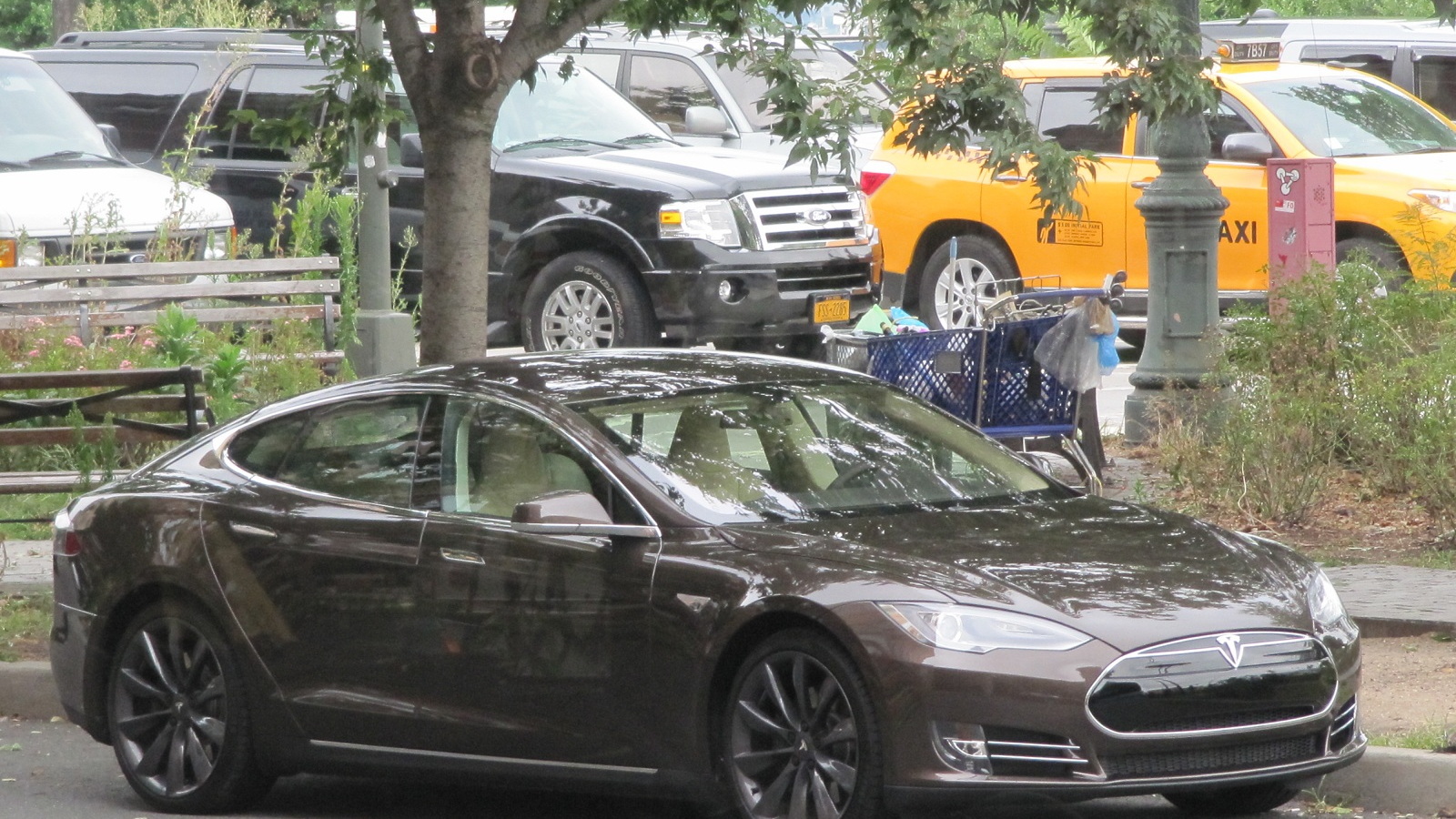
2012 Tesla Model S, brief test drive, New York City, July 2012
Embarrassing some supercars costing twice its $109,000 base price, the Roadster knocked off 0-to-60-mph times of less than 4 seconds, courtesy of a 53-kilowatt-hour lithium-ion battery pack and a 175-kilowatt (248-hp) electric motor powering the rear wheels.
The 2012 Tesla Model S has a larger battery pack that forms the floorpan of its all-new design, but its 270-kW (362-hp) motor still powers the rear wheels. The Performance model has a more powerful 301-kW (416-hp) motor.
With a weight of about 4,700 pounds (a ton heavier than a Roadster), the Model S feels quite different behind the wheel than the attack-jet Roadster.
The Performance model we drove, with higher-spec power electronics and other modifications, is quoted at a 4.4-second 0-to-60-mph time (the standard Model S is quoted at 5.6 seconds).
We couldn't test acceleration times, but the Performance edition certainly offered the ability to surge swiftly away from any other vehicle on Manhattan's West Side Highway (sadly, we encountered no supercars).
Acceleration vs range
The deceptive part is that the Model S is so calm and quiet inside that there's virtually no mechanical noise on acceleration. Tire noise is obvious with the stereo off, and then wind noise kicks in above 40 mph or so.
Only once, on full acceleration from 0 to a high number, did we hear a high-pitched humming whine, presumably from the power electronics.

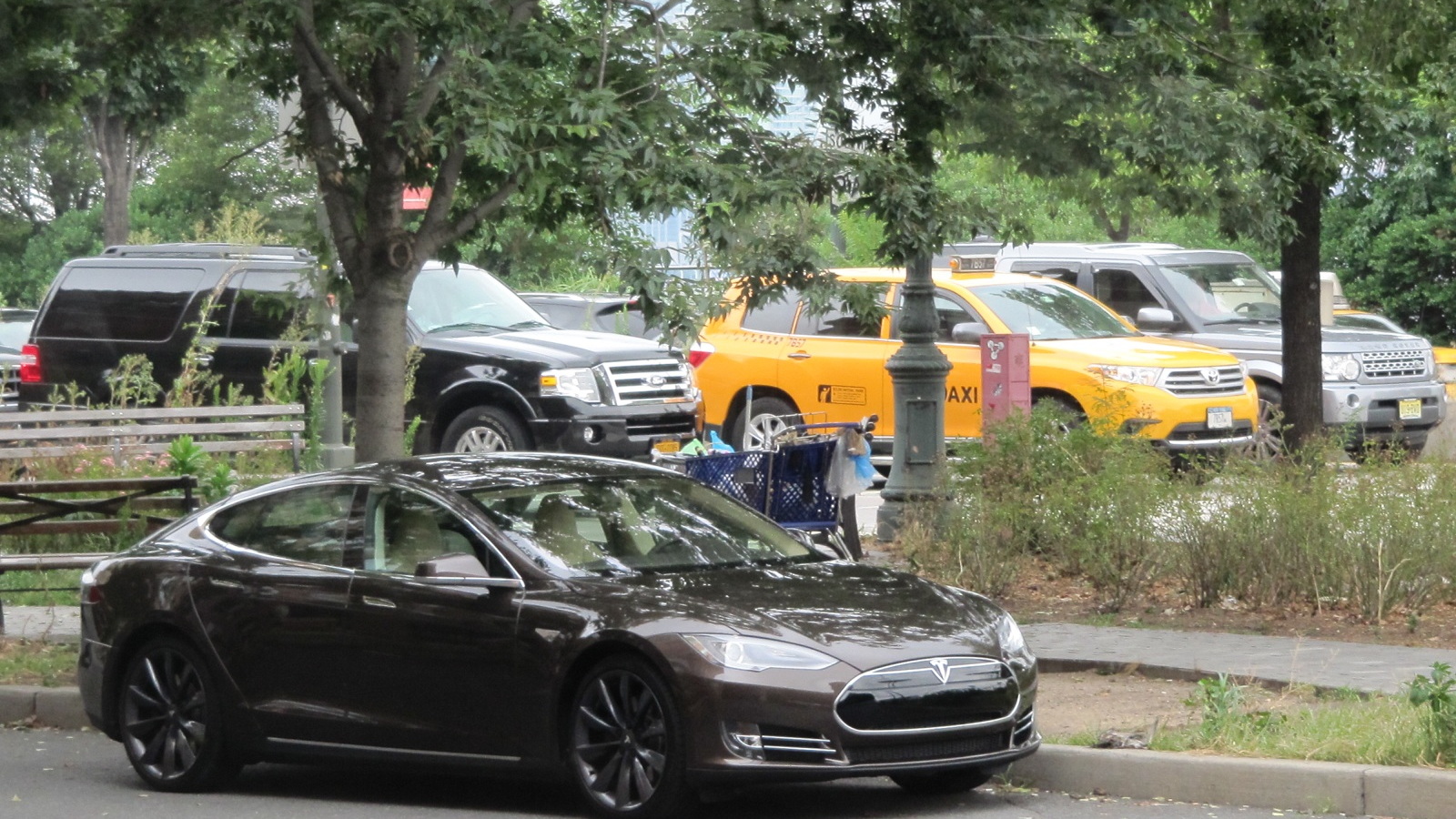
2012 Tesla Model S, brief test drive, New York City, July 2012
Just as in the Roadster, however, keeping your foot in the Tesla Model S will do a lot of damage to your range.
The car showed a maximum potential range of 290 miles on a fully charged battery, but based on the last 30 miles of driving, showed us a predicted range of 165 miles--meaning owners will rapidly learn to trade off the sheer fun of acceleration for longer range.
Air suspension
The air suspension provides ride quality that's firm over small road imperfections, with a little more feedback transmitted than might be expected. We didn't test the various suspension settings, including one that our Tesla minder candidly described as "mushy."
Over the bad stuff, including the uneven, potholed, cobblestone streets of Manhattan's West Village, the Model S rode superbly.

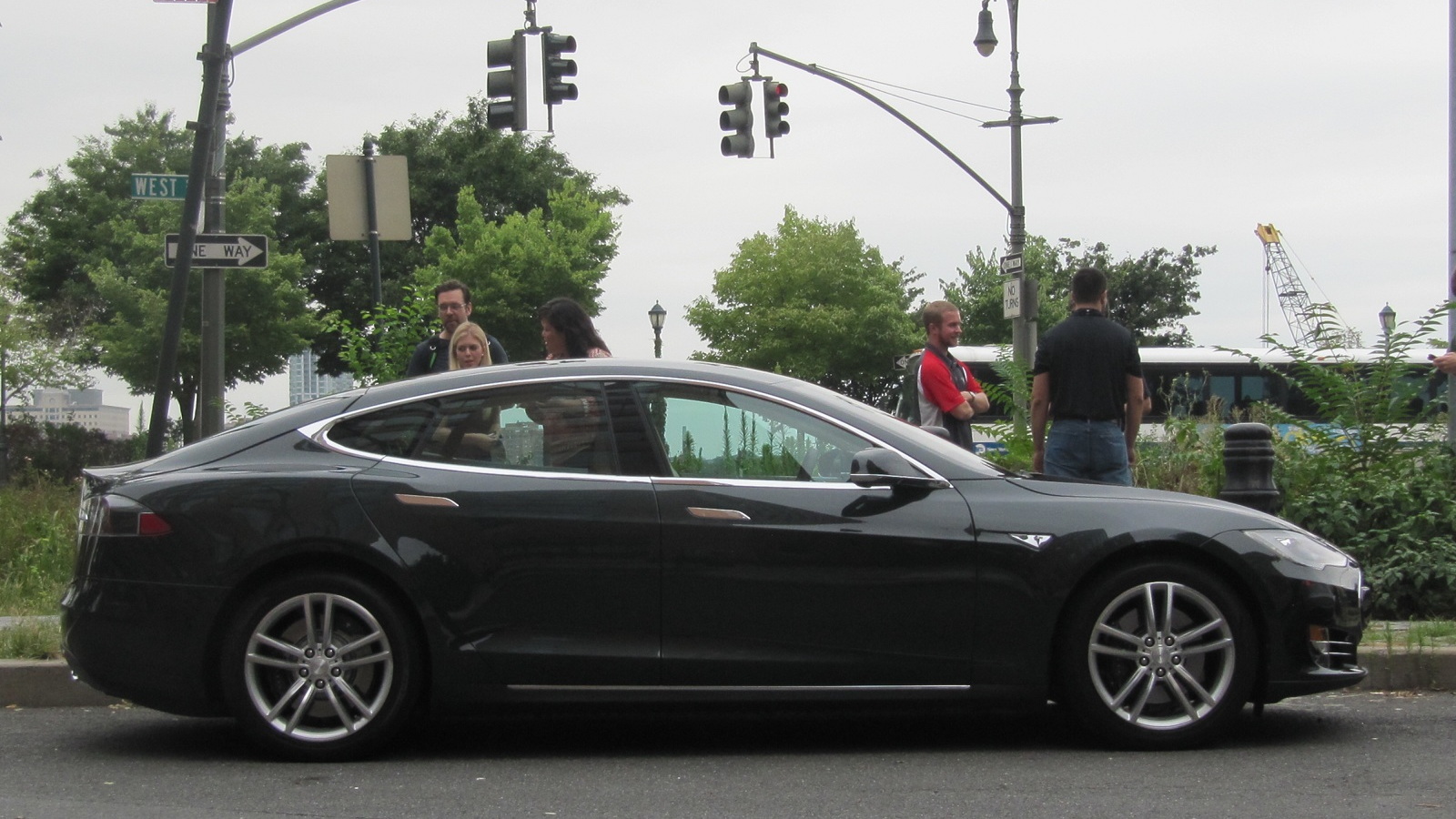
2012 Tesla Model S, brief test drive, New York City, July 2012
In the Tesla Model S, you can easily find yourself not only pulling away from traffic, but traveling 20 mph over the speed limit. And as in the Roadster, at least in the Model S Performance model, you'll want to do it again and again and again.
Michael Sexton, who runs the Tesla Store in Manhattan, says that it took him about six months before he stopped using his Roadster that way and just drove it--knowing that he had sheer acceleration on tap when he wanted it.
Less regen than Roadster
Smooth but aggressive regenerative braking was a hallmark of the Tesla Roadster. There are only two settings for regenerative braking--Normal and Low--in the Model S, and the (highest) Normal setting felt less aggressive.
Experienced electric-car drivers often prefer "one-pedal driving," planning ahead enough to use solely regenerative braking to slow down almost to a stop. That's not quite as easy in the Model S, since its weight gives it more rolling momentum.
But the new and much larger pool of tech-oriented luxury car buyers who will consider the Model S (Tesla hopes) are likely to want it to drive in a familiar fashion, like an automatic BMW or Audi sedan. In that, Tesla's new sedan succeeds.
The handling inspires confidence, with an obviously low center of gravity, but the Model S is a little heavier-feeling than we'd expected. It was more like the Mercedes-Benz S-Class we recently tested than the last BMW 5-Series we drove a couple of years ago.
And we look forward to the head-to-head comparison tests that traditional auto magazines are likely to do whenever they can get a Model S for more than an hour at a time.
Big fast touchscreen a generation ahead
Sitting behind the wheel, the driver sees three control stalks on the left and one on the right, all seemingly identical to those in Mercedes-Benz cars.
The two on the left are an upper cruise control and a lower turn signal, meaning that Model S drivers will try to signal with the cruise lever until they retrain themselves, just as in a Benz. There's also a tilt-and-telescope adjustment for the wheel.
On the right, a drive selector offers simply D, R, and P, with an automatic parking brake built in, without any separate lever or switch for that. There's a small amount of idle creep built in, mimicking an automatic transmission car.
[UPDATE: After speaking with Tesla the next day, we learned that we were wrong: There is no idle-creep built into Model S cars right now. We're baffled as to what we experienced; the only thing we can imagine is that we were on an almost imperceptible downward slope when stopped, and the car has such low rolling resistance that it began to roll. In any case, we apologize for the error.]
But by far the most noticeable feature of the Model S interior is the giant 17-inch touchscreen display that takes up the entire center stack. The instrument cluster behind the steering wheel is entirely a digital display too.
The brilliant graphics, instant response, and easy-to-learn control screens of the central display immediately relegate any other car's system to second-class status. The Mercedes-Benz COMAND system, BMW's notorious iDrive, the mass-market MyFordTouch, and others are instantly outdated and primitive.
We were initially skeptical about having such a big screen to control most functions in the Model S. And, to be fair, an hour is nowhere near enough time to put it through its paces. But based on early use, we may become converts.
And Tesla's Silicon Valley roots show through in a high "surprise and delight" quotient in unexpected places.
Want to open the sunroof? Just swipe your finger along a plan view of the Model S, toward the rear. Or you can use a large slider to open it to any percentage you want.
Switch on a turn signal, and if you happen to be on the Lights screen, you'll see it flashing brightly on a photo-realistic image of your car. Ditto the parking lamps, the headlights, and so on.
You can connect a portable storage device to play digital music through the Tesla's stereo system, though such web apps as Pandora, Switcher, and Spotify aren't yet implemented.
You can likely expect those soon, along with voice commands, which haven't yet been activated.
Remarkably, there's also full web browsing via the built-in cellular connection. Or at least there will be until the Feds weigh in on that one.
Space for five
Inside, the cabin is wide, and five adults should be able to travel in comfort.

2012 Tesla Model S beta vehicle, Fremont, CA, October 2011
The front seats are supportive, the driving position is good, the controls are well-placed, and outward visibility is good to the front and sides--though the steeply angled rear window glass offers little more than a slit in the rear-view mirror.
The rear door openings are smaller than they look, and the windows slope inward as they rise toward the roof rail. That makes access to the rear seat more challenging than you might expect.
Once seated in the rear, outboard passengers will notice that that the cabin is wider at shoulder height than at head level and the rear seat back is angled a bit more steeply than customary.
Because the battery pack is in the floorpan, front and rear footwells aren't as deep as they would be in a conventional luxury sedan.
This means rear passengers are seated in a more reclined, knees-up position than in cars like the Mercedes-Benz E-Class or BMW 5-Series. It's not necessarily uncomfortable, but it's noticeable.

2012 Tesla Model S, brief test drive, New York City, July 2012
If the Model S has a sunroof fitted, a six-foot man sitting in the rear seat comes within a fraction of an inch of the headliner. But most adults should be comfortable riding in the rear over long distances.
Practical electric car for the family
Once you're past the wow factor of the central touchscreen, the Model S interior is relatively plain and unadorned.
Soft-touch materials cover any surface an occupant might come into contact with, but there are fewer of the kinds of power accessories for passengers than the lengthy options list of competing cars offer.
The total interior volume of the Tesla Model S is rated at 95.1 cubic feet. There's 26.3 cubic feet of cargo space in the load bay with the rear seat up, a total of 58.1 cubic feet with the seat folded down, and another 5.3 cubic feet in the surprisingly large front trunk.
That makes it a practical family vehicle, in stark contrast to the subcompact interior of the Fisker Karma, with its absurdly tiny 6.9-cubic-foot trunk.
The early-production Model S cars appear to be well-built, at least after scanning four different models (serial numbers 106, 108, 111, and 116, for those who keep track).
About the biggest quality flaws we noticed among the four were a misaligned Velcro fastener patch on the front-trunk liner, and a recalcitrant rear shoulder-harness retractor.
Overall, A for effort
Overall, our early and brief impressions of the 2012 Tesla Model S are favorable.
It appears to be the first electric car that's simultaneously good-looking, fully digital in the best tradition of Silicon Valley innovation, and requires very little compromise for around-town use.

2012 Tesla Model S, brief test drive, New York City, July 2012
Whether it will become a viable distance traveler depends entirely on whether Tesla launches its much-discussed SuperCharger network of quick-charging stations.
And whether Tesla will become a viable independent car company depends on whether it can ramp up Model S production while keeping quality high, and continue to add digital features.
The company will also have to manage the inevitable tweaks, updates, or quality recalls graciously, swiftly, and decisively in a way that convinces customers they're being taken care of by this audacious new carmaker.
The last car company started from scratch in the U.S. by entrepreneurs whose brand is still with us today was Chrysler, in 1924. Tesla still faces very, very long odds of survival.
But on first impression, it appears that they've at least gotten the product pretty much right.
Now the hard work begins.
+++++++++++