
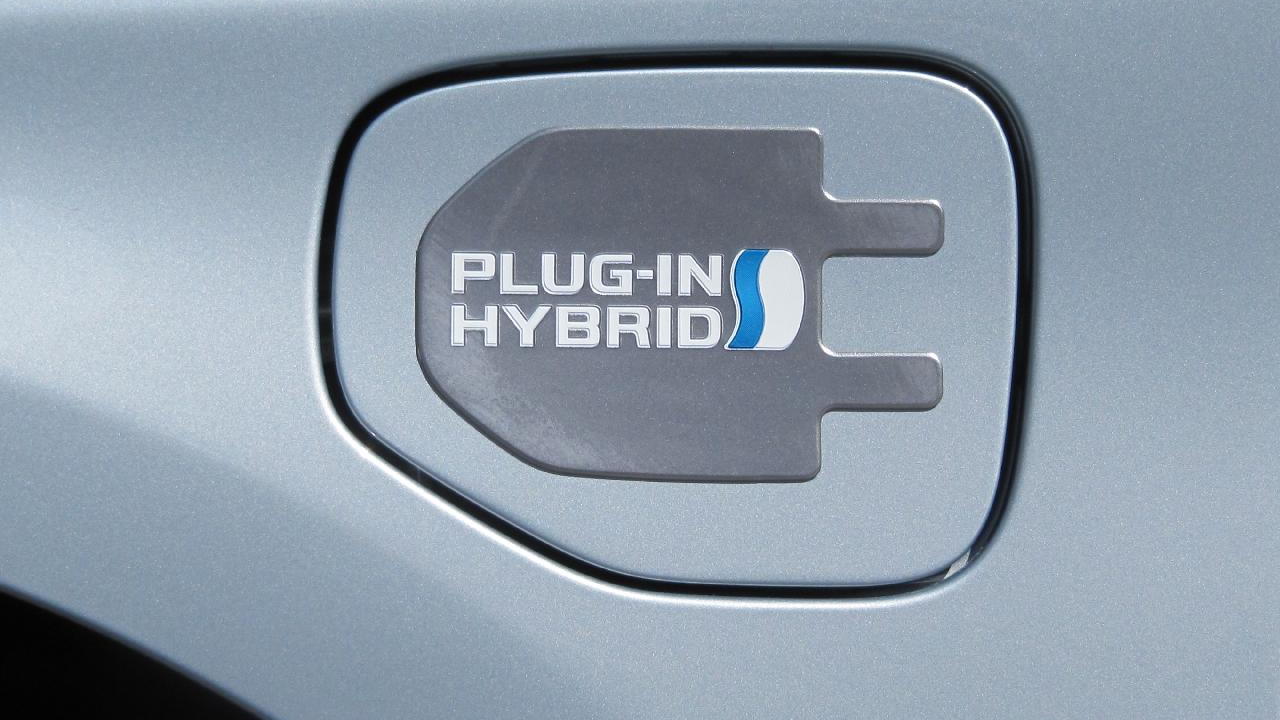
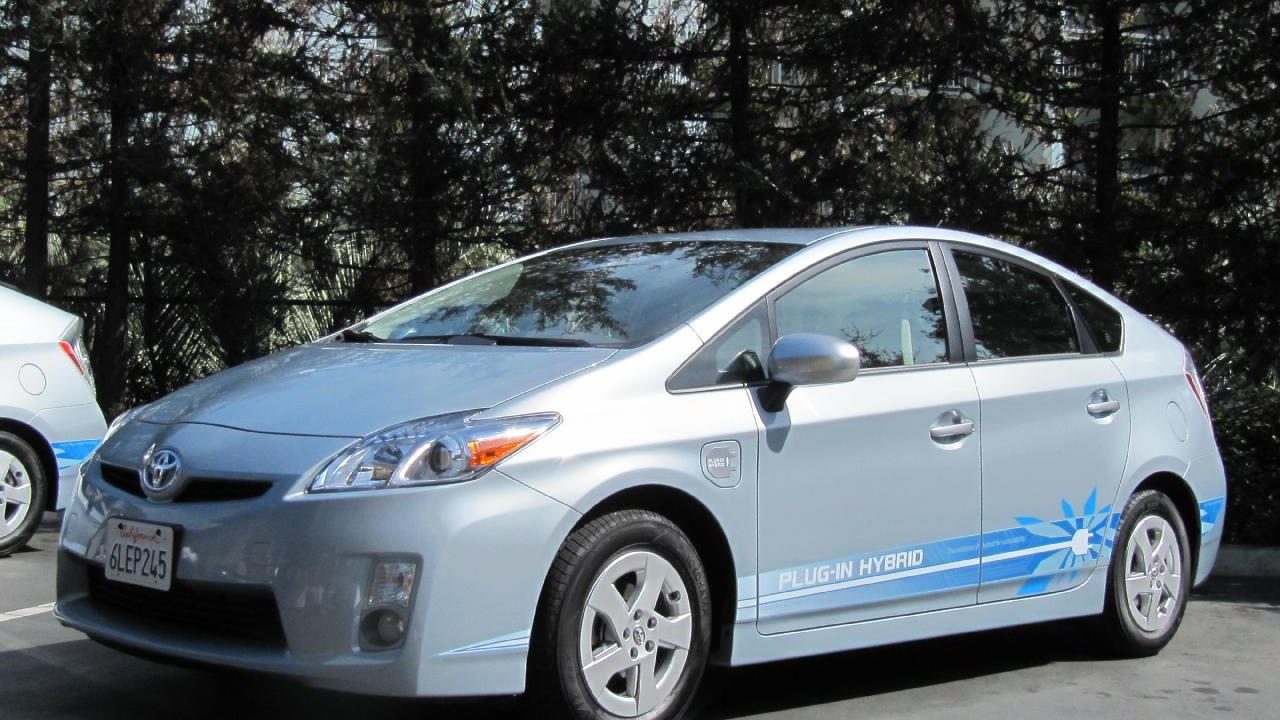
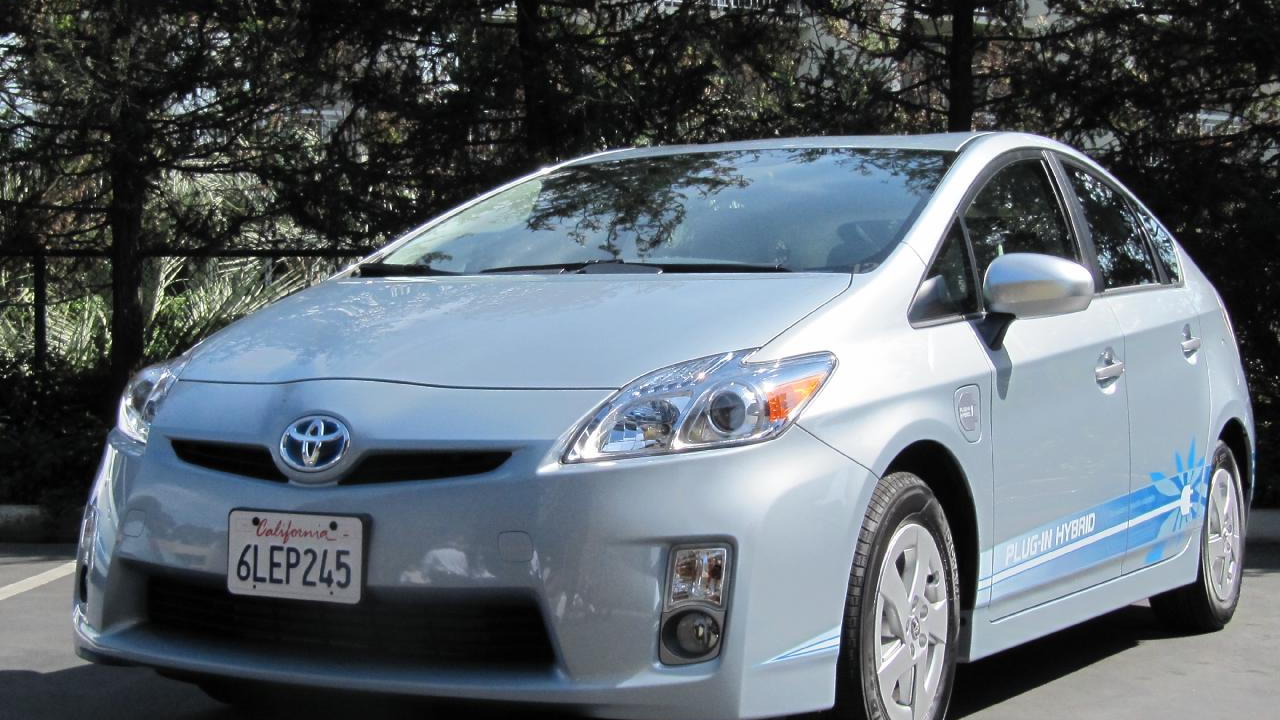
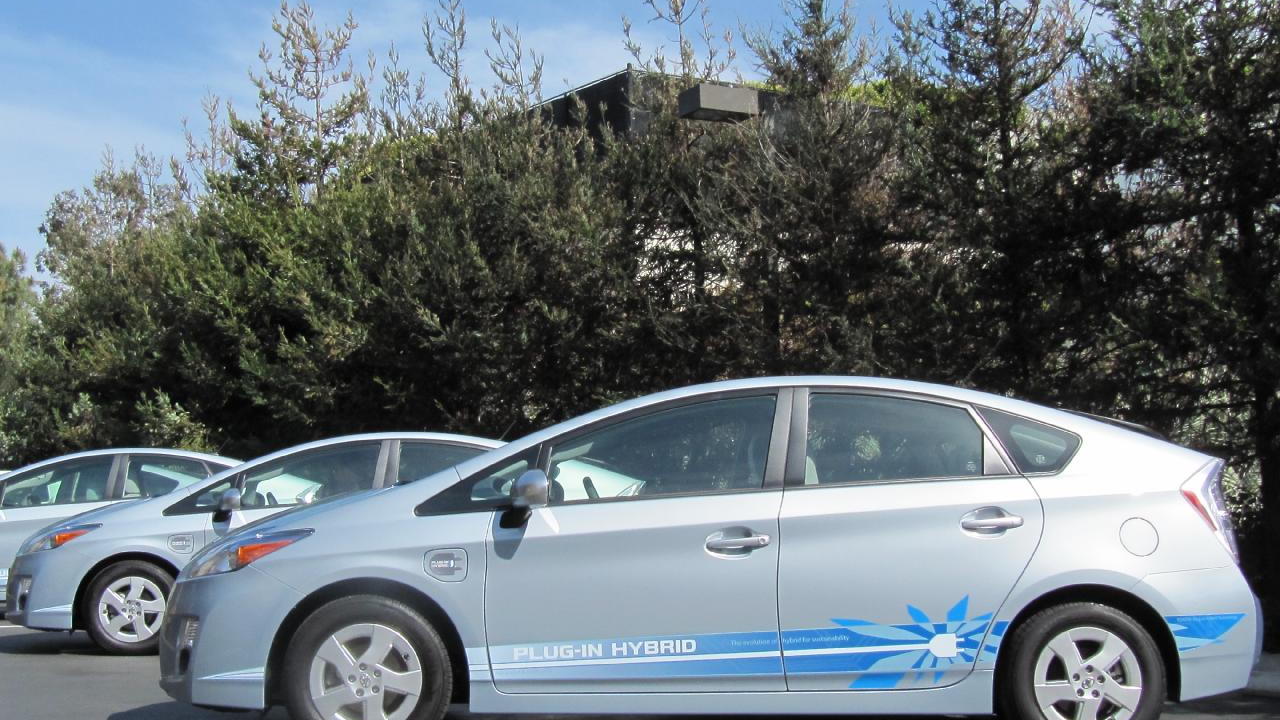
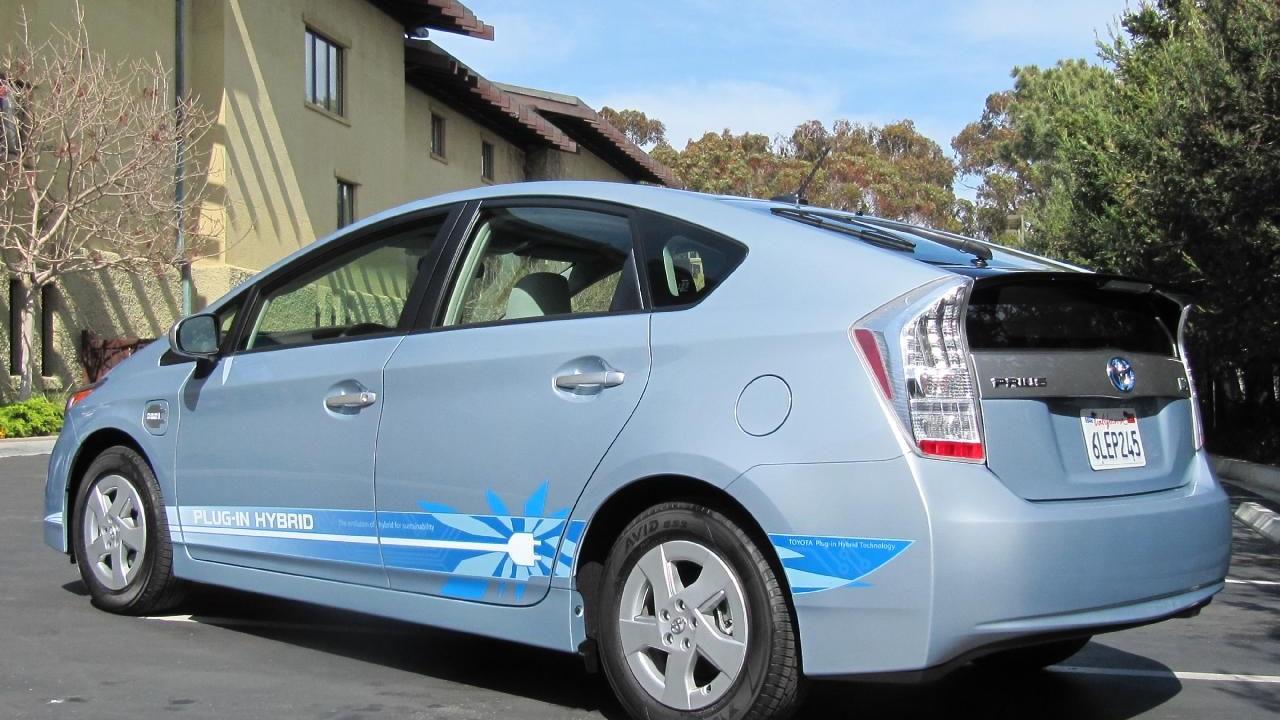
prototype 2012 Toyota Prius Plug-In Hybrid, April 2010
Toyota has come under some fire from electric-vehicle enthusiasts for what some perceive as a grudging, halfhearted approach to building vehicles that plug in.
Its first U.S.-market plug-in vehicle--not including a thousand or so RAV4 electric crossovers a decade ago--will be the 2012 Toyota Prius Plug-In Hybrid.
It's a modified Prius with a larger 5-kilowatt-hour lithium-ion battery pack that recharges on wall current, giving up to 12 miles of electric range at speeds as high as 62 miles per hour. The pack is, in fact, three packs: a main one plus two sub-packs.
Toyota has built 600 Prius Plug-In Hybrid prototypes. We'll see 150 of them in the U.S., with 200 to be deployed in Europe. The U.S. cars are now being distributed to the fleets that will test them over the next year.
Last month, we test-drove a 2012 Prius Plug-In Hybrid prototype. And we were shocked to learn that it does not use regenerative braking to recharge the two extra battery packs that provide the added electric range.
In other words, once the added battery capacity has discharged, the Prius Plug-In behaves just like a plain old 2010 Prius hybrid until it's plugged in again--using only its main pack, which holds the same 1.6 kWh of energy, slightly more than the 1.3 kWh of as a standard nickel-metal-hydride Prius pack.
When we questioned Toyota about this, Dave Lee (a former technical trainer on the program) said that it was occasionally possible to top up the extra packs for 1 or 2 miles of range, if the two auxiliary packs were still largely charged.
But Lee admitted that the ability to recharge the larger pack on the fly "just wasn't the way they designed it."
Why? He said a Toyota engineer told the technical trainers that the battery relays hadn't been designed for repeated opening and closing during driving.
Hmmmmmmmm. This seems odd, to say the least.
Whether or not the Prius Plug-In competes against cars with much longer electric ranges, like the 2011 Nissan Leaf (100 miles) or 2011 Chevrolet Volt (40 miles), it seems wasteful not to provide as much electric driving as possible from the packs it carries around.
And in fact, "I would anticipate us making a change," Lee said carefully. "That would make sense" to use regenerative braking for the added packs, rather than switching on the engine to use up the current.
"What we have in this car," he said, "may not be what we offer going forward."
Let us hope.
Have an opinion?Join the conversation!
By Desertstraw Posted: 5/11/2010 8:47am PDT
As one of the first buyers of the Prius, I am not considering another. They were fine cars for their time. I am on the list for a Nissan Leaf but will consider a better electric car if someone sells one.
By usbseawolf2000 Posted: 5/11/2010 9:22am PDT
That statement is inaccurate. PHV Prius has 5.2kWh pack. Each pack has 1.73 kWh (5.2 divided by 3). The standard Prius with NiMH pack has 1.31 kWh.
PHV Prius in hybrid mode using the Lithium main pack still has 32% bigger battery to store more regen.
But I wouldn't read too much into any of these figures since, as the article notes, the Prius Plug-In that Toyota sells here may have a different pack arrangement and, most likely, a different chemistry of Li-ion cells too:
http://www.greencarreports.com/blog/1041538_why-the-2010-toyota-prius-doesnt-have-a-lithium-ion-battery
By Bob Posted: 5/11/2010 12:38pm PDT
By Doug Korthof Posted: 5/11/2010 5:24pm PDT
By Paul Posted: 5/11/2010 5:24pm PDT
By doug korthof Posted: 5/11/2010 5:30pm PDT
By Doug Korthof Posted: 5/11/2010 5:59pm PDT
The reason for not recharging the Li battery pack via regen braking is simple: Toyota is afraid of battery degradation via "mini-cycles".
What they call a "cycle" is from 100% to 0%, which puts a strain on any deep-cycle battery. That's why we generally fill only to 95% or so and only discharge to 20% or so; but sometimes we go beyond those limits due to the exigencies of driving, or because we want to level the battery pack.
There are hundreds of "mini-cycles", when you go up a hill or accelerate, you draw down from the battery pack; when regenerating, you get most of that back. That's a "mini-cycle" every time you start up (and stop).
Toyota may be concerned that this "mini-cycling" would kill the battery prematurely; indicating once again that Toyota doesn't think Lithium is ready for 100K-plus driving.
Supposedly, there is a LEAF with over 180K on the same pack, so maybe Toyota is wrong. I hope so.
By restricting recharging of the additional packs to the wall-charging events, they maximize the number of cycles. NiMH doesn't have this problem in the RAV4-EV, of course.
By usbseawolf2000 Posted: 5/12/2010 7:06am PDT
PHV Prius main pack has 1.73 kWh, not 1.6 kWh.
We can find out the usable capacity from the information given by Toyota, 60% for Lithum and 40% for NiMH.
Lithium: 1.73 kWh x 0.6 = 1.04 kWh (usable)
NiMH: 1.31 kWh x 0.4 = 0.52 kWh (usable)
As you can see, PHV Prius in hybrid mode can store about twice more energy in hybrid mode than a regular Prius.
By richard schumacher Posted: 5/12/2010 1:22pm PDT
By richard schumacher Posted: 5/12/2010 2:06pm PDT
By walter lee Posted: 5/12/2010 4:54pm PDT
Just the cost of refining, in energy alone, is 12% of the energy in oil. That 12%, if used to power an EV, would take the EV as far as the REST of the barrel takes our average oil-fired car. That doesn't include the cost of oil wars, oil diplomacy, patrolling oil supply lines, oil spills, oil exploration, oil transmission, the natural gas used in refining, the potable water (20 to 60 gallons for each barrel) used in the refining process...
So when we hear these weak arguments about "EVs have a long extension cord reaching into the coal mine" it's difficult to retain a straight face and even disposition.
We are clear about one thing: the Toyota engineers who designed the Prius were not the same as those who designed the RAV4-EV. The approach of the former is bass-ackward; they looked at it as a gas car with a battery assist. The RAV4-EV uses the full power of its 30 kWh battery pack to go from 1.45 volts per cell down to 1.0 volts per cell, or lower, for a nominal "range" of 100% to 0%.
Between this news and the recent announcement from Toyota about a $50,000 hydrogen fuel cell extended range EV in 2015, I am thinking that Toyota is going to let others lead us into the age of EV's. Remember, this plug-in Prius may not be released in quantity until 2012, or later?
As others have already mentioned: Toyota *please* give us a RAV4 EV along with a Matrix/Corolla EV (virtually the same drivetrain?) and an iQ EV, and a plug-in CH-FT with 80-100 miles of electric range!
Sincerely, Neil
By Efried Posted: 5/15/2010 1:57am PDT
Have an opinion?Join the conversation!