Two of the most exciting electric vehicles due over the next few years both originate from German automaker, BMW.
The i3 city car and i8 sports car are both clean-sheet designs, developed from the ground up as plug-in vehicles. With carbon-fiber chassis, purpose-designed interiors and unique styling, each will be proof that electric cars need not be mere re-worked gasoline vehicles.
We've seen concept vehicles and disguised prototypes of each so far, but Autocar and Car have had the first passenger ride in each vehicle, during winter testing in Sweden.
The prototypes may be camoflaged in blue and white swirls, but their shapes are unmistakable--large wheels and a tall profile for the city-bound i3, low, sleek, and not unlike a modern-day M1 supercar for the i8.
i3 city car
The i3 will arrive first, in both battery-electric and range-extended electric versions.
It's longer, wider and taller than the BMW-built MINI Cooper, offering greater luggage volume and passenger space. As we've seen from the concept vehicles, the car's interior is also more minimalist, Autocar's reporter describing "a feeling of genuine space".
The car has no central B-pillar, opening wide to the spacious interior. The seating position is said to be raised and upright, and large expanses of glass make for excellent visibility--vital in a city car.
Naturally, range varies depending on how you drive it. According to Car, BMW project i chief Ulrich Kranz suggests 80 miles is a minimum if you "drive hard", 100 miles is "realistic", and BMW has recorded 140 miles on the EPA's urban test cycle.
Acceleration is "truly impressive"--7.2 seconds to 60 mph the quoted time--while a few sideways laps around the frozen lake suggest the i3 has lost none of BMW's handling talents.
BMW i8 Concept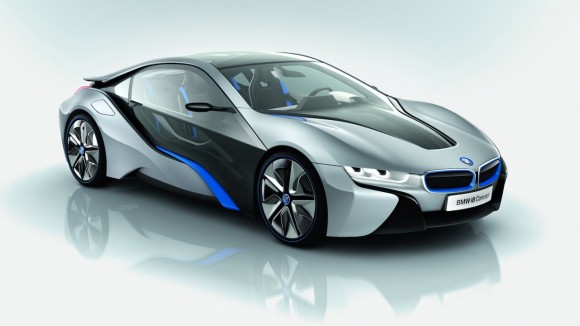
The i8 should be even better for keen drivers, lower, wider and more powerful. Though it should be great fun to drive, BMW has designed it to be properly usable--so it also features a compliant ride quality.
In production form the i8 is said to weigh in at just over 3,260 pounds, with a 1.5-liter three-cylinder gasoline engine and two electric motors providing the power.
On its own, the engine produces 220 horsepower, and the main traction motor an additional 128-hp and 184 lb-ft of torque. A smaller electric motor develops 5 horsepower, mainly used as a generator and alternator. In the i8, peak combined torque of over 400 lb-ft should translate to a 0-62 mph time of only 4.6 seconds.
20 miles of all-electric range should help with economy too. No economy numbers have been officially announced, though BMW has previously touted a figure of around 80 mpg.
Pricing could be similar to mid-range Porsche 911 Carrera models, which doesn't seem unreasonable given the performance and technology. The i3, for comparison, will likely cost similar to a mid-range BMW 3-series.
Which BMW i-car are you most looking forward to? Leave us your thoughts below.
+++++++++++