Buying A 2012 Tesla Model S: Pros & Cons Of...
Tesla Model S Road Trip: Electric Cars Make It...
Tesla Model S 'Get Amped' Tour: 5,000 Test...
It's never dull over at Tesla Motors, but tomorrow is a particularly important day.
It may, in fact, be the most important day in the electric-car maker's history.
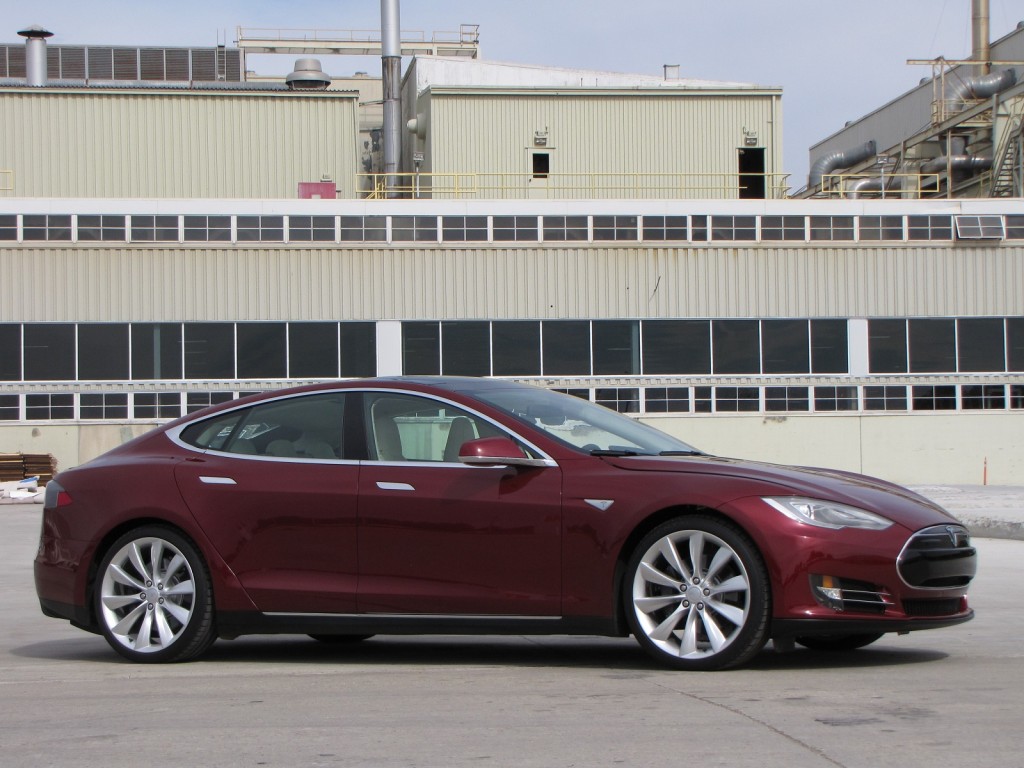
That's because after the stock market closes, Tesla Motors [NSDQ:TSLA] will give the first hints about whether it could genuinely become a profitable independent carmaker.
At 5:30 pm Eastern time, the company will hold its quarterly earnings call to discuss its Q4 financial results from October through December, as well as its full 2012 results.
Tesla is widely expected to have lost money for the full year 2012. It was a year of gearing up and getting its Model S electric luxury sport sedan into volume production, and that costs money. A lot of money.
But for the first time since its founding almost 10 years ago, Tesla's financials will let analysts pore over the costs and revenues of running the Model S production line at its full capacity of 400 electric cars a week.
That happened around New Year's Day, so the three-month financials won't reflect sustained full production. Those numbers will have to wait til the Q1 results call in April.
But financial analysts will want to answer many questions as they tear into Tesla's numbers, including:
To which we'd add:
Tesla Motors has lost money continuously since it was founded, as many startups do before ramping up to full production and sales.
CEO Elon Musk said that the company was profitable for the month of July 2009, a feat not since repeated--and not verifiable by the public, since Tesla was then privately held.
Some analysts have speculated that the brief period of profitability was necessary to qualify for $465 million of low-interest loans from the Department of Energy, which Tesla had been granted just two weeks earlier.
In early December, Musk tweeted that Tesla had been "narrowly cash-flow positive" for the week. He has not repeated that claim either.
Automaking is a brutally expensive, very complex, and time-consuming industry--which is why entrepreneurs rarely dive into it, preferring products with lower capital costs and faster potential payback curves. Software, for instance.
But so far, the stock price of Tesla Motors has risen to roughly double the $17 price at which it was issued in a successful initial public offering in June 2010.
And the company is valued at multiples more likely to be associated with high-flying software startups than automakers.
One confirmed Tesla skeptic points out an intriguing way to assess Tesla on the popular investing blog SeekingAlpha (although his math is off by an order of magnitude).
If Tesla were valued at the same multiple for each car it sells as Ford [NYSE:F], it would have a market capitalization of $175 million--not its current $4.2 billion. (The author wrote $17.5 million, which was wrong.)
Profits and losses and cars, oh my.
Tomorrow afternoon will be the first chance for investors and shareholders to weigh in on the company's first real financial results as an operating carmaker.
What will the market say?
Leave us your thoughts in the Comments below.
+++++++++++

Follow GreenCarReports on Facebook and Twitter.
Have an opinion?
To get some insight in reservation numbers and confirmation rates however could be interesting but only if they deviate a lot from unofficial numbers that are circulating.
Seeking Alpha=LOL of course. Just childish manipulation, nobody shares info of any real value obviously.
"Does the company seem to have enough cash--or can it raise enough--to get it to profitability?"
Full disclosure: I added that to the bottom of the list just now.
"What was the revenue realized for those sales, versus the cost of building and delivering the cars?"
This is the cashflow and in its wake the profitability issue. Presumably being at target production rate the company is per Q-1 this year cashflow positive and in no further need of cash infusions, at least not to fund Model S production. Too bad for investors Q-4 2012 ramp up phase numbers may not be too helpful to determine Tesla's cashflow position at target production.
I'm not a financial analyst, so I don't weigh in on those issues, though occasionally I'll report on opinions from more informed analysts that touch on those questions.
BTW, remind me again: Are you a Tesla shareholder? An owner? Or simply an enthusiast? Just curious.
Developing new products costs money too though of course so Model S production needs to show the sort of numbers that keep investors interested. We'll see one year from now, but the signs are all good so far.
As for me: I'm just a seeker of truth in a world where that particular commodity is very hard to come by...
They're also headed for over 20k units. I'm not worried about cashflow in 2013.
Turns out that's exactly what's Bloomberg is focussed on too and and what they found out is rather alarming at first glance. If they are right that cars ordered today can be delivered in 4-6 weeks indicating a backlog of merely 2400 units than that would be the first sign of trouble I'm aware of. In a market where 40% of Tesla's stock is shorted all negative news should be considered suspect though so we'll see....Never a dull moment over at Tesla Motors!
Source: http://stks.co/hMTJ
I'll be satisfied if the basic numbers are close enough to validate previous claims by Musk. Otherwise, I'm more interested in the results in 2014 and in the short term, in cash flow and other metrics.
Not to say that the data this week isn't critical, just that I personally want to see much more than a quarter of the Model S production included.
-Doing variants like Model X (basically a taller version) or maybe the stationwagon someone designed recently and was received with much enthusiasm
-midlife upgrade: the dashboard is somewhat controversial and seems to miss the refinement (European) customers really want
-More options: trinkets like adaptive cruise control, head up displays and other stuff people shopping in this class think they need but Tesla can't supply yet
-Bigger battery option; next step: 100KWh.
-Investing in the supercharger network will make the car gradually more practical for a wider audience
- More cars on the street means more people will consider Model S a serious option
-advertise.
Fact is: a substantial part of Model S is the battery and despite that factor it can compete with the cars mentioned above right now. Battery prices are dropping though so Tesla is becoming more of a threat to the German überwagens everyday.
It is not fair to compare "If Tesla were valued at the same multiple for each car it sells as Ford". Ford, GM, Honda, Nissan-Renault, Toyota all produce at multiples of millions of vehicles; better to compare to manufactures producing at less-than 100 thousand units (globally) per year. The economics of scale (production, market, technology, etc) need to be relevant before such comparisons can be made.
What stock analysts will worry about is that , for Tesla, it gets harder from this point going forward. Like the problems now engulfing Apple, obliterating its stock, all roads lead downward for a company at the top, especially one with no
intrinsic (patented) technological advantages. Tesla cannot control access to either its electric motors or batteries, the only important parts that differentiate EV versus non-EV road warriors. We won't know anything for sure until competition arrives. Current data is mostly meaningless as a future guide.
1. Most unfamiliar with Tesla overlook key groundbreaking technology that has been deployed. Model S is one of few vehicles since EV1 with an all aluminum body and production in thousands. Major design & production challenges were overcome to make this a reality. This alone is a differentiator.
2. Tesla is first vehicle with virtually a buttonless cockpit. An accomplishment similar to Apple's 1st buttonless phone.
3. Vehicle Infomatics: level of monitoring, deployment of near-time updates/customization.
These are just a few differentiators not unique to electric vehicles… but are for now.
You did say "one of few," but Tesla might find it hard to suggest that this is really a key differentiator from other high-priced luxury brands. Now, if they could do that for a $30K vehicle, that might be a different story. But can they?
I wonder what it will take - another year of poor financial performance? Another round of reviews that point out the obvious limitations of Tesla's core product? Another "revolutionary" business decision that compromises Tesla's long-term success?
Here's my question to you John: How bad do the financial results have to be before someone says Musk should step down (besides me, that is)?
Musk's views of existing auto dealers, who make all their profits selling gasoline cars, is quite well documented by now. You view it as mistaken, clearly.
The factory can't make em any faster, even Rip Van Winkle knows that :)
Could this be a classic example of doing one thing and saying another in preparation for an inevitable acquisition? It would certainly match Musk's history, but I think he - along with Tesla fans - want something bigger.
Sell now to another car company and Tesla will become just a badge for the niche plug-in products that company will introduce fitting the schedule and agenda of a company that's mostly interested in doing ICEs until the oil runs out.
Let us talk a six months from now and see where we are.
http://www.hybridcars.com/new-york-times-cedes-model-s-range-dispute-to-tesla/
difference, is the margin on each unit. Ford is mostly selling low margin units, in a tough competitive space, Tesla sells high margin units, the key is what's the critical mass.
So requirement a hundred years later, now, are much more strict than then a hundred years ago
Have an opinion?Join the conversation!