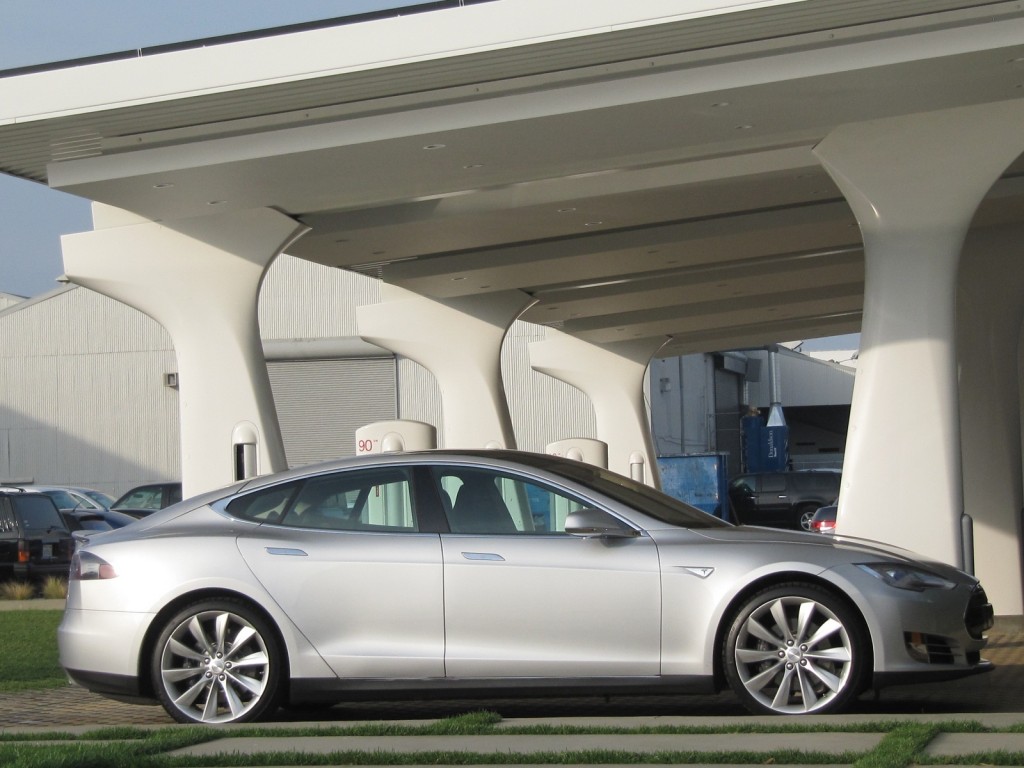
2012 Tesla Model S
Golly.
Turns out nothing ignites the Internet quite like a rapid-fire online spat between Tesla Motors CEO Elon Musk and The New York Times, the Grey Lady of establishment journalism.
Like many such controversies, common ground turns out to be easier to find than you might think: It's a fact that electric-car range falls in colder temperatures.
The details, however, show claims in the Times article are contradicted by the data logs of the Tesla Model S in question--raising disturbing questions about the accuracy of a widely-read article in one of the nation's premier newspapers.
Let's recap.
Winter trip falls short
It all started with a piece in last Sunday's Times with the ominous title Stalled Out on Tesla's Electric Highway. It was written by John Broder, who reports on energy and the environment for the paper.
He described his attempt to drive a Tesla Model S all-electric luxury sport sedan from Washington, D.C., to Boston, using the new SuperCharger network of DC fast-charging stations now being rolled out by Tesla Motors [NSDQ:TSLA].
Spoiler alert: He didn't make it.
He didn't much enjoy the drive either.
Read the article for details, and don't miss the snazzy map graphic that accompanies it.
Ironically, the article was proposed to the Times by Musk himself because he'd liked its earlier long-distance Model S drive report, Charging Ahead on an Electric Highway, which covered a 531-mile journey from Lake Tahoe to Los Angeles last September.
Musk tweets back (of course)
Musk wasn't nearly so fond of Broder's article.
Monday he fired out three tweets (1, 2, and 3) calling the article "fake," saying Broder didn't fully recharge the battery pack and that he took a "long detour" he hadn't written about.
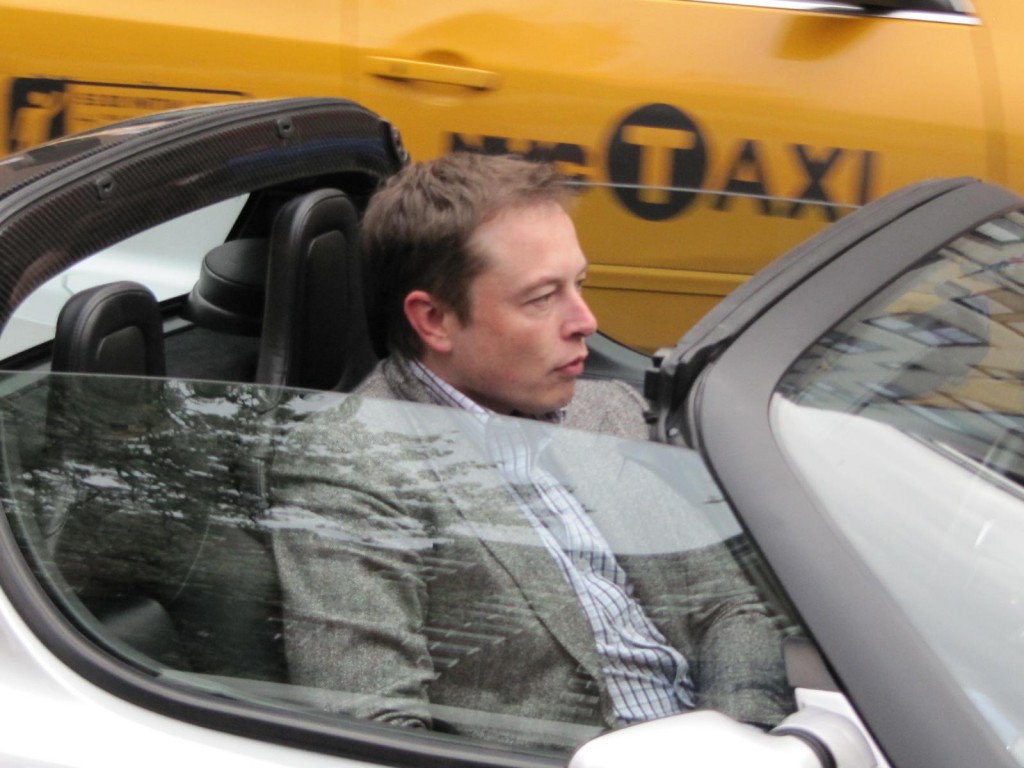
'Revenge of the Electric Car' premiere: Elon Musk arrives in a Tesla Roadster
Musk promised a blog post from Tesla Motors, with further details from the car's data log, would be "coming soon." Data logging, he noted, has to be approved by customers, but it's always turned on for journalists.
Tesla also plans, Musk said on Monday, to invite other journalists to replicate the trip.
Media piled on
Later Monday, Musk tweeted a more conciliatory message, saying he was "not against [The New York Times] in general" and that the paper was "usually fair," linking to its September piece on the California drive.
By the end of Monday, Musk had appeared on CNBC calling the article "unreasonable," and New York magazine had noted the drop in Tesla Motors stock price.
Even The Atlantic--that bastion of the liberal East Coast chattering-class media elite--criticized Musk's critiques of the article, saying they weren't helping Tesla.
Author responds
Then, Tuesday afternoon, Broder published a lengthy post on the Times Wheels blog in which he responded to Musk's tweeted claims.

2012 Tesla Model S
He noted that the car's dash display had said "Charging Complete" at a pack capacity of 90 percent, and that he wasn't told he should also switch to "Max Range" setting and wait another half-hour or so to add the last 10 percent of capacity--which shortens battery life.
To maximize battery life, the Tesla limits recharging to 80 or 90 percent of total pack capacity (reducing range) unless the driver specifically directs it to do otherwise. The "Max Range" setting provides the highest possible range for road trips and/or cold temperatures.
Broder claims his "long detour" was a brief stop in Manhattan that added just 2 miles to total distance.
The real crux of the problem came from an overnight cold soak at a hotel stop in Groton, Connecticut, where he awoke to 10-degree temperatures.
Broder parked the Model S with 90 miles remaining, and awoke to find it showing 25 miles--which fell to 19 miles after he conditioned the battery for 30 minutes at the direction of a Tesla employee.
Things degenerated from there.
Not plugged in overnight
"Virtually everyone says that I should have plugged in the car overnight in Connecticut, particularly given the cold temperature," Broder writes in his followup.
Plugging in the car overnight, even on 110-Volt power, lets the Tesla Model S use grid power to warm its battery pack, keeping it at a temperature that maximizes range.
He then defends his decision not to do so by noting that he was supposed to be testing the SuperCharger network--and that the car showed sufficient range to return to the nearest SuperCharger location.

2012 Tesla Model S
"This evaluation was intended to demonstrate [the Model S's] practicality as a 'normal use,' no-compromise car, as Tesla markets it," he continues.
And he sneers at the idea that Model S buyers will all be "electric-car acolytes who will plug in at every Walmart stop," if Tesla expects to be a "mass-market automaker."
We find that line of reasoning a little disingenuous with the Tesla Model S on sale less than a year.
Electric cars are still an almost unknown quantity among mass-market buyers--who generally don't look at luxury sport sedans whose prices start at $59,900 and can reach $100,000 anyhow.
Data logs, graphs, maps, and annotations
Late last night, the Tesla Motors post, A Most Peculiar Test Drive, finally appeared with Musk's name as author--scooped merely minutes beforehand by the Wired Autopia blog.
2012 Tesla Model S
It told the story with some remarkably different details.
Musk dives in by saying Broder's article "does not factually represent Tesla technology, which is designed and tested to operate well in both hot and cold climates."
And, he notes, "About half of all Tesla Roadster and Model S customers drive in temperatures well below freezing in winter."
'Never had a chance'?
The data logs for Broder's car show, Musk writes, "that our Model S never had a chance with John Broder."
Then Tesla dives into nine separate points where it says the data logs contradict Broder's published claims, among them:
- Cruise control was never set at 54 mph, as claimed; the majority of the trip was done at 65 to 81 mph
- When Broder claims to have turned down the cabin temperature, the logs show he turned it up to 74 degrees F
- Broder's time at the SuperCharger station was 47 minutes, not 58 minutes as claimed; those 11 extra minutes could have delivered enough range for the rest of his journey
- Broder was directed by Tesla to charge the car fully at that point, but he left with the battery at just 72 percent capacity
The post includes five data-log graphs, an annotated version of the original New York Times infographic, an annotated route map, and a map showing all chargers en route.
Disturbing discrepancies
The post also suggests at several points that Broder's motives were less than unbiased: "When the Model S valiantly refused to die, he eventually plugged it in. On the later legs, it is clear Broder was determined not to be foiled again."
The discrepancies raised in Tesla's post, if accurate, are deeply disturbing.
![Speed log from Tesla Model S trip conducted by John Broder, The New York Times [from Tesla Motors]](https://images.hgmsites.net/med/speed-log-from-tesla-model-s-trip-conducted-by-john-broder-the-new-york-times-from-tesla-motors_100419207_m.jpg "Speed log from Tesla Model S trip conducted by John Broder, The New York Times [from Tesla Motors]")
Speed log from Tesla Model S trip conducted by John Broder, The New York Times [from Tesla Motors]
They appear to indicate that Broder's article was not factual on numerous points. That means that either his reporting and note-taking were sloppy, at best, or that he omitted or concealed relevant facts that would add important context to his claims.
We expect--and eagerly await--a rebuttal from Broder, The New York Times, or both.
Whether the newspaper will consider the discrepancies serious enough to warrant an internal inquiry remains to be seen.
[UPDATE: As of 9:45 am Thursday, it appears that The New York Times is preparing a response to the Tesla post. What form that will take--whether it's merely an update to Broder's Tuesday blog post, or something more substantial--remains to be seen.]
"Please note, no one from Tesla – including Elon – will be providing additional comment on this topic moving forward, as we feel the blog speaks for itself," wrote Tesla communications manager Shanna Hendriks in a note to journalists.
"At this time, this post is the company’s final statement on the issue."
Winter weather tough on range
To be fair, electric-car range does suffer greatly in cold temperatures.
2012 Tesla Model S
Broder's article underscores that point, whether or not it was accurate in the details.
We'd argue that Tesla Motors should perhaps have thought through the implications of doing a DC-to-Boston trip during the coldest months of the year.
It's not that a Model S with the largest 85-kilowatt-hour battery pack can't make it--but it will have to recharge more frequently when temperatures are colder.
Broder says Musk told him in a phone call that "the East Coast charging stations should be 140 miles apart, not 200 miles" to account for "traffic and temperature extremes in this part of the country." Musk confirmed that Monday in another tweet.
Reduced winter range is a useful piece of knowledge that every buyer of a plug-in car should know, just as hybrid buyers have learned that their gas mileage falls in the winter because their cars run less frequently on battery power.
Tips to extend winter range in electric cars will become common, but the facts of physics dictate that plug-in electric cars will perform better in temperate California cities than in icy Alaska.
Luckily, California is projected to buy more plug-in cars than the next five states combined.
'Dismal' state of electric cars?
Suspicion of Broder's motives has been quite evident in discussions among electric-car advocates, based on his only other published Times piece that addressed electric cars.

2012 Tesla Model S
The March 2012 news analysis was titled, The Electric Car, Unplugged, and included such claims as this: "The state of the electric car is dismal, the victim of hyped expectations, technological flops, high costs and a hostile political climate."
In our view, Broder is right that plug-in electric cars were severely overhyped--and that a portion of the political spectrum used them as a tool to attack its opposition.
But for a reporter who covers energy and the environment, the piece last year betrays a rather serious lack of awareness of how the auto industry works, the many technological approaches that it will take to meet increasingly stiff emissions requirements, and how new auto technologies roll out to consumers over many years.
Tesla Motors apparently did not know of Broder's prior piece.
"We did not think to read his past articles and were unaware of his outright disdain for electric cars," Musk wrote on the Tesla Motors site.
"We were played for a fool and as a result, let down the cause of electric vehicles. For that, I am deeply sorry."
Sales will grow, slowly
Plug-in electric cars will remain a small but growing portion of total production (nearing 100 million vehicles a year globally) for the next decade.
But sales will increase--in the U.S., last year they tripled the previous year's level--and consumers will gradually come to understand where electric cars are most appropriate (daily errands, predictable commutes, short-distance trips) and where they're not (driving across the country).
Tesla won't grow to the size of Toyota or General Motors or Volkswagen any time soon, but it doesn't need to.
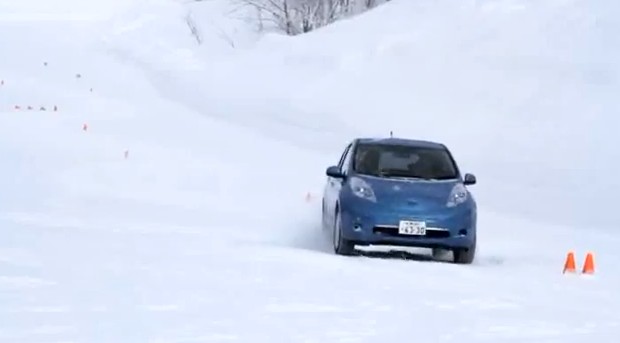
2012 Nissan Leaf winter test
And within two decades, consumers will understand that driving electric cars is a better experience than exploding air mixed with refined dead dinosaurs in increasingly complex engines.
But that all takes time.
The future has arrived
And coverage like Broder's trip report actually helps that process, even if some advocates perceive it in the short run as overly critical or biased.
After all, just 15 years ago in 1998, with the EV1 launching in California, the notion of an all-electric five-passenger luxury sport sedan that could even attempt a DC-to-Boston trip using a network of DC quick-charging stations would have been science fiction.
In other words, bits of the future are starting to reveal themselves despite hiccups along the way.
Now can't we all just get along?
+++++++++++