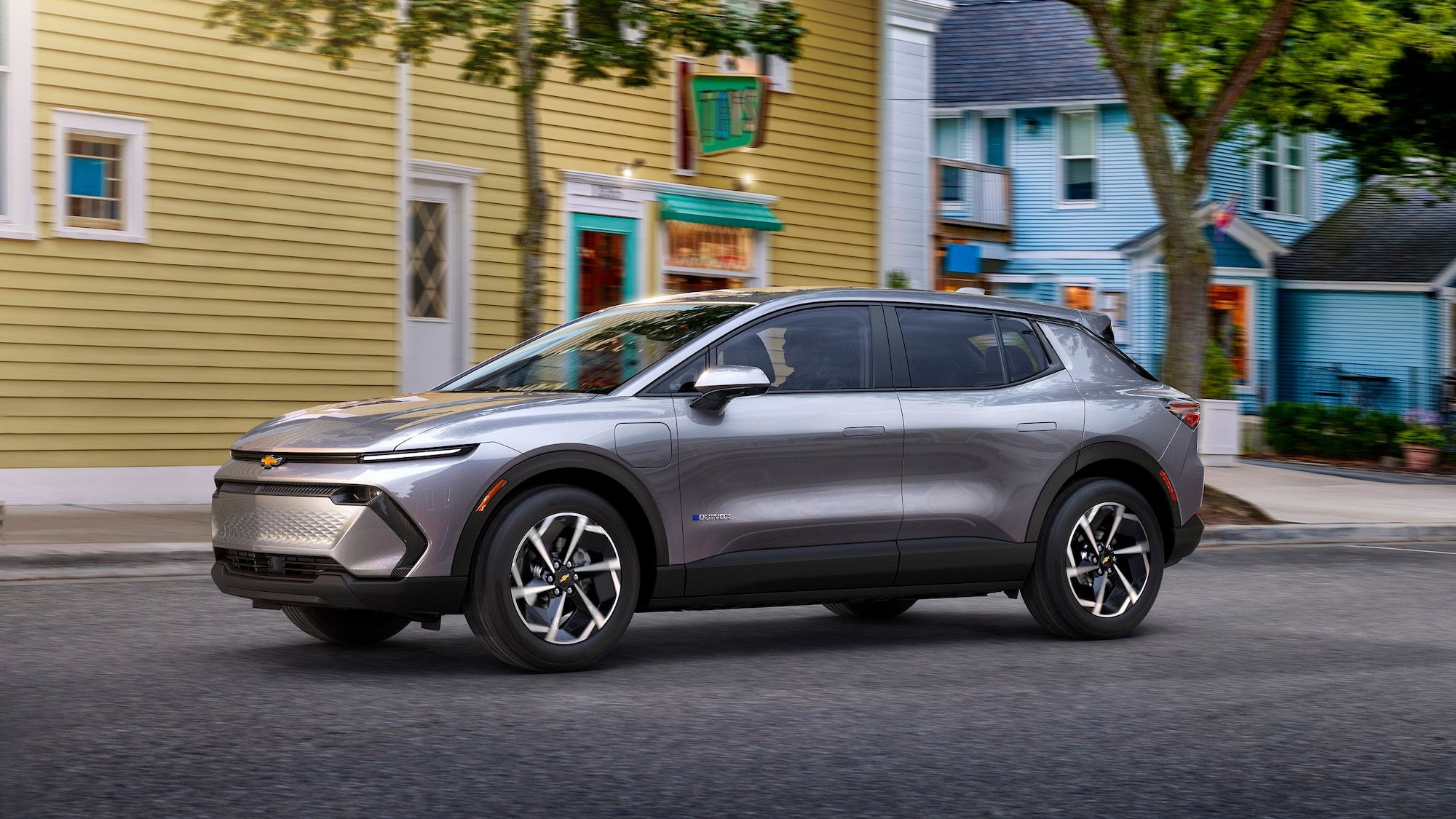
This is starting to look not so good.
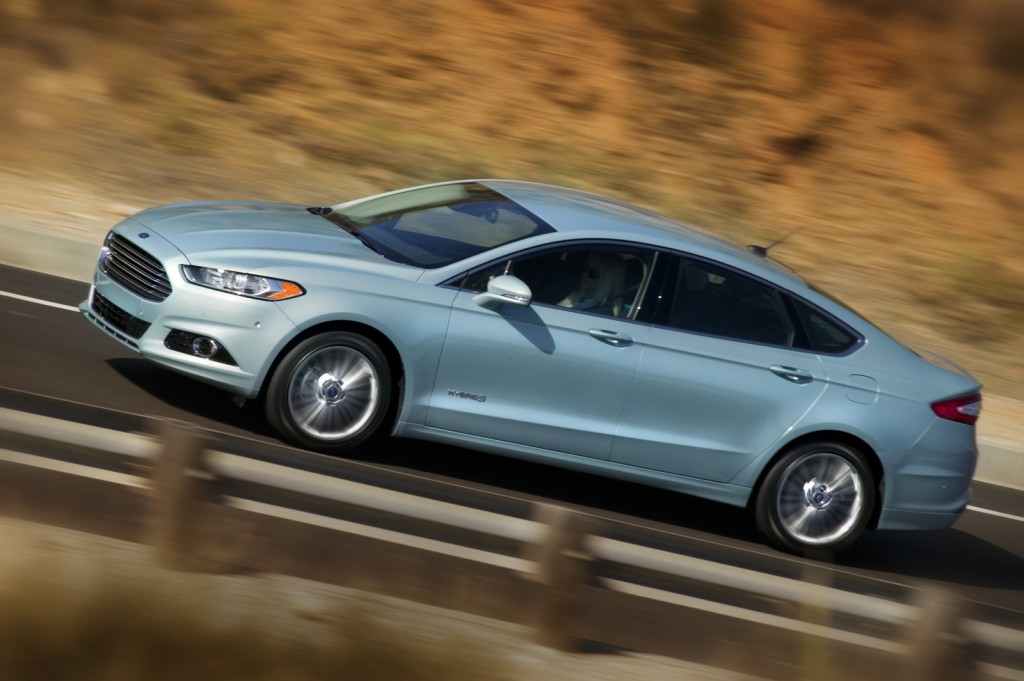
It appears that two new hybrid cars from Ford--the 2013 C-Max Hybrid hatchback and the 2013 Fusion Hybrid sedan--may not deliver real-world gas mileage that's anywhere near their 47-mpg EPA ratings.
Automotive journalists have been quietly discussing this for a few weeks, since Ford began releasing C-Max and 2013 Fusion vehicles into media test fleets.
C-Max Hybrid: stretching to hit 40 mpg?
It's still early yet, and it's possible that gas mileage may improve slightly in the cars once several thousand miles have accumulated on each one.
But Green Car Reports has tested the C-Max twice, once at Ford's media drive and once over a quick weekend route.
In the first case, the C-Max delivered 37 mpg over 50 miles of mixed freeway and urban driving. Over our weekend route, we got 40 mpg over 240 miles, mostly at freeway speeds.
And other outlets had similar results.
Most awkwardly for Ford, Larry Vellequette of Automotive News has documented his struggles to achieve anything close to 47 mpg in the C-Max Hybrid he bought for family use.
His average gas mileage was 37 mpg.
Vellequette even got chief engineer John Davis to show him the most fuel-efficient driving techniques, but he still couldn't approach a sustained 47 mpg.
Moreover, the eight C-Max Hybrid owners who have submitted their real-world mileages to FuelEconomy.gov averaged just 40.7 mpg.
2013 Fusion Hybrid too?
Now tests are starting to emerge for the 2013 Ford Fusion Hybrid, the most fuel-efficient model of the company's new mid-size sedan.
And, again, they seem to be far below the EPA numbers, which duplicate those of the C-Max Hybrid at 47 mpg for all three ratings: city, highway, and combined.
Jason Harper, testing the Fusion Hybrid for Bloomberg, got 36.9 mpg.
Gary Gastelu, testing the hybrid sedan for Fox News, wrote, "Even though I intentionally left my lead shoes at home and light-footed the Fusion Hybrid as much as possible (proving once and for all that I can, in fact, drive 55 mph) I took a lot of work to get it anywhere near 40 mpg, let alone that magic 47 mpg mark."
Only two owners have submitted real-world ratings for the 2013 Fusion Hybrid to FuelEconomy.gov, but their average was even worse: 35.0 mpg.

Last generation: on the money
The discrepancy is all the more surprising because the last-generation Ford hybrids seemed to hit their mileage numbers on the nose.
The late Escape Hybrid, rated at 29 mpg in its all-wheel drive model, generally achieved 28 to 32 mpg.
In our test of the last-generation Lincoln MKZ Hybrid, we registered 40.5 mpg over a 250-mile route with a majority of highway mile--better than its combined EPA rating of 39 mpg.
Similarly, The Car Connection got around 40 mpg on its week-long test of 2010 Ford Fusion Hybrid.
Moreover, all members of the Toyota Prius line of four vehicles appear to deliver real-world mileage within about 10 percent of their combined EPA ratings.
Those are 50 mpg combined for both the Prius Liftback and the new Prius C subcompact, and 42 mpg for the Prius V wagon.
It is all physics. ICE hasn't hit any breakthrough yet. The so called Atkinson cycle engine is a 120 year old technolgy.
Cmax is only 3,600 lbs first of all. Prius V has is bigger and has more cargo room but gets over 40mpg and is 300lbs lighter. Volt gets over 35mpg and is almost 3,800lbs.
Only the Volt gets that kind of good MPG and still go performance. But it is smaller.
Considering the size and utility, 40-41 MPG for C-Max hybrid is still impressive.
Do I need to explain to you the basic physic where weight matter?
Why is your sucky Prius Plugin only get useless 11 miles electric? B/c it sucks. Don't even get me started on your retard reasoning that it is more efficient.
When you tune any car down to the golf cart level performance, it will get better mpg.
If you can't argue with decent reasoning and keep repeating your biased stuff, I am NOT going to bother with you comment.
Volt is designed to be EV first. Its 16KWh is heavy and you are making Engineering tradeoff to get that.
That is why most Volt have majority of the miles in electric.
My Volt has over 8193 miles and only 54 gallon used. Nuff said there.
How come you only mention that the "extended range" mileage? Oh, that is right, but you HAVE NO CLUE on what the Volt is about and you have to keep remind me how "clueless" you are.
Why is ANY "Plugin" car only have up to 11 miles in EV range then? It is SHORTEST EV Range of any Plugin out there. Is that sucky or what? Why is Toyota so dumb and it can't do better as Ford at least with 21 miles in its C-Max. Why are you so inclined using gas in your Prius?
Just buy a regular Prius then, it would be at least faster and cheaper...
So you are okay with C-Max hybrid getting 47MPG EPA rating and C-Max Energi getting 43mpg EPA rating? Care to explain where did the 10% go since the Energi model has smaller space and worse performance...
A little hint for you, battery. Added weight means lower MPG in "gas mode". But C-Max did an engineering trade to give you "real world" EV miles instead of the "fake attempt" by Prius Plugin.
YOu also need to upgrade your "old fashioned" thinking of hybrid and come to the new age of Plugin.
Plugin is about electricity usage instead of gas. If I so cared about gas mileage like you, I would have bought a hybrid instead of the BEST EV range plugin on the market.
You should get a clue sometimes...
First, I have been in green car movement since the beginning so I do have a clue. For any car that uses two fuels, the efficiency of both are important.
In your 8,192 miles, how many miles are driven on the 54 gallons of gas? For the remaining electric miles, how many kWh were consumed?
Efficiency of both fuels are important and should be balanced to maximize greeness (lower emission). Per EPA, using US average electricity, Volt would produce more greenhouse emission than a regular Prius (260 vs 222 g/mi). Plugin Prius is the only plugin hybrid of any size that raised the bar (210 g/mi) while using domestic electricity. Remember, about a third of gasoline is domestic as well.
I get about 13 EV miles from my PiP. That's more than enough for around town and I use them up on the highway section of my longer trips.
That is where you are so WRONG and clueless. LET ME REPEAT this through YOUR THICK HEAD, VOLT is EV first and hybrid second. It is designed to be EV most of the time for most of the people's commute.
Anytime, a vehicle is on electric, it is FAR MORE EFFICIENT by design. That is why you want to stay on EV as long as you can. That is why it is PLUGIN instead of regular hybrid.
8192 miles, 2141 miles are gas miles. MPG of 39.65. EV miles are 6051. KWh consumed varied depending on whether I use the KWh to heat while parked or not. But in general, I get about 3.6 to 4 miles per KWh.
By having solar, I can offset it as much as possible where your Prius plugin can't.
Sure you would think so since you are a "hybrid" fan, NOT an EV fan.
Most Volt owners want an EV, but don't want anxiety. That is why majority of their miles are electric where Prius Plugin ARE NOT.
Stop being a Volt hater and Prius Plugin Fan boy.
Free free to drive your ugly, slow, 4-star rated crappy box...
So, by that logic, since PIP have similar MPG rating as regular Prius, it is the electric portion of that driving that reduced emission. So, the more you drive on electricity, the cleaner it gets right?
Now, let me ask you this, how did EPA come up with the Volt's emssion level? By what Electric/Gas ratio did it use? Care to explain? Even on the EPA's website, the Volt has SIGNIFICANTLY better MPG reported by its owners than Prius Plugin. EV miles are FAR MORE EFFICIENT and HAVE FAR LESS EMISSION. Those are facts!
I average 3.9 miles per kWh (including charging loss) on electricity and 54 MPG on gas. I am getting efficiency that neither BEV or gas only car can achieve. The result of synergy drive when two engines work together.
Even if you use your Volt 100% on EV with the rated 36kWh/100mi consumption, it will produce more greenhouse gas than a regular Prius using 100% gas.
The cross point with 50 MPG is about 34 kWh/100mi. The reasons are simple. EVs are superior than the best HV in vehicle efficiency. However, gas fuel production is superior than electricity upstream.
In simple term, 50 MPG hybrid is as clean as 100 MPGe EV. Look up the emissions of 50 MPG Prius on fueleconomy.gov site and 99 MPGe Leaf on EPA beyond tailpipe emission site.
If the panels 43 hooked up to the grid, use the grid average because some else is getting yooour solar electricity while you may be getting coal electricity when charging at night.
Which household is greener? #1 with Volt and solar panels or #2 with PiP and solar panels?
You are making a classic mistake by including electric miles in the MPG and pretending that electricity has no upstream cost.
Performance is a "safety" feature sometimes...
And that is just average for a clean diesel car; wait until 2014 mazda6 diesel becomes available, then you will really know what an ultramodern clean diesel car is capable of.
My Volt's torque is 270 ft-lbs at any RPM. The New Spark EV has 400 ft-lbs of torque at any RPM.
I am really disappointed because I thought the C-Max Energi might be my next car, but now I am not so sure.
Well, let's hope some Fuelly data shows up soon to shed some more light on the subject.
Of course, if those owners are in the South, than perhaps 40 MPG is the answer.
I believe this is commentary on the C-Max Hybrid not the C-Max Energi Plugin. I'll wait to reserve judgement on the Energi numbers when it's being sold here. (BTW they sell that in Europe, so we should have good european data)
The moral of this story seems to be that as the drive train "wears in", the mileage improves. I hope that is the way it works for others. 65K on my 2010 Fusion Hybrid and so far, I have replaced two tires and the 12v battery and the wiper blades. Oil changes every 10k miles. Absolutely zero other repairs.
Much like the EPA schedule gives too little credit for start-stop technology, it can give too much credit for other technologies. Just a thought.
Of course there could be other factors, but I wouldn't rule out the limitations of the drive cycle's ability to reflect the performance of the vehicle.
Do you know anything about electric propulsion?
The role of a HV battery is to be used when the ICE is inefficient. Generally, if the gas engine can be shut down more often, MPG will increase. Those miles will be either low power or deceleartion so 1.6 kWh battery is all it needs to cover the ICE's "weakness".
Remember, ICE will have to charge it back up to maintain the target SOC. That will be done when ICE really need to run with the loads combined.
Your fanatic attitude is getting tiring. Grow up.
Your "Prius Fanboy" attitude is getting silly.
Feel free to drive your ugly 4-star rated slow handling, bad braking crappy car...
Why are Lexus CT200 worse in MPG than your Prius when they have similar weight and powertrain?
Why does Miata and BRZ/FR-S have worse MPG than larger sedans?
Performance.
That is also why C-Max is worse in MPG than the Prius. The cars with more performance aren't tuned to be a "boring box" like your PIP. That is why MPG is worse.
So FAR, your "square head" hasn't been able to come up anything with Prius PLugin except for the 50MPG in gas mode and maybe 4 cu ft of passenger volume and 1 extra person seating over the Volt... Just about everything else, "Volt would beat up your Prius"
Apparently, the "ultimum" gas MPG and size are ALL THAT MATTERS TO YOU. Feel free to love your "short bus".
We welcome comments that provide facts and argue the point (whatever it is) based on those facts. Links backing up the facts are even better.
We do not welcome--and will delete--comments that are rude or that specifically insult other commenters.
To you specifically: You comment a lot, and we appreciate that, but please try to be more polite. Find other ways to characterize a Prius than "ugly ... crappy car," which is pretty juvenile. Thanks!
Sorry, maybe I was bit angry. But I am sick and tired of Dennis's repeat "bashing" of Volt with the same point over and over again. And that is all he does every time he comes back the comment section, he starts with "Volt sucks b/c it is compact and only get 37mpg"... I am just tired of his anti-Volt bias.
Sure, I might have anti-Prius bias, but I still admit that it is a great long range car and MPG benchmark. I even said Prius-V is a very good product and I considered of buying one...
The meteor of peak oil has struck and it's fascinating and sometimes rather ugly to watch the ICE dinosaurs struggle for survival.
This can be clearly demonstrated in Eco vs. Sports mode and adding passengers to the vehicle.
A loaded Prius with 4 passenger going fast will easily drop from 50mpg down to 40 mpg without any other factors... Or I will drop it down to 42mpg with just my Pb foot by myself. :)
Toss the Coda into your comparison: about same weight and size as the Leaf, but 35% higher energy consumption.
Then, at speed on level ground, vehicle weight or power don't really matter compared to air resistance.
Pitch the i-MiEV vs Focus EV: the latter is 1.5 times the weight and almost twice the peak power, yet they get the same EPA 99 MPGe hwy.
http://johncbriggs-electricvehicles.blogspot.com/2011/09/epa-efficiency.html
Even for the same given car, driving it agreesively in sports mode and agressively in eco mode will return different energy consumption numbers.
My Volt has used only 54 gallons in the last 8193 miles. That is something that NONE OF your GREEN SCAM Prius Plugin can do!!!!
I call Prius such as that "moving road blocks"...
Only the Previous Prius owners buy Prius Plugin anyway...
Just stay out of my way...
FYI, I have gone with 4 passengers in my Volt and loaded cargo and still got over 36 miles in EV miles while I am passing all the slow Prius. That is something Prius drivers won't be able to pull it off...
You just don't get it, do you? Volt is designed to stay on EV mode most of the time since most people commute in short distance. In EV mode, Volt is at least 1.9x more efficient than teh 50MPG.
There was already article on how Volt owners avoid using any gas all the time.
I think the Volt will beat your Diesel in performance. More torque, better response and plenty of "zero emission" range. It also handles decently.
I think John you have found the "truth" there. I have stated this over and over again. By "limiting" power to the car, it will achieve better MPG. Since the C-Max is heavier AND has more performance, there is NO way it can beat Prius in MPG. At some point, it is simple physics. This is clearly why Prius V is SIGNIFICANTLY LOWER in MPG than the regular Prius (42 vs 50). I am even doubting why the Prius Plugin didn't suffer more since it basically has 150lbs of extra weight over regular Prius (that is like carrying an extra adult).
The ONLY way that C-Max can return 47mpg is to program its ECM to detune the engine to the Prius engine's output, put on some skinny tires like Prius and then throw away 200 lbs of materials and it will do 47mpg. And it certainly can't keep trying to beat Prius V on on-ramp repeatly. That will cut down its MPG for sure.
Based on my previously calculation in weight differences, it is "reasonable" assume that C-Max Hybrid is capable of 40-43MPG in real world and C-Max Energi is capable of 37-39MPG in real world in its "gasline mode".
At least the Volt is getting it claimed EPA MPG of 35/37/40 MPG in the "extended mode"....
I consistently get FAR more EV miles than the EPA 35 miles (2012 model) and I consistanly get more than the 35/37mpg that EPA rates. And I have a "pb" foot and I love my "sports" mode...
Per GM, 60% of the miles are on EV of all Volt owners. That means the remaining 40% are driven with 37 MPG on premium fuel.
Efficiency of both fuels/engines are important. For the size and capabilities, Energies and PiP are superior to the compact 4 seater Volt.
Read the EPA's own website with owner's reporting or Voltstats.
It is also clear from other Volt's owner comment.
You are just a Volt hater in denial.
Just so you know, Voltstats has ~7 million miles while GM Volt ticker has ~157 million miles, so it represents about 5% of all Volts.
Depending on gas and electricity costs, the PiP costs more to drive until about 70 miles into a trip. The vast majority of use cases favor the Volt. With the tax credits and vast performance delta, the Volt is clearly the better value.
Try Premium 100% gas during the winter and see if your Prius get the EPA mileage. My bet is that it will.
I drive carefully and make every attempt to maximize EV Mode. As far as I can tell, 47 MPG is not realistic.
I am glad that Ford is coming out with a relatively higher MPG hybrid that doesn't sag performance too much while it still have good space and utility.
I am not a haggling expert but with CR's program you will have a good target price for what ever car you decide on. go
See my post:
http://fordcmaxhybridforum.com/index.php?/topic/542-had-a-breakthrough-regarding-mpg/
Thanks for pointing us to this forum.
http://fordcmaxhybridforum.com/
Go to the Fuel Mileage section and there are lots of entries by owners about the mileage they are able to obtain.
Reading over these helps one understand why there is variation in the mpg's different people are experiencing.
When are we going to have a car that can reach the EPA MPG without any "special technique"? Just drive it like a "regular car" and it will produce the EPA rating, driving it with "special technique" and it will do better than EPA rating...
That seems to be the case in my Volt...
I find I get mixed results - on my drive to work in the mornings, I get better than 50mpg. On the way home, I count myself lucky if I can get 40. But I've been driving in heavy LA traffic and most of the first week was wet weather.
In fairness, I'm not the most light-footed of drivers, and I've come to the Fusion from a Mustang V8, but I'm confident that my average will top 40mpg as time goes by.
Again, you are only partially correct here. Hybrid using electric motor to supplement ICE b/c ICE in those hybrid cars are Atkinson cycle engine. It has higher efficiency but TERRIBEL power delivering curves for everyday use and especially at lower rpm where the torque/hp are both very low. In order to supplement that, higher torque DC motors are used to compliment that "gap". That is why both C-Max and Prius use it.
To saving fuel, stop/start can be achieved without any battery or electric motor.
Stop/start doesn't matter much in highway driving.
Well, "hybrid" mode doesn't really do much on a long distance cruise on the hwy either...
As much as you don't like Prii, the fact is that it is universally appreciated as a very efficient car and has saved many supertanker's worth of fuel. We know that you don't like them but your arguments are just your opinions and they detract from what we are all here for: to be more efficient.
A detractor to your choice might say that carrying 400 pounds worth of gasoline powered generation equipment for a vehicle that is primarily used as an EV is wasteful. You made a decision to buy the Volt because it fit your needs and the Prius owners have done the same. Live and let live. Let's get on with what's most important, saving energy and reducing our effects on our environment.
I have been saying that already that Prius is a great car if you drive many long trips. Volt is great for the typical commuters.
Volt increased emission, gave up a rear seat, small cargo volume, and 37 MPG on premium. For more EV miles? Not a good trade off without even considering the price tag.
C-MAX Energi gave up a flat cargo for more EV miles. It also gave up gas MPG for higher EV speed (PSD ratio regeared). Not a bad trade off.
C-Max Energi gave up the same thing, worse performance, lots of cargo space (by spitting the battery pack) but only 20 miles range. Still about 1/2 of the Volt's 38 miles.
So far, we have seen real world MPG is similar between Energi and Volt, weight are similar. Yet Volt has extra 17 miles in EV miles. Those are what is superior.
Plus, GCR has indicated that it is almost "impossible" during their test drive to stay in EV mode while driving.
There were plenty of times when 5th seat was useful (giving friends a ride to public transportation or dropping off those on my way home). I initially drive in EV and switch to 50 MPG gas engine on the highway. When I got to Manhattan, I stay in pure EV and then drive back out on gas once I reached the bridge.
I have carried 55" TV and a full size mattress in Prius. The point is, a midsize car cost about $3,000 more than a compact. Compact cars are supposed to be more fuel efficient.
Out of all the miles you drive, how many miles were used to carry the 5th person?
IMHO, when there is need for 5, time to get a minivan.
In all my decades of driving, there are only about 4 trips (less than 300 miles) EVER that I carried 5 people in my car...
Volt is superior to PIP in about 80% of the factors out there and only fall short in 3 area. Size, gas mode MPG and price (which is arguable after rebates). Just about everything else, Volt is superior. Yet, he has NEVER admit ANY OF FACTs where Volt is superior.
Volt is rated at 37 MPG while Energi is rated at 41 MPG and PiP is rated 50 MPG. PiP has far higher MPG than Volt.
In term of electricity consumption, PiP would use 29 kWh/100 mile (plus 0.2 gallon of gas). Energi uses 34 kWh/100mi. Volt uses 36 kWh/100mi. Clearly, PiP consumes less electricity.
As for EV/HV ratio, it depends on one's commute. People within 10 miles commute (29%) will pick PiP. Those with 11 to 21 miles (22%) will pick C-Max Energi. Those with 22 to 40 miles (27%) will pick Volt. 41 to 70 miles (15%) will pick the Leaf.
http://www.bts.gov/publications/omnistats/volume_03_issue_04/html/figure_02.html
Performance impact efficiency and you have been side steping that for a long long time b/c you know you lose on That.
Tesla S is worse in your silly logic of "efficiency".
You are good at twisting facts to prove your junk logic.
I just don't like Prius Plugin where I said in that case Prius is a better buy. Prius excels in long range MPG or gas mode. Why bother to spend the money getting a "almost useless" 11 miles EV miles when the advantage of it is its "gas mode" MPG? Most people agree that it is a "weak" attempt by Toyota at "plug in" market.
Yet, Dennis attacks the "BEST selling" benchmark in Plugin market Volt for its 'extended range' mpg...
I agree with you and Xiaolong about the PiP, however.
I know plenty of the PIP owners really "hate" that feature. They wish it is closer to the front or driver side. It is just another proof that PIP is "gas first and electric second". Unlike every other plugin cars, where charging port is "primary" source where gas is secondary.
I finish mine in 3 hours.
It is gas first, electric second...
Where Volt is electric first and gas second.
I like things that do more with less. A plugin with a small battery not only reduce gasoline consumption but also reduces emission, as the PiP has shown. That's the only way to move forward until the grid gets cleaner. I would expect future PiP gen to gain in EV miles according to the carbon intensity of the grid.
C-Max Energi with 21 EV miles is rated 240 g/mi of CO2. The hybrid version is rated 236 g/mi. The plugin version increased emission slightly but nothing like the Volt (260 g/mi).
If I need to go further, I'll jump on the highway and use gas or a blend of both (EV-BOOST).
Every plugin starts in EV mode by default. The condition at which gas is used, differs. Some are range dependant, some are driving condition dependant. Almost all (except early Volts) are driver selectable between EV and HV.
PiP is awesome for someone living in a city like me who prefers efficiency (and emission) of both fuels without giving up functionality or utility.
You could have bought a Leaf and Kept your old Prius, it would have been "greener" as a total solution...
If would have been cheaper and more "green" if you rode your bike and get on with Zip cars...
1/3 of those miles (short trips) on hybrid mode would get about 38 MPG (done it before I was able to charge). Clearly, using EV miles for those short trips is very beneficial. Charging time is short as well. To me, it doesn't make sense to charge 10 hours just to drive 30 mins on the highway.
My 2006 Prius went to my brother which will replace his truck (21 MPG) for his daily commute.
PiP is our only car as my wife takes public transportation. I like the convenience of owning and our garage doesn't fit two cars.
However, when both of them work together and cover each other's weakness, each can be tuned for their maximum potential and the result is greater than what they can achieve individually combined.
PiP takes it to the next level by eliminating inefficient short trips by deligating them to 11 EV miles plugin battery. The outcome is two folds. Electricity consumption is low because those short trips are usually at low speed. The second benefit is higher gas MPG because those short MPG robbing trips are gone.
Start/Stop system cannot bring out the synergy.
This is, remember, an article about *Ford C-Max Hybrid* gas mileage ... not about the Volt OR the Prius Plug-In.
Now do you believe me when I write that EPA is not to be trusted?
Of course, an argument could be made that Ford submitted these claims to the EPA, and that the EPA just slapped their approval on them; but even if that were so, how can one trust an agency which does not consistently verify manufacturer's claims?
If you want accurate fuel ratings, Europeans calculate the correct numbers.
If i want better highway mileage, i try to leave the cruise control on in my Insight
Pump your tires to a good hybrid/plug-in rating and see how mpg changes.
I set mine to 40PSI. Also, I drive in "L" mode all the time. It increased my MPG significantly in the stop/go situation and it saved my brakes a lot...
I got 330 miles using 9.7 gallons of gas: 34 MPG. This was with 90% stop-and-go city driving. I do better on the highway.
I get the best mileage when driving low highway speeds, around 60 MPH. At that speed you get the usual efficiencies that come with highway driving, but it is slow enough that I also get a considerable amount of time in EV mode. Currently, the speed limit for EV mode is 62 MPH. If Ford could get this up to 72 MPH--which is more realistic for travel on the freeway--the Fusion/C-Max could return truly excellent highway mileage.
This clearly shows that Dennis Chin has NO clue on what he is talking about. Plenty of Volt owners have done it with 65mph+ speed.
In fact, I usually get that from 70mph+ cruise. You are just a Volt hater in denial.
Volt can be programmed to "pre heat or cool" the cabin. So, it differs when that happens whether that energy is used to heat the cabin or driving. Also, when I charge at "other public" location where it is just outlet, there is no way to know that amount.
I am precise, unlike you who have no clue on how the Volt can be programmed b/c all you know is how your Prius Plugin functions...
Even with that math, that is 37/0.4 = 92.5 MPG, according to GCR, that is how they calculate it "miles per gallon". Much higher than the 30% of the Pip "MPG" of which 50/0.7 = 71.42 MPG.
"Efficiency of both fuels/engines are important. "
You are SO WRONG, I don't even know where to start.
I would rather trade EV miles for gas b/c regardless how you look at it, EV miles ARE FAR MORE efficient than GAS MILEs. YOu can't deny that fact even if you want to.
And you are ONLY saying this b/c deep inside, you are a GAS FAN. Nuff said.
He wrote: "Come on! How about 10 hours annoying charging time?
I finish mine in 3 hours. "
Volt and Pip both charges at max rate of 3.3KW. Since your "battery" is TINY, so it take less time to fill up. Again, twist facts into your PIP's advantage.
BTW, Tesla S takes even longer, what is your silly point? Your Pip is better than Tesla S then b/c it takes shorter time for a full charge?
Silly logic even for your case.
Again, clueless. It varies from state to state. It has NO validity using average since 1/3 of those EVs and Plugins are sold in California where its power grid are FAR cleaner than average.
Personally, I have never considered CO2 as an emission. But that is another topic.
Also, the CO2 emission on gas doesn't include all the refinery, distribution of the gasoline and mining of it. Another "twisted" fact by you.
The popular CA and Pacific NW have very clean source and account for major portion of the sales.
So, using the "average" US electric grid to gauge the majority market for those EVs/Plugins is a typical tactic OIL COMPANY Supporters use to skew the data in favor of gasoline cars.
It shows your true gas bias, again.
Tailpipe CO2 emissions are multiplied by a national average factor of 1.25 to account for emissions associated with gasoline production, e.g., drilling, refining, and transportation, etc. (See 75 FR 25437, May 7, 2010)
http://www.fueleconomy.gov/feg/label/calculations-information.shtml
I am fuel neutral. I use both fuel when they are beneficial in my PiP, just like C-Max Energi.
You are EV bias and thought electricity has zero emission.
Learn to read.
I am EV biased. B/c in my region, Electricity is cleaner and WE (CALIFORNIAN) work hard at it with our money and our voting power.
Electricity generated from solar panels on my roof and my work place has ZERO emission.
He is attacking EV commmutiy as a whole now.
He wrote: "If the panels 43 hooked up to the grid, use the grid average because some else is getting yooour solar electricity while you may be getting coal electricity when charging at night."
If I put $1,000 into the bank on Monday and get it out on Wednesday, is it still my money?
If I put the 10KWh into the grid during the day, and suck 10KWh out at night, it is still valid. Here is why, during the day the power plant will need to generate 10KWh less and at night it will generate 10KWh more. But since most of the powerplant are under capacity at night, it is actually saving emission.
CA's PGE is less than 10% coal.
It is more like stock market where the price varies when you buy or sell. You buy low and sell high. In this case, you maybe buying coal electricity low and selling solar electricity at higher premium.
Sorry, you don't get to make a profit and claim you are using solar electricity.
I am not attacking EV community. Buying and promoting renewable electricity increases the green electricity percentage in our national grid. I pay about 3 cents more per kWh to promote it as well.
I am on FIXED rate plan. No time varying. Got it?
Time varying rate only allow solar panel owners to "profit" from it. I don't b/c I use power during all time of the day. So, I am on fixed rate plan.
Solar panels generate FAR MORE power than what I use to power my Volt.
Profits don't equal to emission.
Don't mix the two.
Again, you are showing your bias against solar and green energy...
Whichever household drives more on EV miles generated by the solar panels.
FYI, I charge at work too under the 1MW solar panels.
Your attitude is just proving my point even farther. The biggest threat to EVs are high MPG Prius and Prius fans like you. You are so biased toward Prius and its solution, so you are willing to find flaws in just about every other designs regardless of use case.
You still haven't answered me the following question.
Why does Lexus CT200 and HS250 have worse MPG when they are similar to Prius?
Why does C-Max Energi suffer in its MPG comparing to the hybrid?
In your PiP, how many miles are Electric and how many miles are Gas?
In all the miles driven in your Prius, what % miles are driven with 5 people instead of
Name me another current production car that performs better than Volt and can go longer than 35 EV miles that cost less than $50k...
The upcoming SPARK EV is the only one. But it is NOT released yet.
Why 35 miles? B/C majority (75%) of people drive less than that per day. Also, majority of the vehicle haul less than 2 people most of the time. Look around you during rush hour, most of the drivers don't even qualify for Carpool lanes...
If Toyota can come out with 60 electric miles Plugin Prius with range extender and cost about the same as the Volt, I will trade my Volt in tomorrow... Even if it sits 2 only.
People with 20 miles commute are not going to get the Volt. Most would rather get C-Max Energi with midsize interior and 5 seats that runs on regular gas.
As pointed out above, people with 22 to 40 miles trips are only 27% -- of those that can accept 4 seater compact car.
If everyone only cares about MPG and size, then everyone would have driven Prius. But that didn't happen. And I glad that it didn't happen.
Volt is the most fun to drive among all the cars here. People love fun cars with better technology. Leaf is a great car, I would have bought one if it has more range. I know plenty of people who commute with only 15-20 miles bought a Volt b/c it just drives better and it is made in USA, unlike PIP.
Show me the link?
In fuel economy.gov you do a comparison. I put in 2013 Ford C-Max Energi, 2012 Pip, 2012 Volt and 2012 Leaf. Here is the link:
http://www.fueleconomy.gov/feg/Find.do?action=sbs&id=33336&id=32484&id=31618&id=32154tab2
On tailpipe emission alone with "*Based on 45% highway, 55% city driving, 15,000 annual miles and current fuel prices", Volt is 87g/mi, C-Max Energi is 110g/mi, Pip is 133 g/mi, Leaf is 0g/mi.
Now, you would have to customize for your region to add upstream. Using my region, Leaf is at 120g/mile and PIP/VOLT/C-Max are same at 190g/mile.
Now back to oil usage. 2012 Volt is at 3.4 barrel of oil. 2013 C-Max Energi is at 3.7 Barrel and 2012 Pip is at 4.7 Barrel and Leaf is at 0.2 barrel.
Pip is still the worst.
Now, if I use the 2013 Volt, the oil usage drops to 3.1 barrel. And my emission in my Bay Area is down to 180 g/miles and stays the same for your NYC zipcode of 10001.
So, at least in my region (one of the biggest Volt and Prius, Prius Plugin market), Volt is CLEANER than PIP even in your version of definition.
Let's give the Volt vs Prius Plug-In a rest in this comment thread, shall we? It is, remember, an article about *Ford C-Max Hybrid* gas mileage ... not about the Volt OR the Prius Plug-In.
I'll leave the same note for @Dennis Chin on one of his comments too.
Well, when you are passionate about a topic, you tend to comment a lot. I would think that is good for GCR coverage.
I will save some "bandwidth" for others then...
In there, you'll see the figure for both tailpipe and upstream emission.
C-Max Energi is 240 g/mi using national average electricity while the hybrid version is rated 236 g/mi.
http://www.fueleconomy.gov/feg/Find.do?zipCode=75201&year=2013&vehicleId=33336&action=bt3
http://www.fueleconomy.gov/feg/Find.do?action=sbs&id=33010#tab2
I would saying CA is the largest single market for Volt, Prius or Plugin Prius. So, in those market, Volt is lower in emission.
Using EPA's "AVERAGE" is misleading b/c many location where dirty coal power is used have very small car market and small plugin market.
If you plot the emissions of PiP, Prius and Volt of the states, you'll get something like this. Red flags are easy to see.
http://priuschat.com/attachments/greenhouse-gas-emission-png.41249
When he stop being a biased Volt hater with "actual" fact, then I will show him some more respect. I don't respect haters or anyone who support haters...
Looking back at all his comments, he finds every chance at "attacking" the Volt with his "biased arguement". I poked "holes" in all his arguement yet he goes back repeating them in every new article that he finds a chance on.
When you repeat "lies" or "twisted facts" to insult the BENCHMARK product with highest owner satisfaction and highest love, then in their eyes, you become the real jerk.
This is a fun, well designed car, but had I known this, I would have bought a 2012 Civic and saved myself 15k.
It is very sensitive to the speed above 62 mph. If you can stay below 62 mph most of the time, then it should be easier to achieve EPA rating.
"CNET's overall fuel economy for the C-Max Hybrid came in at 45.1 mpg, with an ample amount of freeway and city driving."
http://reviews.cnet.com/coupe-hatchback/2013-ford-c-max/4505-10867_7-35426711.html
For example, when it is cold it will not go into to EV mode regardless of driving style until the system is fully warmed up. So any short trip on a cold morning you will likely see mileage in the 20s. Also, any highway travel above 62 MPH will not go into EV mode.
Under real world conditions, mid-to-high 30s is about the best you can hope for.
An observation and a question about the CMAX Energi:
1. Using a tape measure, the Cargo space (under the cover) measured out at about 6 ft3. Far short of the official value of 19 ft3! Yet it was enough to hold a large suitcase and two small suitcases without affecting visibility. So it passes my test.
2. All-electric range. I've test driven two Energis and both showed the max as 12 miles when fully charged. Both salesmen said that this was because of how the car had been driven thus far (presumably on the highway and with the heater running?), and it would improve upon further use. Does this explanation sound credible? What experience do Energi owners have with the range?
I think Ford has a serious problem on their hands. I like the car overall, but mileage (which is why many, including myself) would buy the car is not even close. I am accepting it probably never will be. It'll be interesting to see how this plays out.
It electric rated range of 21 miles. It seems pretty easy to attain this as long as you get braking scores >90% and keep the speed below 55 and the heat/ac off. I have personally gotten about 23 miles range between germantown md and frederick md using md 355 (a 2-lane highway, not a freeway) and about 21 between germantown md and westminster md. This is using trip odometer, until gas engine starts.
Its gas rating is "only" 43 combined. On the return from westminster to germantown on md 27 I got 41.7 on trip computer. On return from frederick to germantown using i270 using 2 miles electric, it showed 39.3. Going anything over about 50mph causes it to quickly fall into the 30s.
Given the mix between electric and gas (for energi), I don't see a good way to report the real overall mpg. On a regular gas car just use one trip odometer that you reset at each fill up to compute miles/gallons. I am tracking kwh (using kill-a-watt meter). I have 415 vehicle miles, about 1/3 tank of gas used (don't expect to fill it until beginning of next year), and 89kwh so far. The trip computer shows avg of 85mpg (it treats electric as "free"). Maybe somebody has suggestions on how to process the data :).
Last night I had to fill slowly as it kept clicking off.
40.8MPG real world average for the C-max, 42.4MPG real world average for the Prius V on Fuelly. On the government site 'Fueleconomy', the real world average from users who submitted MPG: C-max: 39.1MPG Prius V: 43MPG.
I also own a 2010 Fusion Hybrid, the article nailed it, it meets and exceeds EPA. What happened Ford? You really blew this one, and if I dont start seeing some significant changes, there will be some hardball coming your way.
One not so very happy customer.