The 2013 Ford C-Max Energi is the first plug-in hybrid from Ford to hit the road, and the company sold 144 of them in October even before letting journalists drive the car.
It’s the pricier and more capable of the two C-Max models, and Ford compares it directly to the Toyota Prius Plug-In Hybrid.
That car, which went on sale in February this year, has quickly become the second best-selling plug-in vehicle in the U.S.
More e-range than Hybrid
So how does the plug-in C-Max drive? Very much like the conventional C-Max.
That is to say, the C-Max Energi is a heavy, deliberate, five-door hatchback with an attractive and upscale interior, decent handling, good sound suppression, and considerably more power than the Prius lineup.
Those characteristics are all shared with the conventional C-Max Hybrid.
But the Energi model adds up to 21 miles of electric range from its much larger 7.6-kilowatt-hour lithium-ion battery pack, according to its EPA rating--which carries the following footnote:
"This vehicle did not use any gasoline for the first 21 miles in EPA tests. However, depending on how you drive the vehicle, you may use both gasoline and electricity during the first 21 miles following a full charge."
The plug-in Prius, on the other hand, managed only 6 continuous miles in its EPA test before switching on the engine, though it covered 11 miles altogether on electricity.
Going uphill electrically
During an 80-mile test drive around the San Francisco Bay Area, the plug-in C-Max proved to be far more capable in its all-electric mode than the plug-in Prius.
In its “EV Now” mode, drivers can use the C-Max Energi entirely as an electric car. Ford says it will travel in all-electric mode up to 85 mph (compared to 62 mph for the C-Max Hybrid).
And, notably, Ford vehicle executive John Davis referred to the ability to travel electrically at high speeds by saying the company had learned that, “Customers want this.”
You won’t get anything near the EPA electric range of 21 miles if you’re traveling at freeway speeds, of course. But the C-Max Energi capably, if not briskly, accelerated up a few of San Francisco’s famous hills without kicking on its gasoline engine.
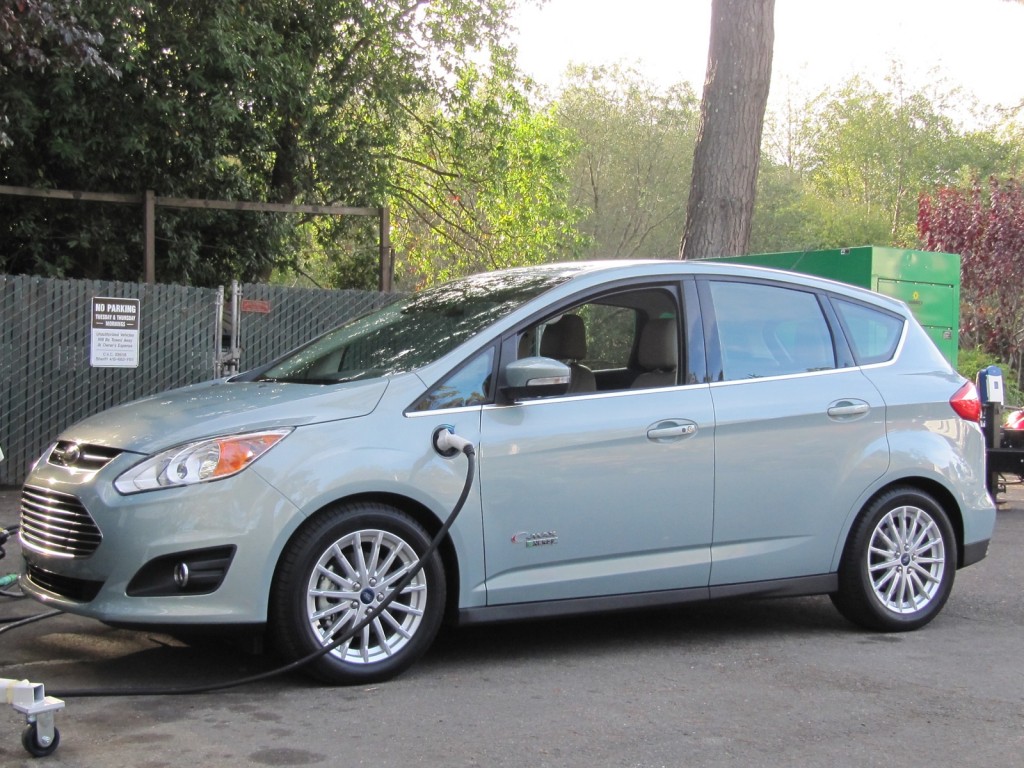
2013 Ford C-Max Energi plug-in hybrid, Marin County, CA, Nov 2012
Use it as an electric car
That stands in sharp contrast to the Prius Plug-In Hybrid, which sometimes seems to switch on the gasoline engine if the driver breathes too hard.
It’s much easier to keep the C-Max Energi in electric mode, aided by the power gauge, which shows how close a driver is getting to reaching the limit of the electric motor’s available power.
In other words, the C-Max Energi can practically be used as an all-electric car for distances up to 20 miles—especially if those distances are covered at speeds of 40 mph or below, before aerodynamic drag starts to take its toll.
The Energi C-Max isn’t particularly swift in its all-electric mode—the traction motor has a peak output of 88 kilowatts (118 hp), against a combined engine-motor output of 195 hp, or 54 hp more than the Prius powertrain—but it won’t embarrass itself in traffic.

2013 Ford C-Max Energi plug-in hybrid, Marin County, CA, Nov 2012
It will, however, switch on its engine even in EV-Only mode if it’s under heavy load. With five people in the car, just like the Prius plug-in, the engine will switch on to move the car as fast as possible from a standing stop onto a fast uphill freeway on-ramp.
The drive selector offers only two forward modes, Drive and Low. The latter increases the level of regenerative braking; Ford says it’s set up to simulate engine braking for descending hills.
Along with EV-Now all-electric mode and Auto-EV hybrid mode, Ford offers an “EV Later” mode as well that lets drivers maintain whatever state of charge the pack contains and save it for later use.
That might apply to a quiet neighborhood late at night, or be used in a European city with a zero-emission vehicle zone.
Gas mileage vs efficiency
As for statistics, we left downtown San Francisco and made it most of the way up the Marin hills on the north side of the Golden Gate Bridge entirely in electric mode.
The gauge said we had covered about 14 miles—and still had almost 3 miles left—when we switched the car into “Auto EV” blended hybrid mode to keep up with fast-moving traffic. That 3 miles vanished quickly, however, and our C-Max Energi behaved like a conventional hybrid C-Max thereafter.
The EPA rating for the Energi's highway efficiency once its pack is depleted, however, is 41 mpg--13 percent down on the C-Max Hybrid's 47 mpg. That's due not only to its higher weight, but to a lower final-drive ratio than the one used in the hybrid version.
Over the course of our 79.7-mile test, which included lots of hills and canyons along the coastal highway, the C-Max Energi logged a blended gas mileage of 62.8 mpg.
That means we used about a gallon of gas during our 66 miles of hybrid running—though the display also informed us that during the total 80-mile trip, we’d spent fully 51.5 “EV” miles with the engine off.
That translates to more than 60 percent of our total travel, and indicates that even with a large amount of freeway driving, the C-Max Energi can spend a lot of time running only on electric power.
And it often does so undetectably. We had to pay close attention to figure out when the engine switched off under many conditions, though a slight change in note indicated when the engine came back on.
The EPA rates the C-Max Energi at 100 MPGe combined in all-electric mode (108 MPGe city, 92 MPGe highway), making it more efficient than the 2013 Chevy Volt by exactly 2 MPGe--and, remarkably, better than the Prius Plug-In by 5 MPGe.
(The Miles-Per-Gallon-equivalent measure looks at how many miles a plug-in car can cover electrically on the same energy content that’s contained in 1 gallon gasoline.)

2013 Ford C-Max Energi plug-in hybrid, Marin County, CA, Nov 2012
Ford proudly touts the C-Max Energi’s projected range of 620 miles, among the highest for any non-diesel passenger car. The plug-in Prius, more than one Ford person noted, delivers a mere 541 miles.
Real-life experience tells us that few people—and almost no families with kids—actually manage to travel six to nine hours without stopping. Still, the less filling up, the better.
Active noise cancellation
Just like the C-Max Hybrid, the plug-in C-Max Energi uses active noise cancellation that broadcasts sound waves through the door speakers to counter engine noises that customers disliked. That lets Ford run the engine at lower, more economical speeds—also known as “lugging’—that would otherwise generate noises customers react adversely to.
That clever electronic masking works, assisted by thick side glass, an acoustic glass for the windshield, and upgraded sound insulation in a variety of places throughout the vehicle. Ford also focused extensively on reducing wind noise and improving body sealing.
The result is a much quieter, more restful hybrid driving experience than in the often-strained-sounding Prius. The C-Max 2.0-liter gasoline engine still howls under heavy loads from time to time, but it’s tolerable and somehow sounds further away than just a foot or so ahead of the driver’s feet.
Cheapest plug-in hybrid?
Ford’s effective pricing is aided by a larger Federal income-tax credit than the Prius Plug-In Hybrid earns. Its larger battery—7.6 kWh versus the 4.2 kWh in the plug-in Prius—not only delivers longer electric range but also qualifies for a $3,750 tax credit (for buyers who qualify). The Prius plug-in gets only $2,500.
The base C-Max Energi stickers at $33,745, while the plug-in Prius base model lists at $32,710. That means that Ford can claim a “net price” that’s $200 $400 lower for the base versions of both vehicles.
The plug-in hybrid C-Max costs $4,750 more than a C-Max Hybrid with similar equipment, though Ford used “net pricing” to say that a C-Max Energi model was only $1,000 costlier than the comparable C-Max Hybrid SEL after the $3,750 Federal incentive.
Equipment differences in the Energi version, compared to the Hybrid, include standard electric heated seats, a high-capacity electric heater, and that lower final-drive ratio.
Born in the USA
For buyers who care about where their car is built, the 2013 Ford C-Max Energi is the first plug-in hybrid car built in the United States.
In fact, Ford will export the plug-in C-Max to Europe from its U.S. plant, although diesel and gasoline versions of the C-Max (not offered here) have been built in Europe for many years.
Both the Energi and Hybrid versions of the C-Max are built in the Wayne, Michigan, assembly plant that also produces the Focus compact sedan and hatchback, and the Ford Focus Electric battery electric car.
The Toyota Prius Plug-In Hybrid and the upcoming 2014 Honda Accord Plug-In Hybrid are built in Japan, however.
Ford provided airfare, lodging, and meals to enable High Gear Media to bring you this first-person drive report.
+++++++++++