First 2011 Nissan Leaf Delivery, To Northern...
NY Marathon: 2011 Nissan Leaf Acts As...
Nissan: 2011 LEAF Will Reach Full Production By...
Just under a month ago, we reported a few cases in which owners of 2011 Nissan Leafs had noticed the first of twelve lights on their car’s battery capacity gauge had switched off, indicating a marked deterioration in battery capacity after just one year.
Now Nissan has released an official statement about cases in which it affirms its belief that the Leaf’s 24-kilowatt hour battery pack will have a long and useful life.
In short it says, there is nothing to worry about.
Lost capacity
A twelve-bar gauge to the right of the battery charge indicator, the battery capacity gauge is designed to give an at-a-glance indication of battery capacity and health.
As time passes and the battery ages, its ability to hold charge diminishes, meaning each full charge results in a slightly reduced range compared to when the car was new.
With time, the capacity gauge slowly drops, representing that drop in capacity.
When we originally reported the story, the affected cars -- all in Arizona -- experienced the loss of the first battery capacity gauge between 13,633 miles and 17,000 miles.
“A few cases”
Since then, other owners have stepped forward reporting the same issue, but Nissan says it is still only a few owners.
“We’re aware of a few isolated cases where a very small number of consumers are reporting a one bar loss. (We’re talking less than 5 units versus the 12,000 on the road in the U.S.),” a Nissan representative told us.
Non linear loss.
In our original article, we told you that the Nissan Leaf workshop manual indicates the extinguishing of the first capacity light represents a 15 percent drop in battery capacity.
Losing that much capacity in the first year seemed drastic in the light of Nissan’s previous statements on battery life, but Nissan says battery capacity loss isn’t linear.
“In general, all batteries exhibit a higher loss of capacity early in life, but then the curve flattens over time,” we were told. “Our internal results indicate that the battery will have 80 precent of its capacity under normal use after 5 years, and 70 percent after 10 years.”
It’s complicated
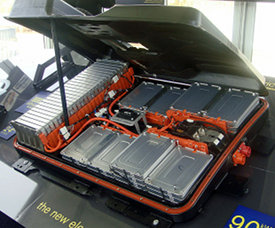
Lithium-ion battery pack of 2011 Nissan Leaf, showing cells assembled into modules
While we’re glad to see Nissan remains confident in the battery technology found in its Leaf electric car, we’re sure that those customers who have already experienced a loss are anxious to see what happens next.
What will happen? We’re not sure, but for now, Nissan’s official line is non-committal.
“We can confirm that the state of charge[sic] is depicted as a non-linear scale but are not able to confirm the specific totals that each ‘bar’ represents,” Nissan’s official statement says. “Battery life is contingent upon many variables related to driving habits and conditions. We are confident that if owners care for their vehicles properly, they will experience many years of enjoyable driving!”
Your thoughts?
For now, Nissan is not concerned about the battery capacity losses that have occurred so far in a small proportion of Leaf cars in the U.S. They are, it says, still within normal expectations.
But what do you think? Is Nissan’s explanation enough, or have the examples in Arizona made you wary of buying its electric car?
Let us know in the Comments below.
+++++++++++

Follow GreenCarReports on Facebook and Twitter.
Have an opinion?
I wonder if the battery was "liquid cooled", would it degrade slower?
Just repeating the results of their "internal testing" (? accelerated life testing) without further details is not reassuring in the least. All of those who lost a capacity bar who went for testing at the dealer were told this is "normal".
Many others have reported a loss of capacity of around 10% - typically in warmer areas such as Texas or southern California.
The highest mileage LEAF (TaylorSFGuy) charges to 100% twice a day and has probably 40k miles on his LEAF so far but doesn't report any significant capacity loss. He is in Seattle. Others in Seattle also report that their battery appears to be like new.
All those AZ owners must be kicking themselves for not leasing instead of buying right about now...
If Nissan is right, 0.04% of cars are showing signs of battery degradation in what appears to be a harsh environment. I am sorry for these 5 people, but seriously...0.04%? Talk about putting the car under a microscope. There are some gas vehicles with some pretty horrible failure rates out there..they might even have 0.04% rate of catching on fire.
--Nissan says this is "normal"; that's what the dealers tell these folks when they go in for a battery check
--Nissan has no warranty on battery capacity, and hasn't done anything for these folks
--This is most likely the tip of the iceberg in Arizona
--Nissan apparently knew that the loss of battery capacity is non-linear, but didn't bother to disclose this fact to prospective buyers
Don't get me wrong, I love my Leaf... but I live in Southern California near the coast and my Leaf spends less than 10% of its life in a hotter climate.
It's all about managing the perception of future buyers Nissan need to worry about. Like most companies they don't give a rats *ss about customers who have already bought.
Deny - "It's only a few"
Rationalize - "It's not linear"
Blame - Somehow the customers fault
Finally, accept responsibility but not fault.
Let's see how this plays out....
(http://m.prnewswire.com/news-releases/asphalt-going-green-with-cool-pavement-in-phoenix-122850164.html) – where I got the 150-170 degree info.
Not to be a jerk, but it is well known that temperature affects the life of a Li-ion battery. The upside to this is that, now, we all know what to expect to see after a Phoenix summer in a LEAF.
I'm waiting to see how my frequent DC fast charges will impact my LEAF's battery and I’ll make sure to let everyone know when I find out.
Not every consumer with this problem, especially with new technology and a new car, will immediately file a formal complaint with Nissan, so let's not overreact in either direction. I'm not convinced it's a design issue yet, nor is it a non-problem because an OEM claims something.
Let's see what the long-term data suggests and go from there. I hope it's just a minor blip since EVs don't need any more bad PR right now.
On a side note, can anyone guess in around 7 to 10 years how much a replacement battery might cost?
On another note, when Better Place charge batteries that have been removed from cars, they cool them and the whole operation is done inside their air conditioned robot stations which are kept nice and chilly. I also notice that when charging my Fluence ZE on its standard level 2 charger the battery makes all sorts of cooling fan noises and liquid sloshing noise that is never made in driving use.
The BMS montiors each cell in the pack.
It prevents the charge level of any single cell from going too high when charging and any single cell from going too low when discharging.
The lowest capacity cell limits the usability of all cells to that capacity - there is no risk of over-discharge due to top-balancing here.
1) Leaf owners should park in cooler, shaded places when possible and/or use a good car cover.
2) Nissan will likely come up with a solution for extreme heat ares for 2013 or 2014 Leafs. They did this for cold weather states for the 2012. All 2012 leafs n younger include a battery heater as standard equipment. Perhaps Nissan will do the same w/ a battery cooler next year.
I don't think most folks, let alone the folks on this forum, realize how important the Leaf n EV tech is for Nissan. Nissan is committing billions more this year to new n better EV vehciles. Nissan wants the Leaf to be the new green car of this decade like the Prius was last decade.
It's rather ironic that the green media darling LEAF may be on its way to be giving the EV market segment a black eye, while at the same time the unpure black sheep Volt appears to be paving the way toward EV sales success.
Nissan should be giving a lot more detailed advice about how to care for the battery and the results of not doing so. I am sure they didn't want to do that because it makes the Leaf look like more of a hassle. Unfortunately, the result of withholding those details is now coming home to roost.
My recommendation: buy the Leaf if you live in a moderate or cool climate. Otherwise, lease the Leaf or wait for a version with a thermal management system for the battery.
Have an opinion?Join the conversation!