2013 Nissan Leaf: Driven Through Tennessee...
2014 Cadillac ELR: Volt-Based Coupe To Get New...
2013 Nissan Leaf: Longer Range, Faster...
There's lot of discussion about how the value of electric cars will hold up over time, depending on how long their expensive lithium-ion battery packs last and how quickly they may lose capacity.
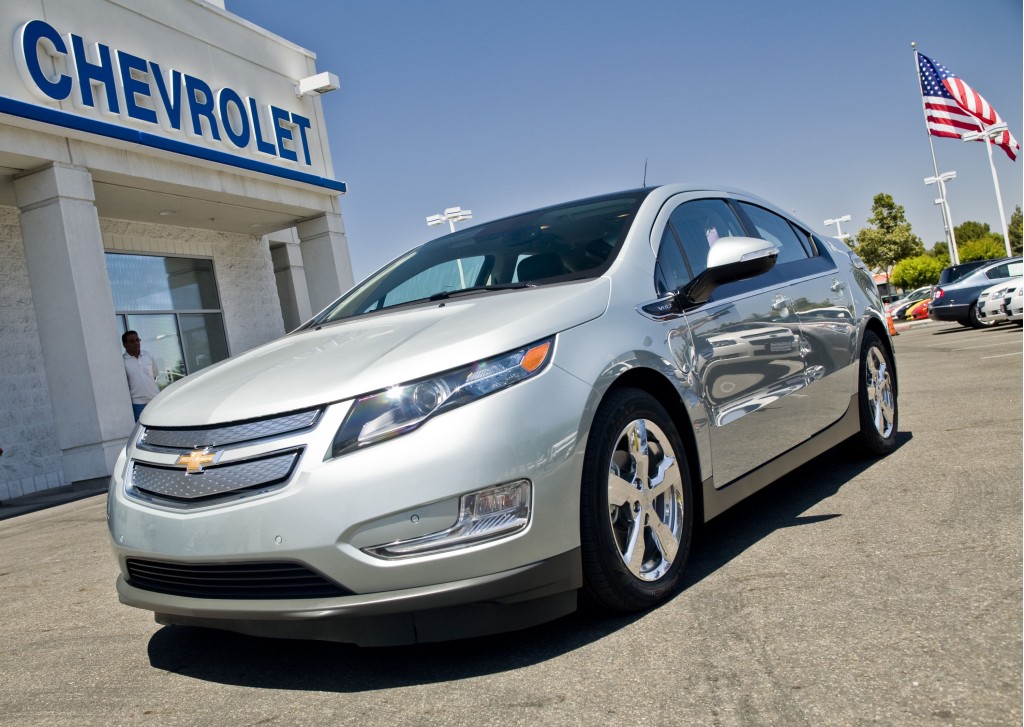
But now the folks who estimate used-car prices for a living, the NADA Guide, have weighed in with their take on the value of one-year-old Nissan Leaf and Chevy Volt models.
According to trade journal Automotive News [subscription required], the June issue of the NADA Guide will set the value of a "typically equipped 2011 Leaf SV electric car" at $23,975.
That, according to NADA, is 95 percent of its price after incentives.
Which is true, if you assume that the original owner paid the 2011 sticker price of $32,780 and has already filed 2011 taxes and been able to realize the full Federal tax credit of $7,500 on them.
That puts the retail cost at $25,280--using the calculation known as "net pricing," a practice with which we take issue.
NADA Guide analyst Maynard Brown says the company considers tax credits to be equivalent to purchase rebates because used Leaf and Volt buyers are aware of them and would not buy a used plug-in car for a higher effective price than the original buyer.
Note: Since $32,780 is the base price of a 2011 Leaf SV without any additional options, the math would likely be a bit more accurate if we were to add something like $1,500 for the options that may be in the "typically equipped" Leaf SV model assumed by NADA Guide.
For the record, the base-level Leaf SV model was vastly outsold by the high-end Leaf SL model, according to Nissan.
Without the credit, though, the math is not as good: The Leaf lost about $10,000, or 30 percent of its value, in a year. (That is, for fans of useless statistics, slightly more than one dollar every hour.)
That's a higher percentage loss than the 2011 Honda Civic (which lost 24 percent) or the 2011 Toyota Prius (which lost a remarkably low 12 percent of its price).
Comparable figures for the Chevy Volt were 90 percent of sale price after the tax credit, and 75 percent not including its value (or a 25-percent loss).
Do you think the argument that Leaf and Volt prices have to be below the post-incentive level, because a second buyer won't pony up more cash than the original owner, holds water?
Leave us your thoughts in the Comments below.
+++++++++++

Follow GreenCarReports on Facebook and Twitter.
Have an opinion?
The real question is, can you by a used LEAF for $23,975?
It's a new ball game when EVs are the used cars.
And how would the second owner of a Leaf pony up more money than the first if he pays $23995 and the base Leaf currently has a $35200 MSRP?
The author's last paragraph remains somewhat enigmatic. Maybe the suggestion is that net prices are irrelevant so there is no reason that used prices should necessarily be below those net prices. That would suggest some pretty irrational behaviour from used EV buyers though which is actually made less likely by the industry's practice to advertise with net prices which makes used and new prices better comparable.
the battery price is the portion of the car that will come down the most.
to that degree, an ev will have a harder time keeping its original sale value than an ice car.
but people know this going into it. and it only makes a difference if you sell it.
if nissan was smart at all, new battery packs should be interchangeable.
so a current leaf owner will simply buy a new pack for his car, at a much cheaper price as well, when compared to the cost of the original battery pack.
the new leaf will drop faster in price than its ice counterpart, for the same reason that the leaf cost more in the first place - the battery.
so really what we are talking about is purchasing an ev earlier or later. the early buyers pay the most for their original battery.
but on the same token, they start saving everywhere else, earlier as well.
by that i mean, way less maintenance, no smog checks, better driving experience, etc.
those that have some money want these conveniences early on, and are willing to pay for it.
and as long as there is demand at a certain price, the price will not drop.
people keep mentioning the drop in leaf sales. but i think it occurred at about the same time that nissan announced its next year's model would have a thermally cooled battery management system, like the coda does.
that has turned out to be a big deal, and people will wait a few months for it.
if this is what is happening, we should see a marked rise in leaf sales when the new model is out (assuming the new battery system is in place).
Also, Volt should still be a decent hybrid even after battery degradation. Leaf would be useless without a decent battery.
In addition the true running costs of EVs will be better known and also their longevity.
In the UK Diesels tend to have a 15-20% premium used (like for like) as they last longer and are cheaper to run.
Once these things become known then the market price for a used EV will become clearer.
With respect to the nett price issue, clearly that is going to drive any second hand price as the market knows the true price of the vehicle is nett of the rebates. If an individual owner has not gained those benefits for whatever reason the market will not care, that will be the individual's loss.
Also, the 2011 pre-HOV CA cars are most certainly going to be worth less in CA than the HOV sticker CA cars.
another thing that has buoyed the 2011 prices is the 2012 price hike which is essentially causing more of a devaluation since the 2011 may not have dropped much from a new 2011, but there is still a significant price difference if looking at a 2012.
Have an opinion?Join the conversation!