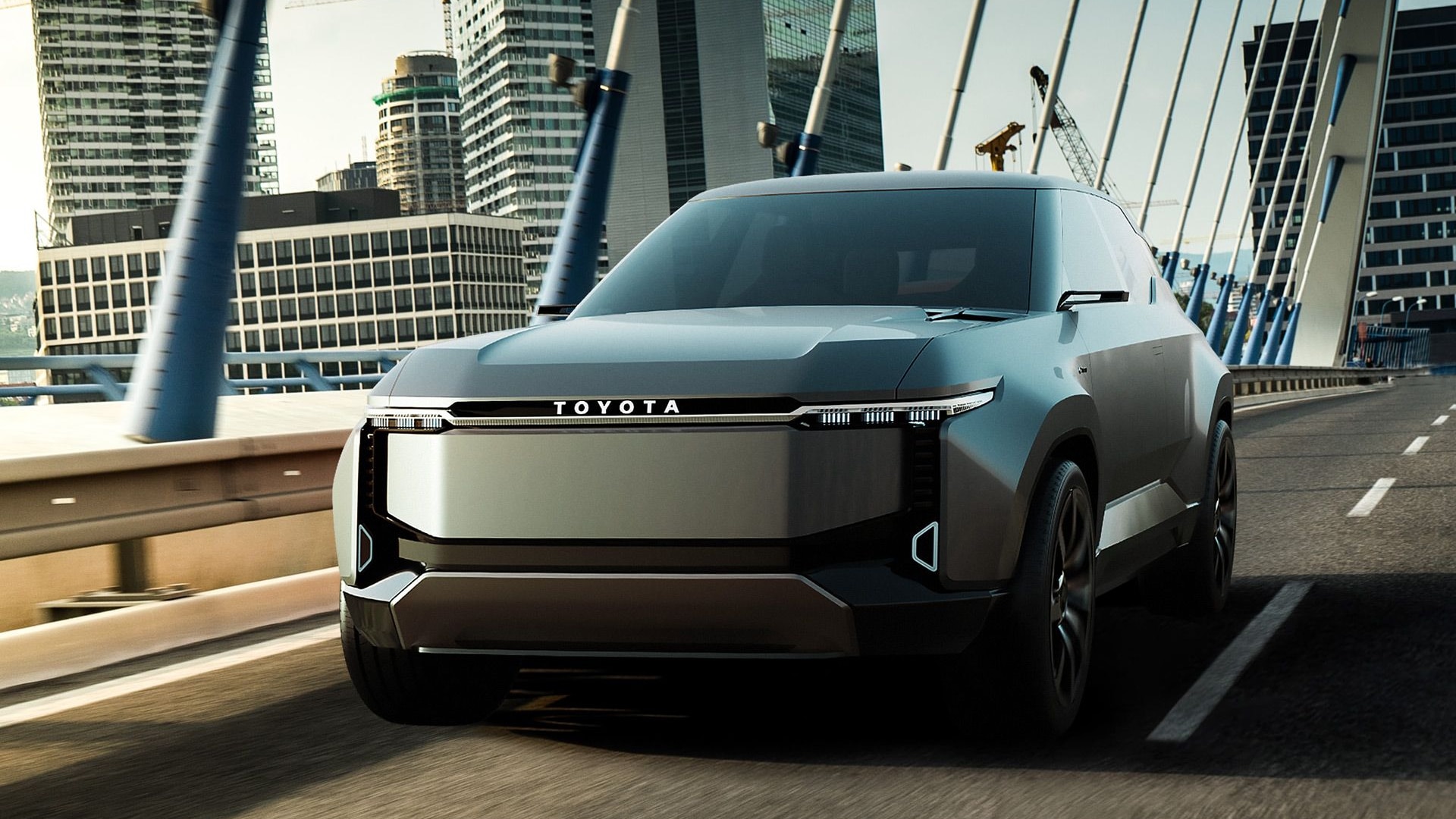
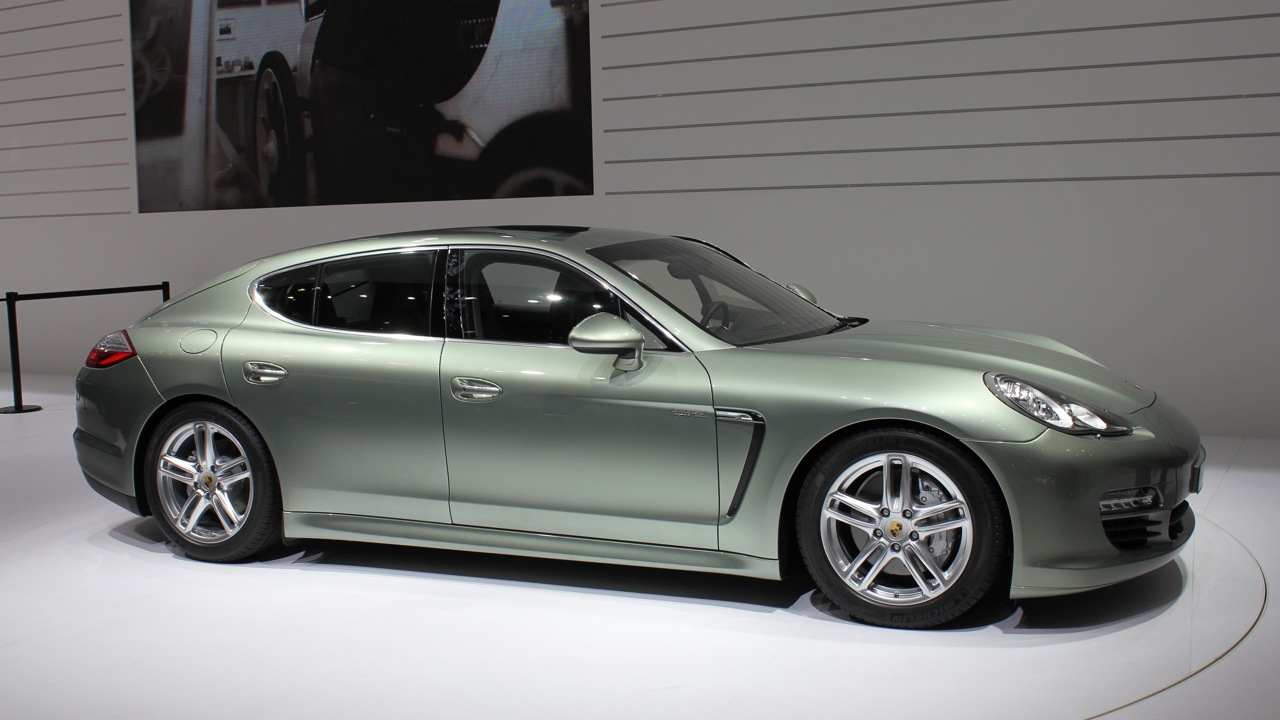
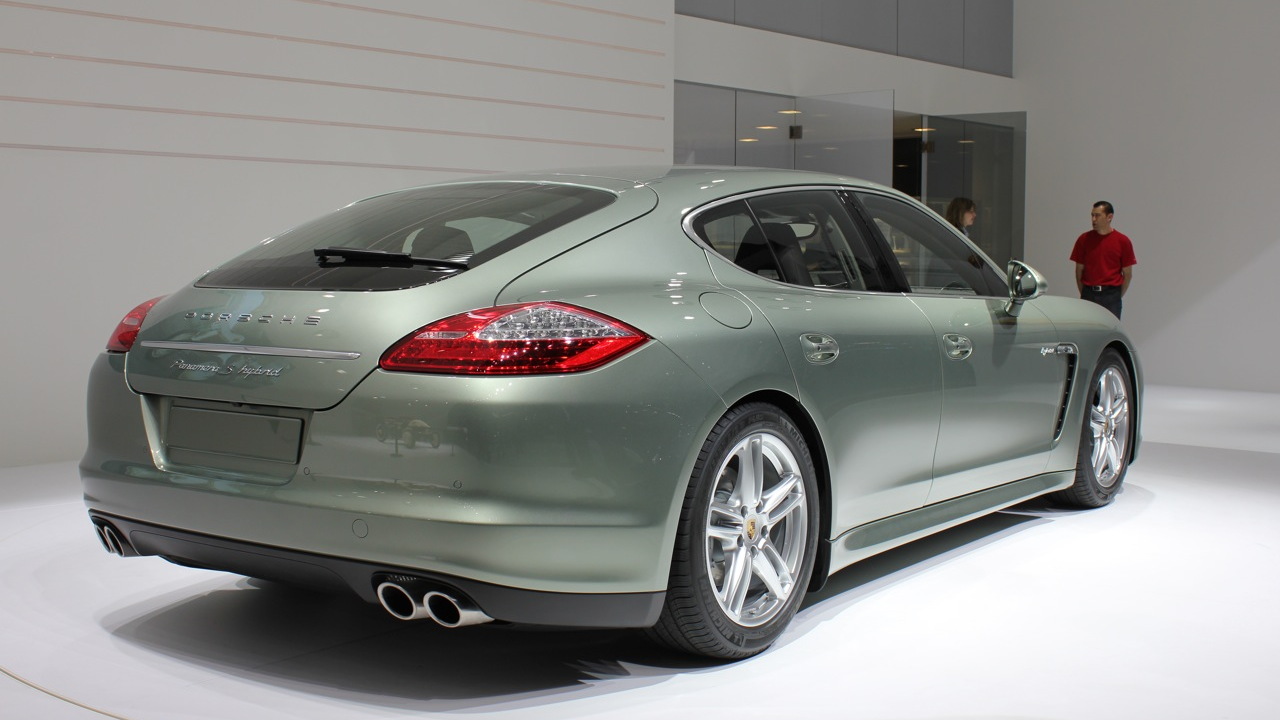
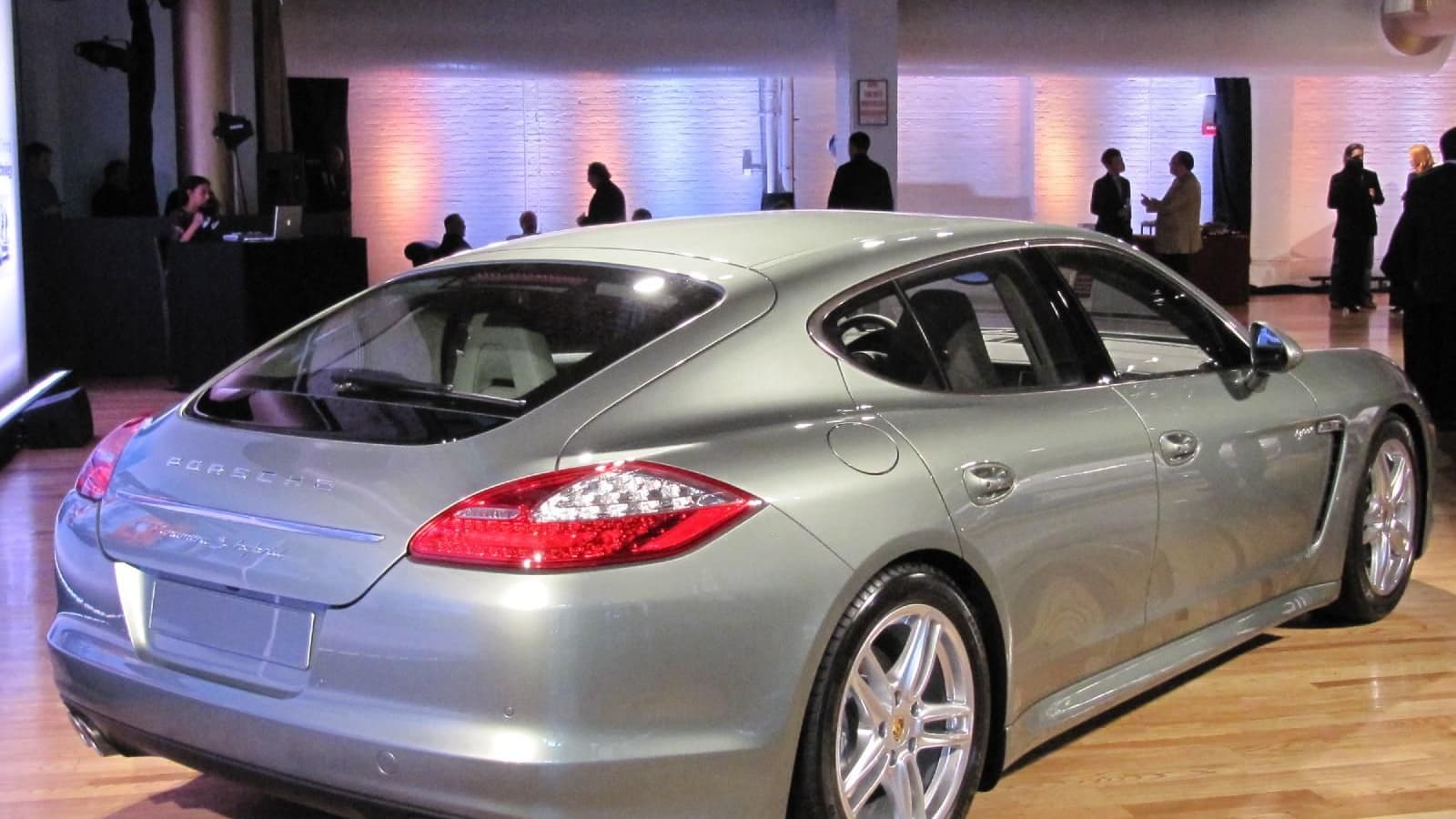
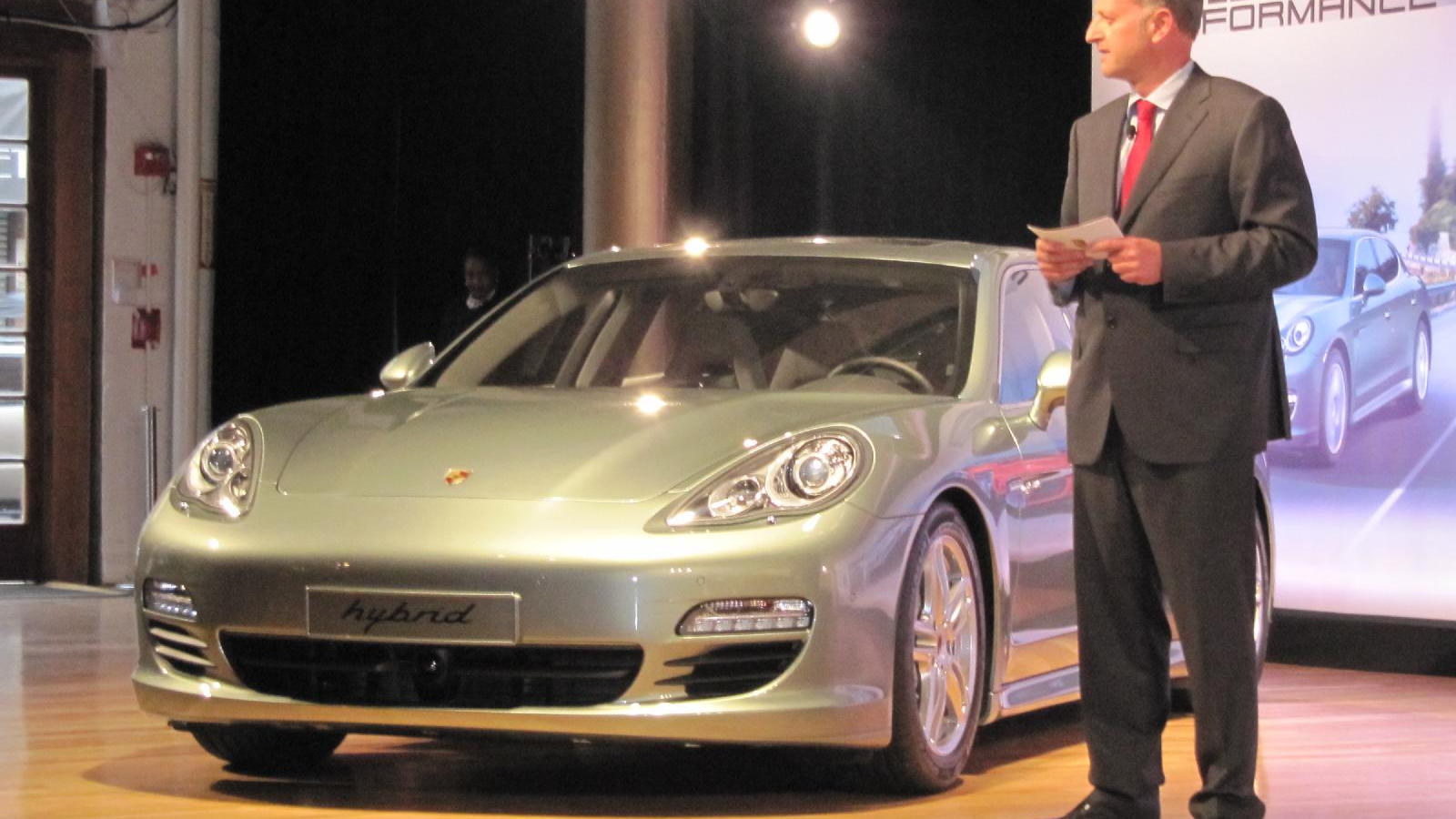
2012 Porsche Panamera S Hybrid live photos
Steady-speed highway cruising doesn't actually take that much energy compared to accelerating up to, say, 70 mph in the first place.
The really hard part is getting consistently high gas mileage in all driving conditions--which is why the 50-mpg Toyota Prius hybrid is still a remarkable vehicle.
Does 52 mpg at 70 mph sound impressive to you?
Well, Mark Phelan of the Detroit Free Press managed to get that level of fuel economy in the 2012 Porsche Panamera S Hybrid he just tested.
(He also tested a Panamera S Turbo; let's just say its twin-turbo V-8 engine did not produce anywhere near that level of fuel efficiency.)
We don't test a whole lot of Porsches around here. The 2011 Porsche Cayenne S Hybrid we drove last summer was a rare exception.
And it confirmed the gas-mileage gains of the Porsche hybrid system, giving us a remarkable 27.7 mpg overall on our usual test route of two-thirds highway, one-third city.
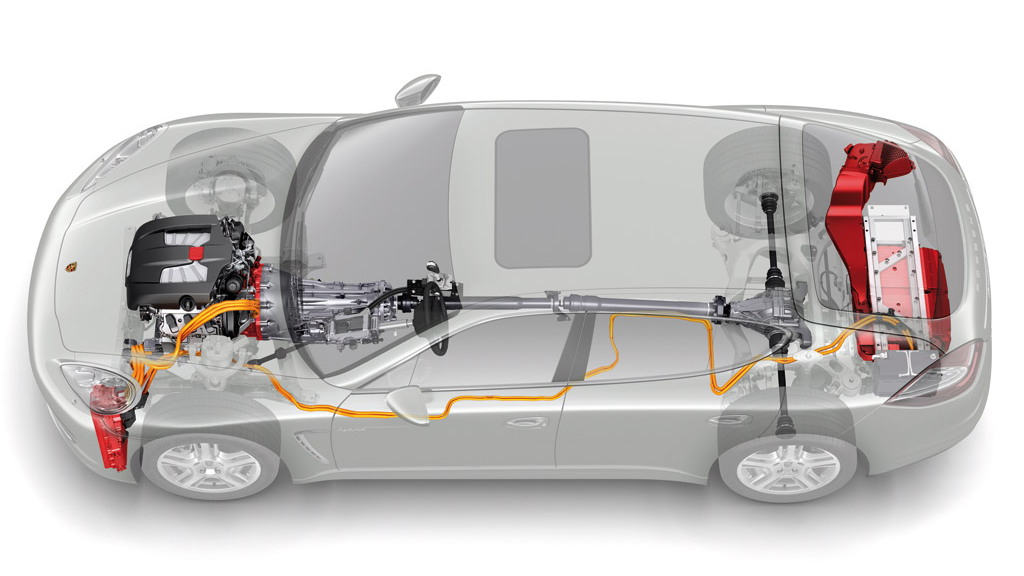
Porsche has taken full advantage of the VW Group hybrid system it uses in both the Panamera luxury sport sedan and the Cayenne sport-utility vehicle.
Phelan's reading of 52 mpg over 100 or so miles of cruise-controlled 70-mph travel exploited the Porsche system's ability to propel the car electrically at speeds above the legal limit, under light load. Many hybrids only run in all-electric mode up to 30 mph or so.
And as every hybrid driver knows, any time you can shut off the engine (or even shut off fuel delivery temporarily), you save gas.
The EPA rates the 2012 Porsche Panamera S Hybrid at 22 mpg city, 30 mpg highway, for a combined overall rating of 25 mpg.
Which isn't bad for a large, luxurious, high-speed luxury sport sedan--and only goes to show that there's quite a lot of efficiency that can be wrung out of the old gasoline engine yet.
For more on the Panamera S Hybrid and the rest of the model range, see the 2012 Porsche Panamera review on our sister site, TheCarConnection.
+++++++++++
Follow GreenCarReports on Facebook and Twitter.
Have an opinion?
One trip, down hill with a tailwind and good MPG does make kind of a story, it is called a "fantasy." It is usually reserved for the truth-benders on Top Gear, but it is good to see they don't have a monopoly.
Not sure where you get the "down hill" and "tailwind" bits. The article is as accurate as the piece it's based on, and points out that even large, fast, luxurious cars can get surprising mileage using hybrid systems.
And, re/"crappy": Watch the language, hmmmm? That's probably within our permissible terms (the filter didn't flag it) but it seems a bit unnecessary.
2), "this article is as accurate as the piece it's based on" is that part of the standard journalistic due diligence process or are there perhaps other standards that journalist apply from time to time.
3) "even large, fast luxurious cars can get surprising mileage with hybrid systems," that is really the problem with article. They get cr..., ah make that, poor mileage as the body of your article points out.
(2) Not entirely sure what this means. I'm not going to be able to fact-check whether or not the writer did in fact drive almost 100 miles with the cruise control set to 70 mph, or whether he did get the indicated gas mileage. If you know how I could do that, do tell.
(3) "can" ... the operative word is "can." The article does not say that they all DO. We can agree that most don't.
(3) Sloppy. Any car "can" get 50 mpg under the right conditions, but they "don't" because they are inefficient.
(3) I would be surprised if a Hummer H1 could get 50 mpg under any circumstances at all. Moreover, many people define "inefficiency" quite differently than you do.
On one hand, there's the argument that anything over 35 mpg doesn't save enough total gasoline to be worth enduring the vehicles it requires. On the other hand, there's the argument that YOU, the Prius driver, are reprehensibly inefficient for hauling around 2 extra seats you don't always use. Get thee a two-seat plug-in or stay home! Etc.
(3) Just find yourself a little bit of an incline, and don't let the truth get too much in the way of a good story and there you got. Honestly, I hear more of these suspicious MPG numbers from Prius drivers than from anyone else.
At this point, we don't know what is possible for 35 MPG vehicles, that is, if we insisted on them rather than praising 25 mpg inefficient vehicles.
As for the two seat plug-in, that is scary, can you read my mind?
I don’t care if it is hyper-miling Prius driver claims, 220 mpg Volt driver or whomever, these non-standards based, anecdotal reporting is misleading (if my other adjective is unacceptable, perhaps you will allow this one). The article makes it clear that the number is misleading, so why do it?
Is it the joy of the “man bites dog” ironic headline?
Do you want to believe it, even though you know it is misleading?
To me, it highlights a positive accomplishment: better fuel economy (under certain circumstances, which I describe) in a seemingly unlike car.
I'm a bit puzzled why this seems to outrage you so.
Do tell what headline you'd propose instead.
Give me a headline of 60 characters or less that has both the name of the car and the salient point of the article in it. Go.
Headlines have a life of their own, e.g. Prius does more environmental damage than Hummer, no matter if they are really baseless claims or tempered in the body of the article, the damage is done unless the headline reflects the reality of the situation.
In the end, I can't help wondering if you simply disapprove of the idea that anyone is buying a car with lower fuel efficiency than a Prius?
2025, 54.5 mpg, Panamera less than half
2016, 37.8 mpg Panamera fail
1985, 27.5 mpg Panamera still fails
By what objective standard is a 25 mpg car considered to have impressive gas mileage in 2012?
Lab director with an M5 wants a Model S instead.
As for the goal of having everyone drive a vehicle with the efficiency of a Prius, I would never settle for a goal with such low efficiency. Not only can we do better than the Panamera, we can do better than the Prius. Much.
Second, we return to the idea that you apparently will never tolerate ANYONE not driving the MOST efficient car in the market, your beloved Prius. And that's at a minimum, per your second comment.
Which is a fine opinion to hold, but I fear the auto market doesn't work that way. We report here on what IS, not what one reader believes SHOULD BE. We are reporters, not advocates. See here:
http://www.greencarreports.com/news/1073906_on-bad-electric-car-news-a-note-to-our-valued-readers
It is categorically not a lie if you report as you find. The original claim should be testable and refutable, like any good scientific theory. If someone is willing to lend me a Panamera hybrid, I'd be quite happy to do my own test...
However, commenting on an article to say that the original driver is lying, or that John is "misleading" people with a headline as John B. has done (we like to think that people read the articles once reading the headlines, thereby absorbing the information within) is NOT refuting a claim, it's simply throwing around baseless accusations.
Right, the term "lie" is really inappropriate but burning off less than 2 gallons of fuel and reporting the MPG based on the auto-stop mechanism of the pump is also inappropriate or (insert inflammatory adjective here).
It is not the same as filling up the car with gas, driving around the block, filling it up again, and computing MPG. However, the inaccuracies that make that process inappropriate, make Mr Phelan's process inappropriate.
"Yes. I'm saying that a large, fast, expensive luxurious sport sedan that can do 50 mpg at steady speed IS a good thing. "
Well, it would be a good thing, if it happened, which it didn't. What happened is Automotive Journalist burned of less than 2 gallons of fuel and computed a suspect MPG figure.
But what IS a good thing is that we have the EPA that knows how to make these measurements and the answer is 25 MPG.
EPA prohibits auto manufacturers from using any MPG number other than the one they supply. This exercise shows us why they feel the need to do that.
When that engine can switch off at times and the car can "sail" on battery power--as we observed our Cayenne S Hybrid doing at times--then doubling the rated EPA overall mileage of 25 mpg is plausible.
The added efficiency on the highway of the hybrid system in the Panamera comes from using the engine at a point of higher efficiency.
Let's assume the non-hybrid loads the engine at 10% all the time. Then lets assume that the hybrid loads the engine at 20% but only for half the time. Half the time the engine is driving the wheels and charging the battery. The other half of the time, the battery drives the wheels.
But loading the engine at 20% for half the time, is more efficient then loading the engine 10% all the time. It is about getting the ICE to operate more efficiently when it is on, and then turn it off.
Still 52 mpg is at the "upper limit of plausibility".
oh dang it, I was so hoping it would be the Panamera, oh well
1) BMW Activehybrid 7, 20 mpg
2) Lexus LS600, 20 mpg
3) Porsche Panamera 25 mpg
So among the hybrid cars, Panamera ranks 21 out of 23.
And the story probably should not have been written at all with the dubious data source as its basis.
In the case of the excellent Panamera, the goal was performance, and the company achieved that for sure.
Now we come down to the consumers and the reviewers. Shall we set high goals and expectations? or low ones? What types of goals do we wish to achieve? What will success look like? What type of shape will we leave the planet in? the country in? What do we want to optimize?
A Model S, for example. But the author prefers to push hybrids, I think. ;)
But at the moment, the Model S is not a production car. No one's driven one, the lines are not building cars for sale to the public, and deliveries are still several months away.
And as recent history shows us, many new electric cars get announced, or even go into production, only to meet a sad end.
I think Tesla's chances of putting the Model S into volume production and broad sale are now better than 50-50, but I don't consider it a real car. Yet.
Tesla is now better capitalized, post-IPO, for sure, and it has experience from the Roadster to guide it. That's why I say "better than 50-50" chance.
Still, many a slip 'twixt cup and lip ... and getting a car into production at all, and ramping it to volume + selling it broadly over a matter of years are two different things.
I hope Tesla succeeds in doing that. But the only way they will convince their skeptics is...doing it.
Seems to me that Voelcker looks more holistically at a car to form an opinion rather than having a single-minded focus on efficiency. He seems more persuaded by "driving dynamics" (whatever that is), road noise, luxury, sometimes valve-for-money, and then gets down to efficiency after he is sure he likes the car otherwise.
Also, he seems to be a huge fan of the smooth quiet accelerating of electric vehicles.
I am sure he will correct me if I have mis-characterized him.
No doubt Voelcker is a little too quick to believe this 52 mpg number that is at "the upper limit of plausibility."
I made that mistake once. Saw a number in an EPA report showing hybrids at 4% of market share at a time when Voelcker kept reporting them at 2% market share. Eventually Voelcker provided enough additional references to convince me that the real number was 2% and the government report was flawed in some way.
My mistake: I wanted to believe the 4% number.
So with data, you have to consider the source (EPA data being more credible than one guy driving 100 miles) but you also have to recognize that mistakes are made and it helps to have additional, particularly if you are putting it in a headline.
In other words, you'll remain skeptical even if they are successful? I don't think that's a fair position to take towards a new company. Of course there are risks, even GM went bankrupt.
Sorry I should clarify. To have a meaningful impact (in my opinion), Tesla needs to do more than get to the point of producing a few Model S's. They need to thrive.
So yes, shipping the first few units is "success" and will be celebrated by everyone including me. But I will celebrate even more when Tesla is just another manufacturer shipping tens of thousands of cars every year like GM, Ford, and Chrysler. That would be real success.
Neither Nissan nor GM produced "tens of thousands" of EVs (well, worldwide, Nissan produced about 20,000) in their first year.
I'm not sure if you are aware that the # of Model S reservations recently crossed the 10,000 mark. It appears Tesla has a good chance of selling about 15,000 in the US, in the first 12 months of production. Considering the meaningful, actually large, impact which the Roadster had with less than 2,500 sold, that will be a huge success, no matter what comes afterwards.
The Model S with a 300 mile range, and fast charging, will show that electric cars have the full potential of being the future. No EV has done that yet. In respect to that, it doesn't matter how many ICEs the big three sell per year.
You are suggesting another measure of "success" which is simply showing what is possible to an industry resistant to change. I think you have an excellent point.
In a number of ways, the Tesla Roadster has already achieved that "success" and indirectly launched the Volt into production.
Yes, I meant that "meaningful impact" does not have to come from numbers, especially it doesn't have to come from numbers which would be comparable to ICE numbers. None of the EVs or PHEVs have reached such numbers yet. And why would we necessarily want such huge numbers already? EVs have been built before, but the current ones are new developments and meant for specific markets so far. Production facilities are not yet designed for huge numbers.
Some want numbers already just so they can say: "See, people want them", to oppose the argument "Nobody will buy them". But another way to convince people that EVs "are the future" does not need those numbers. A "real car" is real in volume 1 (one).
But at times, I presume the engine switched from powering the car to recharging the battery. (The VW Group single-motor hybrid system can't do both at the same time, unlike the twin-motor system used by Toyota.) Once the pack was charged, under light load, the engine can switch off completely and the battery and motor alone can propel the car for a while. Then the cycle repeats.
I observed this in the Cayenne S Hybrid we tested, and I have no reason to believe the Panamera S Hybrid wouldn't operate in the same way.
Would a larger engine, running part of the time, be more more efficient than a smaller engine, also running at its optimal load, but all the time?
I'd rather think that some juice was left in the battery from previous driving, and/or that John Briggs info about auto shut-off imprecision might explain it.
50 mpg at 70 mph seems pretty far from EPA 30 mpg highway rating, to me. Or its some unusual explanation. Like wind. ;)
He wrote: "My favorite example of how little energy steady-state requires was in a 1001-hp Bugatti Veyron convertible. There's an analog gauge that shows instantaneous hp output. At 70 mph...it was about 60 horsepower."
I'm quite willing to admit that his number may be off. Instead of 52 mpg, it might be 47 mpg--or 55 mpg.
But the point of the article remains: You can get remarkably high highway cruising mileage in unexpected cars, including a large, fast, luxurious full-size sport sedan like the Panamera using hybrid technology.
However, I don't think the Porsche would get more than a few miles on the 1.7 KWH battery in the Panamera and Mark did travel 100 miles. So this error would likely be only a percent or two.
The much greater opportunity is in the filling process. It is for this very reason that MPG is typically reported after multiple tankfuls of gasoline are used. This reduces errors and gives feedback on the measurement process (error bars?).
In this case, only one tenth of a tankful was used which significantly increases uncertainty.
Regarding the 52 mpg Porsche
"extraordinary claims require extraordinary proof"
52 mpg at 70 mph for a 100 mile flat run on a warm day in a Prius is easily believable. But that performance for the larger, heavier Porsche Panamera with out the benefit of eco-tires is, as Voelcker has said at the "upper limit of plausibility.
Also the debate is so vigorous because the stakes are so small. :)
Mark drove 100 miles, put 1.92 gallons into a 21.1 gallon tank relying on the accuracy of the auto-shutoff at the pump to come up with the 52 mpg figure. Let's consider the air bubbles in the tank, how full the tank was when he started, the inter-instrument repeatability of the auto-shut off measurement of multiple pumps. The error bars on that experiment are huge.
This is why you should not pay too much attention to automotive journalists. After all the criticisms of the EPA mpg process by automotive journalists, too bad there isn't some self reflection.
Have an opinion?Join the conversation!