Major evolutionary change takes a long time.
That's as true for electric cars as for opposable thumbs--though it will be measured in decades, not millennia.
We frequently have to say that declaring plug-in cars a sales failure after 14 months (as certain commentators have done) is wildly premature.
So let's do a bit of context setting, shall we?
About 17,000 plug-in cars were sold in 2011. In their first year, the Nissan Leaf (9,674 sales) and the Chevrolet Volt (7,671 sales) both outsold the Toyota Prius hybrid on its first year in the market (5,562 sales).
Dueling headlines?
We expect plug-in sales roughly to double for 2012. That produces two possible headlines:
- Electric car sales double! or
- Buyers continue to shun electric cars
Each one is defensible, because the latter is accurate in the broader context of the market: Sales of tens of thousands of cars in a total U.S. market of perhaps 14 million vehicles this year are still an unimportant fraction of the market.
We'll likely see dozens of headlines this year, as we did last year, touting the predictions of one industry analyst or another on the increases in electric car sales this year, next year, and through about 2020.
Those estimates vary by almost an order of magnitude.
Utopians vs pessimists
On the one hand are what we think of as the "green Utopians" who believe that by 2020, 5 percent or more of the new cars on sale will have plugs.
On the other hand, the dour pessimists (with German diesel makers heavily represented) say that even 10 years hence, far fewer than 1 million plug-in vehicles--perhaps no more than 500,000--will be sold globally out of production that will have reached 100 million vehicles a year or higher.
Beyond 2020, by the way, we don't pay much attention to forecasts.
Many unknowns
A decade hence, there are just too many variables in play. Factors affecting the cost and range of plug-in cars (the main factors that affect their market prospects) include:
- Global oil prices
- Price-performance improvements in lithium-ion cells, generally estimated at 6 to 8 percent a year
- Stricter limits on carbon emissions (Europe, Asia) and gas mileage (U.S.) and requirements for zero-emission vehicle sales
- Government incentive programs, from electric-car tax credits to purchase rebates, high-occupancy vehicle lane access, and others
But overall, plug-in vehicles won't be a noticeable fraction of the overall market--by which we mean 1 percent or more--for several years.
In the U.S., that would mean 150,000 plug-ins a year sold out of a 15-million vehicle market.
Doubling every year?
Plug-in sales would have to double each year in 2012 (to 35,000), 2013 (to 70,000), and 2014 (to 140,000) even to approach that level. It took hybrid cars until 2005 to reach that level--or almost six years after the first one went on sale late in 1999.
And the U.S. may be one of the faster-adopting markets for plug-ins. Cost-conscious China isn't likely to be that accepting of pricier electric cars, nor are India, Brazil, Russia, and other expanding economies.
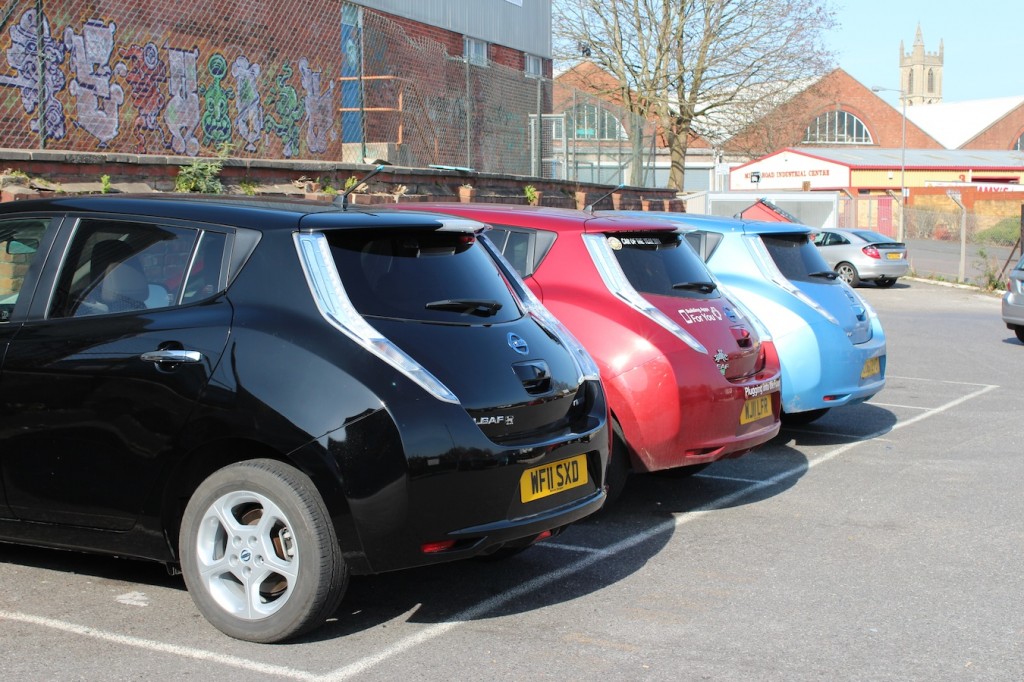
Three Nissan Leafs
And those nations are where all the growth in global auto sales is coming from. The U.S., Western European, and Japanese markets are little more than replacement markets by now.
So, most analysts predict that plug-in cars won't reach 1 percent of the global market, or 1 million plug-ins a year, until 2018 to 2020.
Still, they ARE coming
While analysts vary in their estimation of the slope of the adoption curve, virtually all reputable analysts acknowledge plug-ins will come. But, it will be a slow emergence.
This should hardly be news, except to breathless commentators eager for gloomy headlines or particularly uninformed automotive journalists.
One of the big questions is when the tipping point in prices will be reached that consumers can comfortably compare a plug-in car to a gasoline vehicle of equal size and capacity.
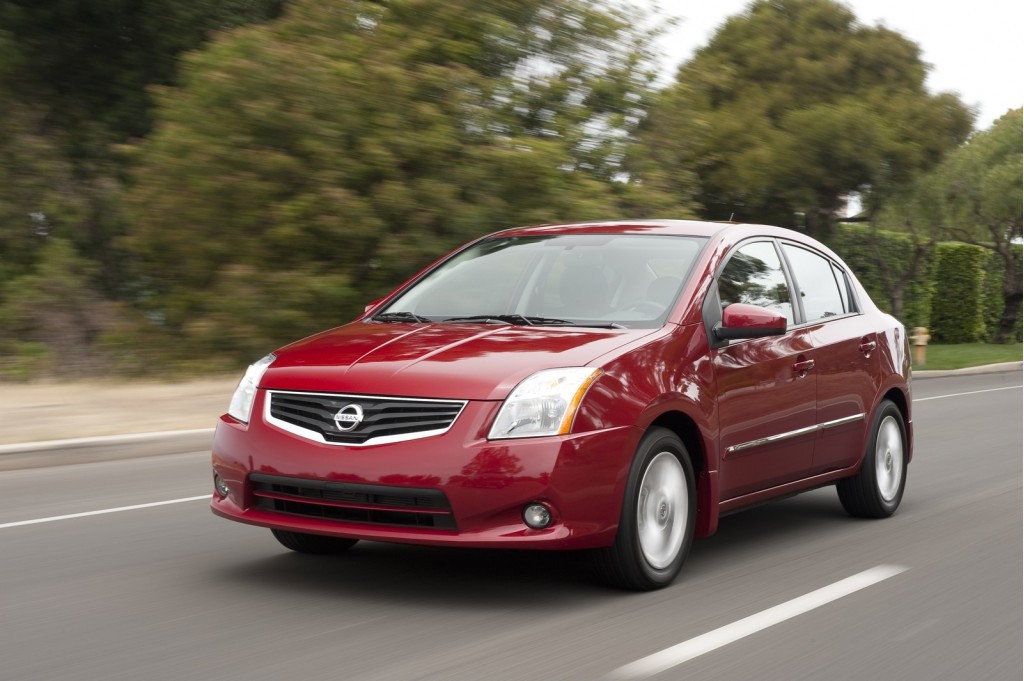
2011 Nissan Sentra
Right now, a 2012 Nissan Sentra starts at $16,250, while the 2012 Nissan Leaf starts at $35,200. Those two cars largely won't be cross-shopped--despite the Leaf's much lower cost-per-mile and reduced maintenance costs--because one costs more than twice as much.
Electric cars cheaper, gas cars pricier
But as battery prices fall and electric-car production volumes rise, the plug-ins will get cheaper. And to comply with increasingly stringent fuel efficiency regulations, the price of gasoline cars is likely to rise in real dollars.
That means that, several years hence, today's $17,500 compact sedan getting 30 mpg may be a $19,000 car that gets 40 mpg (note: That's an example, not a prediction). Meanwhile, the plug-in car may fall from $35,000 to $25,000.
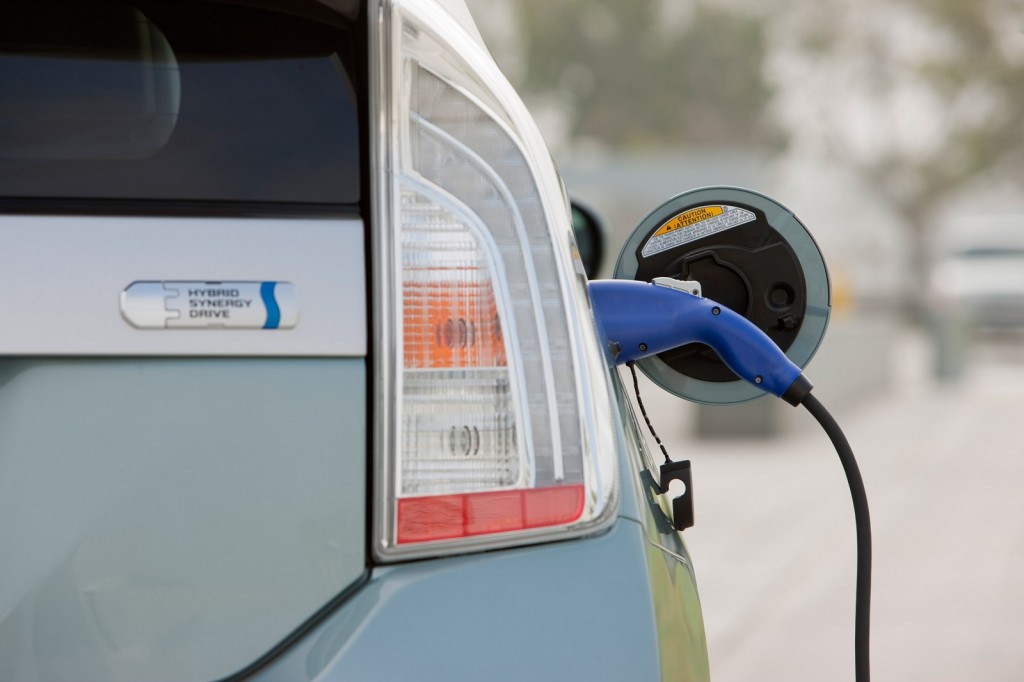
2012 Toyota Prius Plug-In Hybrid - production model
Nissan CEO Carlos Ghosn has said many times that for his company, the "hockey stick" upturn in sales will come around 2016, when the company and its alliance partner Renault together can build half a million electric cars a year or more.
Even allowing for some slippage, that means that 2018 might be the point where "regular" buyers begin to consider plug-ins seriously.
By then, they may have rented one, they may have ridden in a relative's or a neighbor's electric car--and, just like hybrids, they'll have learned that they're not quite so foreign or nervous-making as they'd thought.
2020 or later
For the rest of the industry, that hockey stick may come in 2020 or later.
So what does that mean? That means that for the next decade, electric cars will remain rare.
That corresponds to the adoption curve of pretty much any expensive new automotive technology. It took a decade or sometimes several before electric self-starters, automatic transmissions, disc brakes, fuel injection, turbochargers, and other advances became mainstream.
So it will be with plug-in cars.
Most early buyers: It's not about cost
One final note: There's widespread misunderstanding about the early buyers of plug-ins, all of whom can afford them. And contrary to the conventional wisdom, many or most of them don't do so because electric cars will cost them less money in the long run.
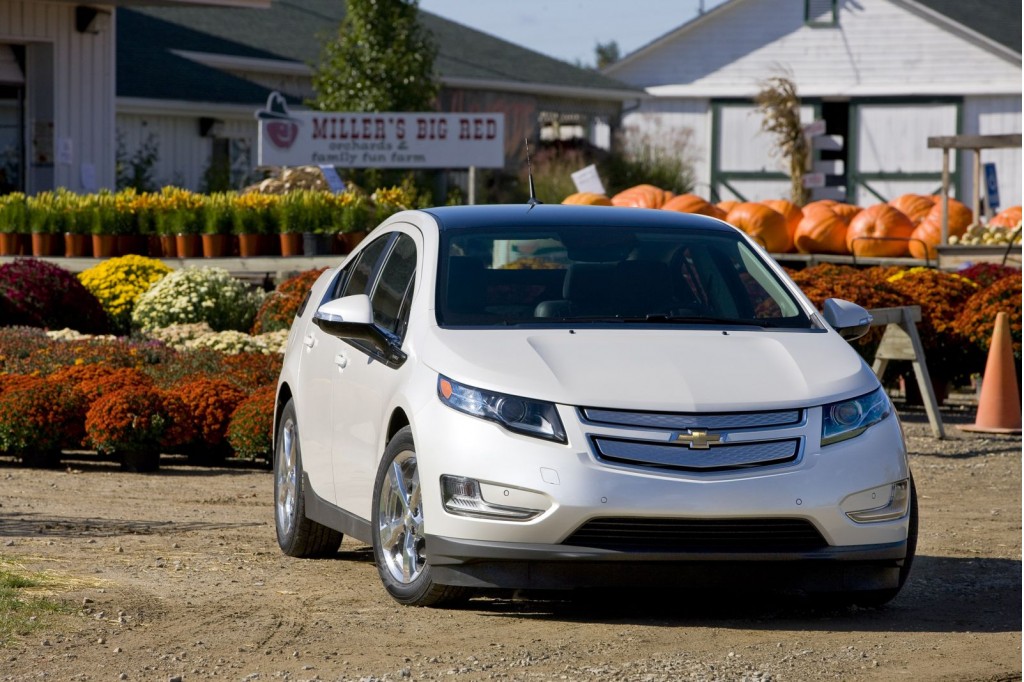
2012 Chevrolet Volt
The early buyers of plug-in cars include early adopters, technology enthusiasts, uber-greens, energy security folks, and those who I fondly call the "cheap bastards"--the folks who calculate total cost of ownership like fleet buyers, and plan to own their plug-ins long enough that they actually see a payback.
Each of those five groups is a distinct audience, but they are far from the mainstream buyers who will start to consider plug-ins six to 10 years from now. (Just as plenty of mainstream buyers are now comfortable enough with the Toyota Prius hybrid, after 12 years, that they have made it Toyota's third best-selling line of cars in the U.S.)
The widely accepted idea among auto journalists that electric cars are a non-starter because they cost more to own is uninformed--just as uninformed as the expectation among some environmentalists that a third of the cars in showrooms in 2020 will have plugs.
Better driving experience is the hidden ace
As costs come down, the biggest appeal of electrics for the future mass market could well turn out to be driving experience.
An electric car is simply better to drive than a comparable gasoline car. It offers lots of low-end torque, it's smooth and quiet, and there's no shifting going on.
Spend a week in a Nissan Leaf, and then return to your similarly sized gasoline or diesel car. You'll be surprised at how raucous it is and how much mechanical stuff is going on in the background.
We just don't know
Of course, the great thing about the future is that we can never predict it.

Gas pump
So any projections of electric-car sales are only estimates, based on what we think we know today.
And as always, there's a huge asterisk on any mid- or long-term sales estimate: "This projection may be affected by unexpected changes in global oil prices."
If for whatever reason, oil prices fell to $50 a barrel and stayed there, prospects for plug-in car sales emerging from early adopters and tech geeks into the mass market would be dimmed considerably.
But few people expect that to happen.
1 percent globally in 2020?
Assuming that oil prices stay at $70 a barrel or higher for some years--or, even worse, oscillate from lows to highs and back again--it's reasonable to expect plug-ins to make up 0.5 percent to 2 percent of global production in 2020.
One to 1.5 percent is a relatively conservative estimate, meaning 800,000 to 1.5 million cars depending on total global production.
Just as an aside, the cost of lithium-ion cell fabrication plants to produce 1.5 million car's worth a year (assuming 20-kWh battery packs) could run as high as $5 billion itself.
Meanwhile, electric-car sales in the U.S. might be higher, perhaps 2 to 4 percent. That would be 300,000 to 600,000 vehicles, assuming our market stays around 15 million vehicles on average.
So the next time someone tells you "electric cars are a market failure," smile indulgently at them. Pat them gently on their shoulder. Say something like, "Yes, dear, I know."
And then run them through the numbers.
+++++++++++