John Duncan takes delivery of one of the first 2011 Nissan LEAF EVs, near Portland OR, 12/15/2010
Enlarge PhotoSigh. Here we go again.
It's the first of the month, which means that auto journalists are scrambling to put together their monthly sales reports.
Sales in May weren't great, for a variety of reasons: higher prices and shortages of some Japanese models, among others.
Unusual scrutiny
But the most dismal part of the monthly process is watching the inordinate attention paid to sales of the two plug-in electric cars now available at U.S. dealerships.
Those are the 2011 Chevy Volt and the 2011 Nissan Leaf, and every month their sales have been followed with the kind of media scrutiny usually reserved for utterances by possible presidential candidate Sarah Palin (she of the anti-Subaru comments).
481 Volts, 1,142 Leafs
In May, Chevrolet sold 481 Volts, for a yearly total thus far of 2,184. That's right in line with the 493 it sold last month.
And Nissan sold 1,142 Leafs, for a 2011 total to date of 2,167 , its highest monthly total this year by far. So with five months in, the two makers are neck and neck on sales volume.
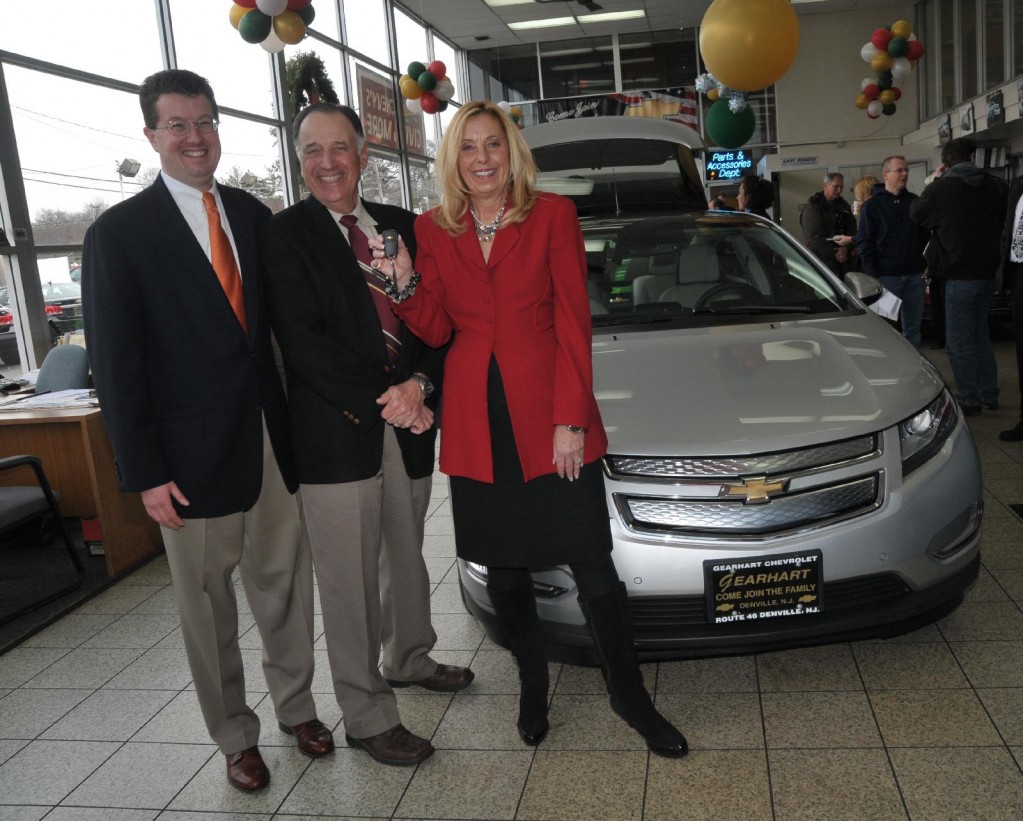
First 2011 Chevrolet Volt delivered to retail buyer Jeffrey Kaffee, in Denville, NJ, December 2010
Enlarge PhotoEach manufacturer has challenges this year.
GM will shut down the Detroit-Hamtramck plant where the Volt is built for four weeks in July to retool it to build the 2013 Chevrolet Malibu, now that production of the Cadillac DTS and Buick Lucerne has ended.
And Nissan has been coping for the past few months with the devastating impact of the February earthquake and tsunami that devastated its home country and damaged the supply chain for all automakers, especially those in Japan.
Utter lack of context
What irks us above all is the lack of context on the part of political commentators--we won't dignify them by mentioning names--who have already pronounced the Volt and Leaf "sales failures" based on a few months' data.
Get it straight, guys: Chevy always said it would build 12,000 Volts in 2011, and they've just boosted that to 16,000 based on demand. Nissan planned to deliver 20,000 Leafs in the U.S. this year, and has waiting lists that stretch out for months.
They are still delivering demonstration cars to dealers, shaking down production, and otherwise doing what any sane maker does when it launches a new and important vehicle region by region. Especially one that requires more than average education on the part of the buyer.
In other words, it's a problem of supply, not demand. Got it?
Check back in two years...
In a couple of years, when Nissan can build several hundred thousand electric cars a year, then we'll see whether they all find buyers. Until then ... do your homework, hmmmmm?
There were also Volts and Leafs sold in December 2010, by the way, when each plug-in car first went on sale. On December 12, Nissan delivered its first 2011 Leaf, and just three days later that was followed by the first Volt.
For the record, plug-in vehicles are also sold in the U.S. by Fisker, Smart, Tesla, Think, and Wheego. But none of those companies release monthly sales reports. Their volumes are far lower than those for the Volt and Leaf.
+++++++++++

Follow GreenCarReports on Facebook and Twitter.
Have an opinion?Join the conversation!
What's patheic is the defensive argument that "GM never planned to sell more than so-and-so Volts the first year."
The point being avoided here is that the Volt isn't selling because it has nothing going for it and is being pushed by green car advocates only because it happens to use a battery in some driving situations.
Crappy, cramped, slow, expensive and ugly cars simply don't sell. And having to fork over another $12K after 8 years when the battery dies doesn't say much for one's intelligence, economically speaking.
And as Voelcker rightly says, it is too early to call the game one way or the other. Check back in one year's time.
If you choose to ignore facts like GM shipping the Volt to dealers first or production shutting down for a month to re-tool the plant, then that says more about your rigid inflexibility than about anything else.
At about $33k after tax credit, it's cheaper than my current car. Before that I had Camry and Maxima at $26k and $32k. I'd easily save more than the price delta, and unlike you, enjoy a car I've already driven.
At both Johns, I disagree, the Cruze is exactly what people are shopping against. Almost every time I'm at the Chevy dealer checking on my Volt, shoppers are there complaining about the Volt price and discussing the Cruze instead. They do look similar. People interested in EVs may cross a LEAF, but the general public will cross reference the Cruze, especially GM long-term customers. Different market, of course
Again, the people here, myself included, simply aren't typical consumers. The average consumer will compare the Volt to a Cruze, Civic, Focus more often than a LEAF since very few consumers consider the LEAF to begin with. Early adopters here but most consumers are not.
I appreciate the pushback, and understand where you are coming from. Personally I own a $13,000 Toyota Corolla and a $25,000 Toyota Prius. I know fully well, that the economic choice would have been to get a second $13,000 Toyota Corolla and not the Prius.
However, that was never really an option. My wife wouldn't drive a low end vehicle. So it was either a Sienna or a Prius. The Prius was actually less expensive and more than acceptable to my wife.
You can see that behavior described in this report
http://www.cleanenergycouncil.org/files/Topline_Strategy_Report_Why_People_Really_Buy_Hybrids.pdf
which describes that for most Prius buyers, the Prius was the cheaper alternative.
Later
John C. Briggs
Like most of us here, I look forward to having more options in the market. I think Doug K. below had some good comments, too.
Finally taking the Volt for a test drive this week. I've been in one with a GM engineer who was commuting in it, but it's finally in at the dealer.
If gasoline hits $6/gallon, people will be more receptive to the idea of EV and more willing to listen.
When I bought the Prius in 2006, friends and family basically said I was stupid. However, when gasoline started reaching $4/gallon, those very same people came back to me with curiosity and interest about the Prius and how it worked. These things take time and while most of my friends and family have not bought a hybrid, they do accept it as a viable alternative.
The Leaf is a historical vehicle due to being the first mass produced EV. A Versa is nothing worth remembering.
Have an opinion?Join the conversation!