2010 Tesla Roadster Sport 2.5 Cold Weather Testing
We’re big fans of Mythbusters here at AllCarsElectric and love busting some of our own myths.
So we decided to test a myth we hear time and time again: electric cars can’t go very far in the Winter when in-cabin electric heating zaps the power from the battery pack.
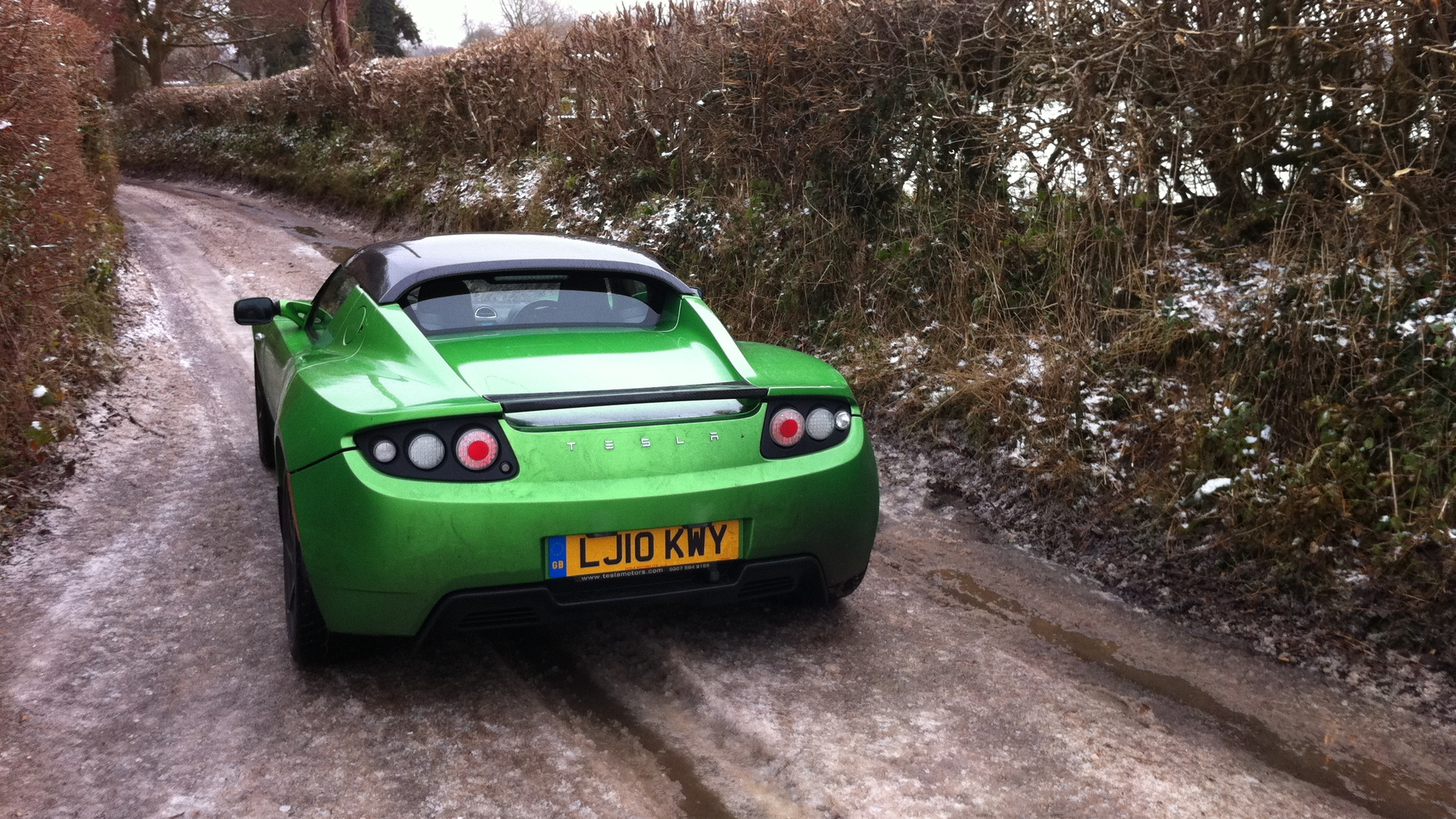
We put on our thermal underwear, grabbed a warm coffee and headed out into unseasonably cold weather with a 2011 Tesla Roadster Sport 2.5 to see just how the sports car coped with ice, snow and a raging cold northerly wind.
As luck would have it our car for the weekend was exactly the same vehicle we borrowed in October, so we were able to draw a good comparison between the two weekends in true Mythbuster style.
Fully charged, warm inside
As we pulled out of Central London and headed west down one of the many freeways radiating out of the U.K’s capital the entire U.K. was under severe weather advisories for heavy snow and extreme cold.
While the temperatures we were set to experience were mild in comparison to a severe north east Winter we were promised temperatures as cold as 14 °F, with daytime maximums barely creeping above freezing point.
But this didn’t phase the Tesla Roadster Sport 2.5. With powerful seat heaters and a fully electric heater providing enough warmth to make the cabin more than cosy, the Tesla forged forward into the encroaching darkness.
Driving snow, not driving slow
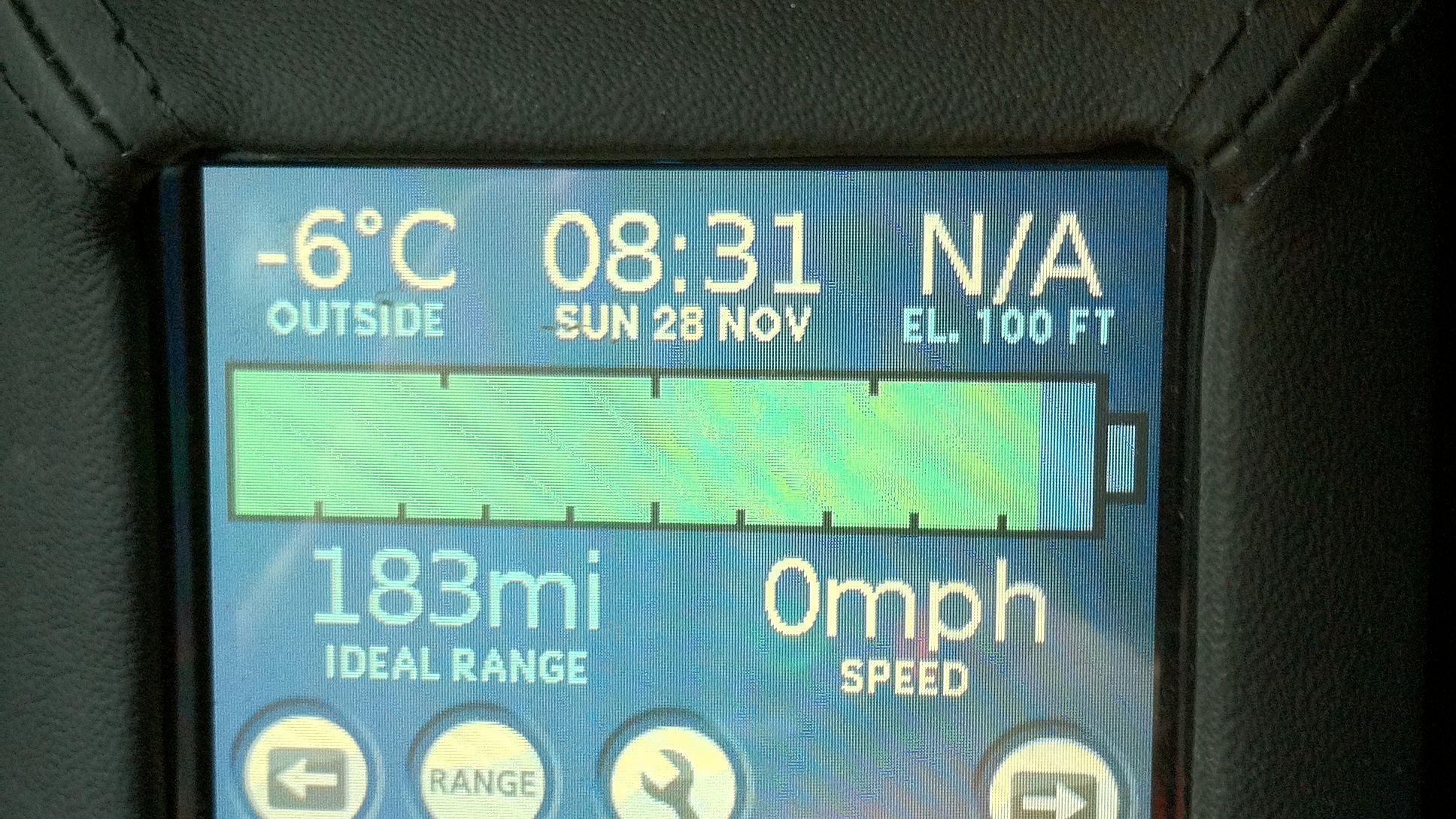
About 40 miles before our destination snow started to fall. Initially light, the snowfall became heavier until our car registered an outside temperature of around 25 °F.
At this point the Tesla, still in Range mode, was predicting enough power for at least another 80 miles. On arrival, the on-board computer predicted a further 40 miles in range mode was possible.
Sure footed
The next day, we took the Tesla on an exhaustive trip designed to give it a thorough working out. First, a 60 mile freeway trip at 70mph, followed by a further 80 mile meandering route through some of the southwest of England’s most challenging roads.
With the temperature below 27 °F for the entire trip and temperatures dropping to an indicated 20 °F while driving through the iconic Cheddar Gorge, our test car didn’t put a foot wrong, climbing up the 1,000 feet twisty road with ease.
Computer controlled traction control
Even with the best will in the world we just couldn’t make the Tesla Roadster Sport 2.5 lose grip while driving. The Tesla’s traction control made sure it stayed pointed in the right direction, even when we drove on sheet ice.
In fact, the only way we could force the Tesla to slide around was to find a deserted parking lot and turn the traction control off.
Dead camera before dead car
We’d planned to film our frigid fun, but it turned out our camera equipment just couldn’t handle the cold and switched off as soon as it was exposed to the extreme windchill. No such problems for the car, however, which kept on providing heat, power and entertainment for a whole weekend.
In total we used just over 140 kilowatt-hours of power over the weekend, resulting in a massive 450 miles of snow-filled fun.
We struggled to find a difference in performance, range or energy consumption between our cold-weekend and our mid-Fall test-drive. Whatever we threw at it, the 2010 Tesla Roadster Sport 2.5 kept going.
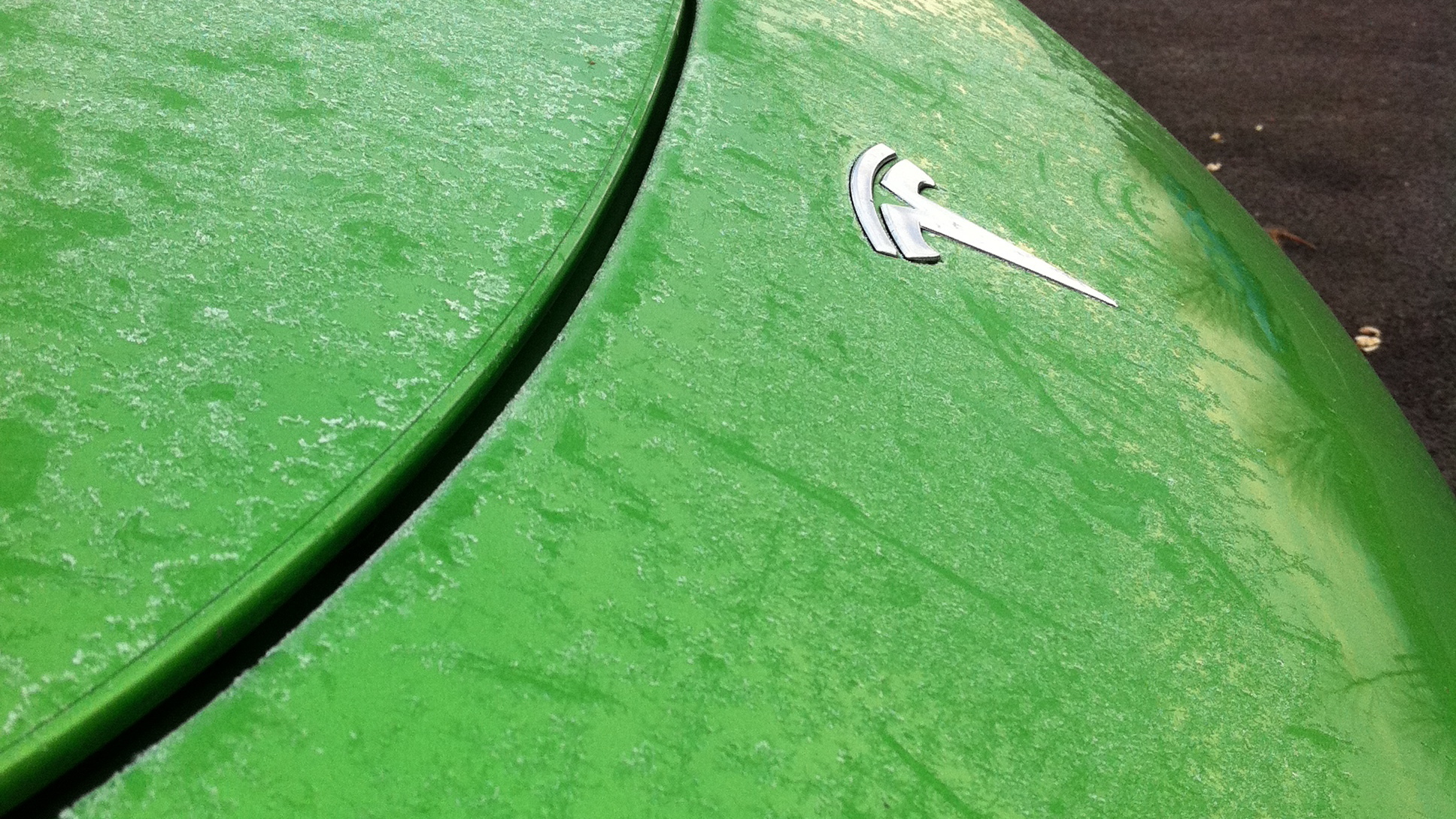
Our only problem? A frozen trunk mechanism after the overnight temperature dipped below 16 °F which required a few hours of driving to thaw out.
Other than that, we’d have to say that Tesla have managed to change our perception of Winter electric vehicle motoring.
Myth Busted.
Have an opinion?
Noel Park Posted: 11/30/2010 12:21pm PST
B-Man Posted: 11/30/2010 1:14pm PST
lne937s Posted: 11/30/2010 3:21pm PST
http://www.nissanusa.com/leaf-electric-car/news/general/nissans_pursuit_for_zero_emission_mobility#/leaf-electric-car/news/general/nissans_pursuit_for_zero_emission_mobility
"The Prairie EV, with no Nissan support or maintenance, served as the daily transportation from the base research station to the town and airport and, most importantly, while conducting meteorological observations. Zero emissions vehicles are critical for such use in order to not contaminate the research data with CO2 emissions."
Good job -- keep bustin' those myths!
Sincerely, Neil
Kevin Sharpe Posted: 12/1/2010 1:45am PST
Sean Phelan Posted: 12/1/2010 4:39am PST
The car wasn't kept in a garage, and we used Range mode charging which I believe uses more power at the wall.
Thermal underwear? I did spend some time outside the car taking photos, but no, it wasn't necessary!
As for the heating, we treated the heating just like any other car, turning it on and off as needed to provide an adequate amount of heat. I would estimate the heated seats were turned on for about half the time, and the heater on low most of the time once an optimum temperature was reached.
As for the icy roads? No, smooth acceleration and sensible corning - although we did try hard to make it lose grip with sudden acceleration many times.
Nikki.
JPW Posted: 12/1/2010 6:20am PST
Don't worry, its three-faze motor guides it easily over eggcorns. . . .
Dan Gilligan Posted: 12/1/2010 6:55am PST
Kevin Sharpe Posted: 12/1/2010 6:55am PST
Robert Posted: 12/1/2010 7:10am PST
http://www.teslamotors.com/roadster/technology/battery
"In general, Lithium-ion cells cannot be charged below 0 degrees Celsius, which would theoretically prevent charging in cold environments. To overcome this cold weather charging obstacle, the Roadster is designed with a heater to warm the cells (when plugged in) to an appropriate charging temperature. If there were no battery pack heater, drivers living in cold environments would have difficulty charging and experience stunted driving performance."
On hot days, it will heat up, especially if you drive it hard. But then Tesla circulates cooling fluid through the pack. That can lower your range by running the A/C compressor; but it's a heat pump so it really doesn't seem to be a big draw compared to pushing the car.
The worst drain in winter is running the cabin heater. It is a resistive heater, so it can draw a fair bit of power (I can't remember the exact number, but I think it's about 3kW). However, between the seat heaters and the small cabin, you don't want to run it at full power for very long, so the drain in practice isn't bad.
Here is a chart showing the worst-case hit to Tesla range assuming the heater--and A/C, and all other accessories--are on full blast:
http://www.pluginamerica.org/drivers-seat/how-far-can-you-really-go-electric-vehicle
Edward Camuffo Posted: 12/1/2010 8:11am PST
Bert Posted: 12/1/2010 9:32am PST
The Nissan Leaf won't come even close to that. I have yet to see any real road tests on the Leaf and I mean REAL road tests.
Go 75 on an AZ highway for 25 miles on a 100-110 degree day with the A/C on. That's typical weather from May into September.
Or in a hilly area of Pennsylvania, New York, or other cold northeastern state in the dead of winter.
Not everyone has a garage. How about it parker outside on a 20-30 degree night with a 30 mile commute?
I'm saying here and now there's going to be some miffed customers when they find out that their $32,000 Leaf is getting a range of 60 miles on highway commute in the winter.
Also, regarding energy usage, note that the Roadster screens report battery-to-wheel energy use which can't be directly compared to EPA wall-to-wheel ratings for the Leaf. If we can also get the energy used to charge after each drive, we can calculate the wall-to-wheel number to compare to other EVs.
L. Dagg Posted: 12/1/2010 11:04am PST
Electric vehicles are inherently more suited to low traction situations since torque can be fully controlled independent of speed, something for which gas engines are poorly suited. Front wheel drive or all wheel drive would be better, and the people I know who drive the front wheel drive Toyota RAV4-EV in the snow rave about how good it is.
Despite the Tesla Roadster's rear-wheel drive, we're getting very enthusiastic reports from Roadster owners driving in the snow.
http://www.teslamotorsclub.com/showthread.php/4738-Winter-Performance
Also, some information about the testing Tesla did on a frozen lake in Sweden in 2007:
http://www.teslamotors.com/blog/slip-sliding-away
scamripper Posted: 12/1/2010 12:10pm PST
R. Stocks Posted: 12/1/2010 12:17pm PST
Thanks,
Robin
true Posted: 12/1/2010 12:30pm PST
Lakawak Posted: 12/1/2010 12:35pm PST
cold Posted: 12/1/2010 1:49pm PST
Do a proper article and discuss how the car drives and performs after it has sat overnight at -30F, with daytime highs getting to -15F then (and only then) will you be able to start to have an educated opinion on cold driving/winter performance.
Kevin Sharpe Posted: 12/1/2010 1:51pm PST
This may not have been terribly scientific but I think it's a good stab at busting the myth...
Caroline Schroder Posted: 12/1/2010 2:17pm PST
It would be no surprise if the Tesla did not do well in high latitude extremes----many gasoline powered cars have their own difficulties in such extremes--or in tropical heat and humidity. The real question which seems to be emerging is how performance, particularly battery performance, may or may not degrade over months, and years, of use.
One other question, however, would you be inclined to favor an on-board charger solution, if one existed, against unexpectedly harsh conditions or on the motorway at 70 mph for prolonged excursions?
Tom R Simenstad Posted: 12/1/2010 2:20pm PST
Bert Posted: 12/1/2010 2:23pm PST
In addition, I'd like to see a follow up article performing this very same test in three or four years with these very same batteries.
ev enthusiast Posted: 12/1/2010 5:27pm PST
the heck with tests. lets get some evs on the road. customers will be the ultimate tests. they will tell us what works, what doesnt work, what needs improvement.
if the first evs dont do well for someone in -1000 degrees, okay. they dont work well for them. there are a gazillion other people for whom they will work well for. lets get the first gazillion in electric vehicles.
then we can start to address the remainder, and what needs to be done to deal with their special situations.
ev enthusiast Posted: 12/1/2010 5:37pm PST
this way the car companies will get honest feedback, and dont risk soiling their reputation with something that doesnt work well enough until improvements are made.
and the users are getting free vehicles, so they wont have anything to complain about. they freely chose to be test pilots.
people like to bitch and moan about problems. there is a solution to every problem, once the problem is known, and not being speculated about.
need i remind everyone that gas vehicles have radiators that can overheat and freeze ? and all sorts of other parts that can break or stop working, that the ev does not have ?
Nikki is really not the right person to do this type of testing. EPA, or Nissan, or some other authority will need to test the range is the right conditions. I wonder if anyone has a dyno that is in an environmental chamber that can go down to -40 F? It would be nice to know the reduction in range with temperature. We all know it will happen, we just don't know how much and at what temperature.
ev enthusiast Posted: 12/1/2010 7:12pm PST
while she may not have experienced "north pole" conditions, it does show that the vehicle did well in a fairly cold environment.
if another environment is more harsh, then we would need to find out what happens in those sorts of conditions.
we dont need to have them survive the sahara desert or the north pole for them to take over 99.999999 % of the world.
as i stated in other threads, it seems obvious to me that our evs will eventually have options on them, regarding weather conditions.
why charge someone on the beach in california for something that is only required for freezing temperatures ? or why charge someone in a cold climate for something that is only needed for hot climates, etc. ?
the customer has a choice. when you buy your battery pack, what sort of climate control do you need with it ?
ev enthusiast Posted: 12/1/2010 7:37pm PST
this way the car companies will get honest feedback, and dont risk soiling their reputation with something that doesnt work well enough until improvements are made.
and the users are getting free vehicles, so they wont have anything to complain about. they freely chose to be test pilots.
people like to bitch and moan about problems. there is a solution to every problem, once the problem is known, and not being speculated about.
need i remind everyone that gas vehicles have radiators that can overheat and freeze ? and all sorts of other parts that can break or stop working, that the ev does not have ?
Arthur Dent Posted: 12/1/2010 7:48pm PST
Kevin Sharpe Posted: 12/2/2010 4:14am PST
Chris Posted: 12/2/2010 6:28am PST
Perry Posted: 12/2/2010 6:43am PST
Kevin Sharpe Posted: 12/2/2010 7:06am PST
Most of us are lay people and can't give you a definitive, scientific, answer. What we can say is that as drivers EV's work for us. Tesla has delivered more than 1,400 Roadsters in at least 30 countries... they are being used in extreme climates today.
Stephen Matthews Posted: 12/2/2010 7:52am PST
Since there are a number of Tesla owners commenting, How is your max range today versus when the vehicle was new? I am interested in understanding how the battery pack is doing over time. Please let me know how many miles you have on your Tesla if you answer. There is a guy in Europe who reported having 40,000 miles on his Tesla. Great, but what has happened to his max range over time.
Lastly, EV's are extremely efficient so small changes affecting operation have big effects on overall range. Winter is directionally bad for EV's. Excluding the cabin comfort issues, the tires are stiffer, the air you drive through is thickner, your oils/greases are thicker, your batteries require thermal mgmt or you lose even more tange.
Brian H Posted: 12/2/2010 9:39am PST
-40°F? That's nuthin'! You should try -40°C!
Oh, wait, they're the same ...
;p
andy Posted: 12/2/2010 10:20am PST
It's something I plan to do as soon as I can!
Nikki.
A Canadian Posted: 12/2/2010 10:53am PST
albert miller Posted: 12/2/2010 11:56am PST
Khadgars Posted: 12/2/2010 1:19pm PST
The problem is when you get to vehicles like the Leaf and other EV's that don't have proper thermal systems in place. I have a hard time believing the Leaf would be able to perform decent at all at freeze or below temps or well above 100F for that matter.
Kevin Sharpe Posted: 12/2/2010 4:42pm PST
Kevin Sharpe Posted: 12/3/2010 7:57am PST
Kevin Sharpe Posted: 12/7/2010 4:34am PST
http://www.facebook.com/album.php?aid=267367&id=18790602800
Kevin Sharpe Posted: 12/7/2010 4:42am PST
Kevin Sharpe Posted: 12/7/2010 4:51am PST
http://www.teslamotorsclub.com/showthread.php/4738-Winter-Performance?p=53554&viewfull=1#post53554
Kent Posted: 12/8/2010 9:05am PST
Nate Posted: 12/14/2010 11:14am PST
Dan Posted: 12/15/2010 6:34am PST
Dave Posted: 1/17/2011 11:57am PST
ROBERT STOCKBURGER Posted: 1/18/2011 9:16pm PST
Gord Posted: 1/20/2011 3:00pm PST
paul Posted: 3/6/2011 1:28am PST
-10 Celsius is warm... that's not winter.
here is a winter chart for cold for you to understand cold **(these temperatures are with the wind chill affect taken into account):
-10 to -20 Celsius - a bit chilly
-20 to -30 Celsius - starting to get cold
-30 to -40 Celsius - cold
-40 to -50 Celsius - darn cold
-50 to -60 Celsius - too darn cold
anything below -60 and your so far north in Canada your near where Santa lives, head back south lol.
Guess What? Posted: 3/29/2011 11:36am PDT
Jim Posted: 3/29/2011 1:19pm PDT
Oh ... real world 6 to 8 inches of snow on ground with sleet and snow on the roads ... now that is real world, lets try that test next I can not wait!
Lorin Coulombe Posted: 4/3/2011 9:43am PDT
DaveMTL Posted: 4/24/2011 3:26pm PDT
DaveMTL Posted: 4/24/2011 3:30pm PDT
Have an opinion?Join the conversation!