The British have a long history of improbable and unlikely quests. Sometimes they succeed, sometimes they fail.
So the attempt by a group of 20-something engineers to boost the image of electric cars in the public eye by driving the length of the Pan-American Highway in an electrically powered two-seat supercar might not seem so audacious.
Except that they're planning to do it in a car that has no windscreen, and merely 3 inches of ground clearance. And, oh yes, they designed it all themselves to boot.
Electric range: 300 miles
The EV in question, created by the Racing Green Endurance team out of London's Imperial College of Engineering, is an EV with a range of 300 miles-among the highest of any electric car announced or planned.
Still, it's not a car you can just top up with a gallon of electrons if it runs out of juice on one of those long, remote stretches of highway with more grizzlies than drivers.
To test their car and get some early publicity, the group did two complete laps of London's orbital M25 motorway a few weeks ago, traveling a total distance of 265 miles-with 14 percent of battery capacity still left after covering that mileage at highway up to 70 miles per hour.
This past weekend, they planned a further test: a drive from London to Paris on a single charge, a road distance of 284 miles.

Racing Green Endurance team at the start of 280-mile London-Paris run
"Not the most practical...but quite engaging"
The Racing Green Endurance vehicle is based on an adapted racing-car chassis from the firm Radical. Its welded-steel space frame is covered-barely-with low-slung fiberglass bodywork. The cockpit barely holds two adults, and they'd better be friendly, because they sit very close.
Their choice of vehicle, admits the team's PR director, Andrew Holland, is "not necessarily the most practical" vehicle you might choose to navigate 15,000 miles of primitive roads.
But with British understatement, he notes that it's "quite an engaging car"--easily confirmed by the scores of pedestrians snapping photos of it at every stoplight--and asks, "Really, now, would a 4-by-4 get this much attention?"
Errrrr, no, it wouldn't. But there's still that problem of just 3 inches of ground clearance ....
Less power for more durability
The powertrain consists of a pair of Evo electric AC motors, a design so new they're not yet available for commercial sale. These motors have been ‘downwound' to reduce their power output in the interests of longevity and reliability.

Racing Green Endurance electric car, Imperial College, London, June 2010
While the standard Evo motor puts out 150 kilowatts (200 horsepower), each now peaks at 75 kW, with a continuous output of just 44 kilowatts. That's still quick enough to make the car accelerate more quickly than most traffic, owing in part to its weight of just 2,580 pounds (1170 kg). And the motors are designed to run at their most efficient at speeds of 50 to 60 mph.
Each motor, incidentally, drives one rear wheel directly, with no gearing or differential between the output shaft and the wheel hub. This keeps the drive very efficient, and is one of the car's unique features.
Thundersky cells from China
Power for those motors comes from an air-cooled battery pack containing 164 Thundersky lithium iron-phosphate cells, with a total energy capacity of 54 kilowatt-hours. That gives a range of 300-plus miles (480 kilometers), or one-third again that of the 2010 Tesla Roadster, which has a 53-kWh pack, albeit of a very different design.
The Chinese Thundersky cells, they note, are designed to maintain their performance over 3000 to 5000 full-discharge cycles. How'd they come to pick Thundersky over other lithium cell makers? "Because they said yes," said team founder and project leader Alexander Schey candidly.

Racing Green Endurance electric car, Imperial College, London, June 2010
Rather than using Thundersky's control logic, however, the Racing Green Endurance team opted to write their own Battery Management System (BMS) software. They've kept the parameters conservative, to take good care of the electric components during a lengthy and grueling endurance trial.
We experienced the system's limits during an exhilarating 20-minute blast around London's West End and museum district-home of Imperial College, where the members of the team all received their degrees.
After a burst of acceleration by our driver, powertrain engineer Aran Kankiwala, the temperature of one motor spiked above its 100-degree-Celsius limit.
The safety systems promptly shut down the car to protect the motor from any potential overheating, even though we were sitting in the middle of traffic. The two motors can actually operate safely at temperatures far higher than 100 degrees, but the team wants to take no chances.

Racing Green Endurance electric car, Imperial College, London, June 2010
Bad roads, thunderstorms, and moose
That is, at least, unless you consider their choice of vehicle a bit risky for the route they're taking. The Pan-American Highway stretches from Anchorage, Alaska, down through the west coast of the U.S., into Mexico and then Central America, all the way to the southern tip of South America, a total distance of more than 15,000 miles (26,000 km).
Along the way, they'll encounter roads that are little better than trails of crushed stone. They may also meet moose, which weigh most of a ton-and can kill them if they happen to hit one. They'll get snow, and tropical thunderstorms, and stifling heat.
They'll also have to contend with gigantic semi tractors towing multiple trailers, who may not even see a car that's less than 3 feet high and almost silent. The suggestion of a large orange flag to raise the car's visibility seemed intriguing to Kankiwala. For their safety, we hope they consider it.
They'll be wearing full racing helmets to avert the worst effects of hitting mosquitoes the size of golf balls and having gravel tossed up directly at them over the minimal bodywork--since they defiantly refused to fit a windscreen that might block both.
The team does say, cheerfully, that they expect the driving to be arduous.
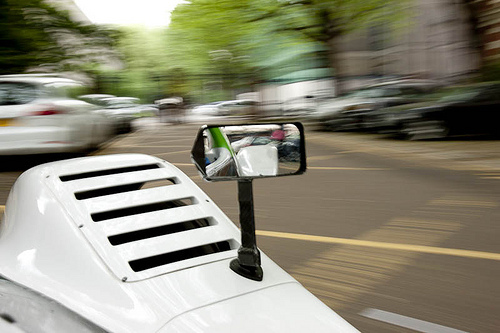
Racing Green Endurance electric car, on the road to Paris
Quiet motor, creaky body
Riding in the vehicle itself is like being in a race car, which is what the Radical started out as. The passenger's head is no more than 30 inches above the pavement, and you look up even at cars as small as Fiat 500s.
The turning circle is huge, requiring muscle-building three-and five-point turns, and while the powertrain is nearly silent--without the motor whine of so many amateur-built electric cars--the bodywork creaks and groans over every imperfection in the road.
This quixotic venture has nonetheless amassed 27 different sponsors, and the team has raised almost £500,000 ($738,500), representing £150,000 ($221,500) in cash and the rest in kind-including the Radical chassis, the Evo motors, and the Thundersky lithium cells.
Just like the college teams of the Challenge X competition, and the contenders in the Auto X Prize, the members of the Racing Green Endurance team have sacrificed a lot.
Their time off, personal lives, incomes, and quite a lot more has gone by the boards while they logged months of 16-to-18-hour days to design, build, and test a car they believe can change the perception of electric vehicles.

Racing Green Endurance electric car, powertrain engineer Aran Kankiwala
"Electric cars are awesome"
The group came together during an earlier project to build an electric go-kart with a hydrogen fuel-cell range extender, while they were still students at Imperial College.
In the words of Andrew Hadland, the team's front man and PR director--he's one of the few members who isn't a mechanical engineer--their basic takeaway from that project was, "Electric cars are awesome; why isn't everyone driving one?"
Founder and project manager Schey initially wanted to compete in an "Around the World in 80 Days" race for alt-fuel vehicles, but that event never came together.
Then the longest highway in the world beckoned, so in January 2009, the team began to design their electric vehicle. And they deliberately made it as striking and noticeable as possible.
Although the car was actually built in a hired garage in Ladbroke Grove, it spends much of its time being shown off to sponsors, students, and the public at Imperial College.
Why do it? "It's all about fun, and excitement, and adventure," says powertrain engineer Kankiwala.

Racing Green Endurance electric car, Imperial College, London, June 2010
Getting students interested too
In addition to changing the public perception of EVs, says Schey, they want to stimulate interest among students in studying electric-vehicle technology.
The goal is to get more engineers to take part in the Mechanical Engineering discipline known as ‘mechatronics,' or the design of systems of computer-controlled electrical and mechanical devices-including hybrid and electric vehicles.
84 days, top to bottom
The Racing Green Endurance team and their car will arrive in Anchorage at the end of July. They've planned 84 days for the entire north-to-south trip. That includes, they admit, about three weeks of contingency time.
They'll have two support vehicles traveling with them to carry repair parts, including at least four spare wheels and tires, along with backup drivers and supporters.
If you're interested in learning more about the Racing Green Endurance team, they have a website, a Flickr site, and a Facebook page. You can follow them on Twitter, and Hadland promises they'll issue regular updates on the progress of their journey.