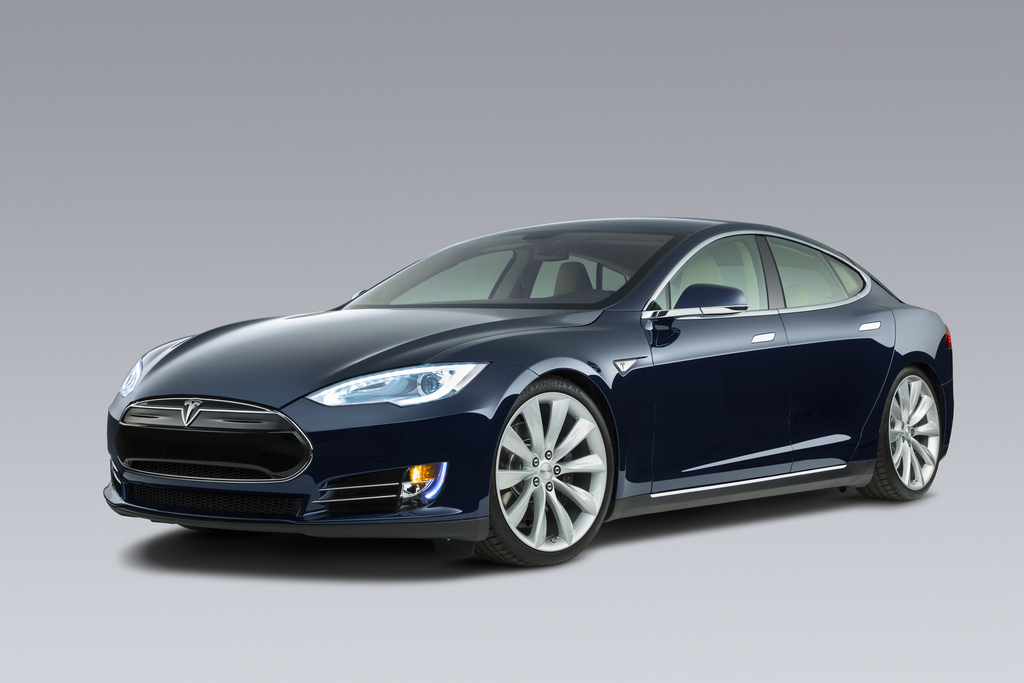
2013 Tesla Model S
Does the supposedly clean, green Tesla Model S really pollute more than a gas-guzzling Jeep Grand Cherokee sport-utility vehicle?
That's what one analyst has claimed.
In an exhaustive 6,500-word article on the financial website Seeking Alpha, analyst Nathan Weiss lays out a case that the Model S actually has higher effective emissions than most large SUVs of both the greenhouse gas carbon dioxide and smog-producing pollutants like sulfur dioxide.
As a 2013 Tesla Model S owner, I was shocked and concerned by his claims.
Although carbon emissions were not a big factor in my decision to buy a plug-in car--I was more interested in performance, style, and low operating cost--the car's green cred was a nice bonus.
Now here's this Weiss guy, calling me a global-warming villain.
But I couldn't help but notice that in his role as financial analyst, Weiss had been advising his clients to "short" the stock of Tesla Motors [NSDQ:TSLA]--to bet against it. (Tesla stock price down = happy clients; Tesla stock up = very unhappy clients.)
And is it a coincidence that the article appeared the same day Tesla stock skyrocketed 30 percent, after Tesla's first-quarter earning report? (It's since risen another 30 percent.)
Weiss's motives aside, his claims deserve a close look on their merits.
Not only the tailpipe
Like all 100-percent electric cars, the Model S indisputably has zero tailpipe emissions.
But Weiss looks at emissions from the powerplants that supply the Tesla's electric "fuel," as well as the excess electricity consumed by the Model S due to charging inefficiencies and "vampire" losses.
These two factors, he concludes, give the Model S effective carbon emissions roughly equal to those of a Honda Accord.
Throw in the carbon emitted during production of the Model S's 85-kWh lithium-ion battery, says Weiss, and the Model S ends up in Ford Expedition territory.
Not so fast....
Although Weiss makes a number of valid points, I see several flaws in his argument. And he bases his carbon-footprint estimates of battery production on a single report that is far out of sync with previous research on the subject.
Furthermore, he fails to account for the carbon emissions resulting from the production of gasoline. If the carbon footprint of a Tesla's fuel counts against it, why shouldn't a standard car's fuel be subject to similar accounting?
So let's go through his analysis and his conclusions point by point.
*Power plant emissions count against electric cars
Virtually all electric car advocate agree that when toting up the environmental pros and cons of electric cars, it's only fair to include powerplant emissions.
When this has been done previously, the numbers have still favored electric cars. The Union of Concerned Scientists, for example, concluded in a 2012 report, "Electric vehicles charged on the power grid have lower global warming emissions than the average gasoline-based vehicle sold today."
The carbon-friendliness of the electric grid, of course, varies wildly from region to region, depending upon the type of powerplants there.
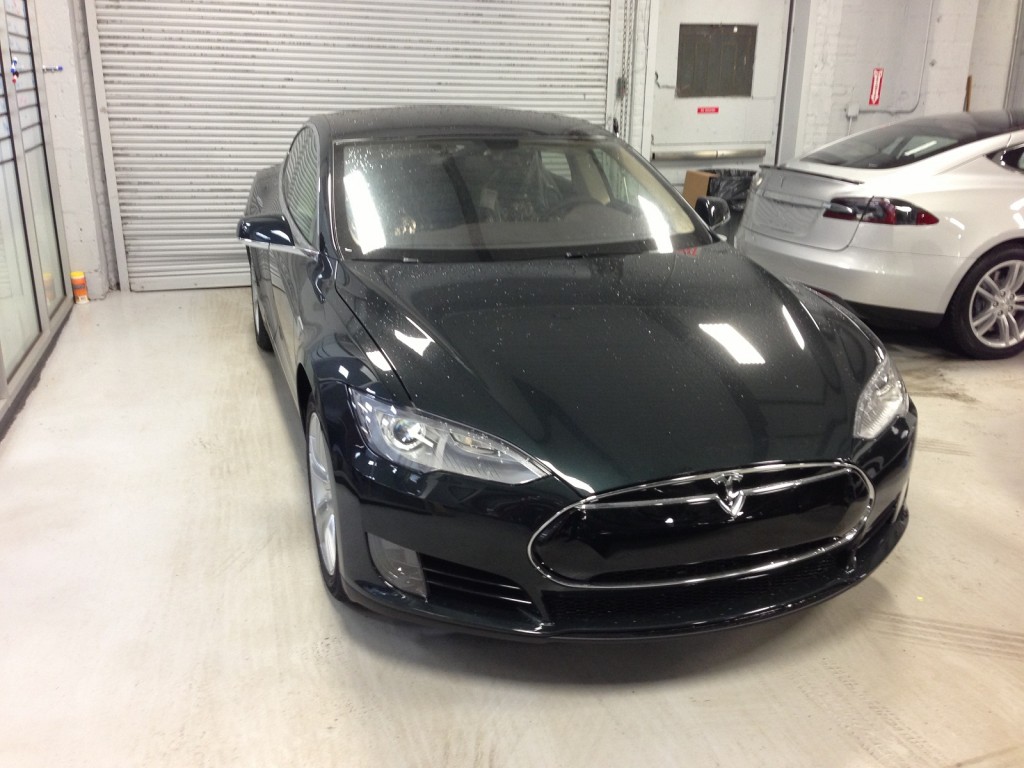
2013 Tesla Model S in Queens, NY, service center, awaiting delivery to buyer David Noland, Feb 2013
Tesla Motors has an interactive calculator on its website that allows you to calculate the effective carbon emissions of your Model S, depending on your particular state's powerplant mix (coal, gas, nuclear, hydro, etc.). The numbers range from 26 gm/mi in Idaho (mostly hydro) to 310 gm/mi in West Virginia (mostly coal).
According to Weiss, the national average for Tesla's claimed Model S CO2 emissions works out to 163 grams per mile (g/mi). Tesla says the corresponding figure for gas cars is 400 g/mi.
Although not truly zero-emission, electric cars in general (and the Model S in particular) are still better than most gas cars. Or so goes the mainstream scientific thinking.
Weiss begs to differ.
*Tesla's numbers are too optimistic
According to the Tesla website, it assumes a Model S electricity usage of 283 Watt-hours per mile for its CO2 calculations. That's the power required to drive at a steady 55 mph.
Weiss disputes that number as unrealistically low. He cites, among other sources, the EPA's number of 321 Wh/mi, as well as 48 reports on the Tesla owners' forum that averaged to 367 Wh/mi.
He concludes that the real-world power consumption of the 85-kWh Model S is actually more like 375 Wh/mi. That's 33 percent higher than Tesla claims.
Accordingly, CO2 emissions would also be 33 percent higher.
I can't argue with Weiss on this one. In 3,000 miles of driving my 60-kWh Model S, I've averaged 343 Wh/mi. Since my 60-kWh car is about seven percent more efficient than the heavier 85-kWh model, that would correspond to a real-world consumption of 367 Wh/mi for the longer-range car.
Because my driving--as well as that of the 48 Tesla owners Weiss cites--has occurred mostly in winter, I would expect average energy usage to decline as the weather warms. (I've already seen my efficiency improve in May.) I'd guesstimate a real-world year-round number for the 85-kWh Model S of 340 Wh/mi.
But I won't quibble with Weiss's figure of 375.
So a 33-percent bump raises Tesla's claimed Model S effective carbon emissions of 163 gm/mi to 216 gm/mi, or about the same as the Toyota Prius V.
*Charging losses boost carbon emissions by 18 percent
Not every kilowatt-hour of energy that comes out of the wall plug ends up in the Model S battery. Citing EPA figures and reports from owners, Weiss estimates the Model S's real-world charging efficiency at about 85 percent.
Again, Weiss has a good point. I've measured charging losses of 10-15 percent in my own car. Tesla quotes a "peak charging efficiency" of 92 percent on its website. An average charging efficiency of 85 percent seems plausible.
That means a Model S typically draws 17 percent more power from the plug than it uses to power the car.
So now our Model S carbon emissions are up to 254 g/mi, slightly less than those of a 2013 Honda Civic.
*Vampire losses further raise emissions by 55 percent
Whoa! This is truly a shocking claim. It implies that vampire losses--the power used by the Model S when it's off, just sitting there in your garage--amount to nearly as much as Tesla claims the car uses while driving.
Weiss, citing a number of sources, (including my own report on Model S vampire losses on this site), settles on a number for vampire losses of 5.1 kWh per day. He then combines that figure with an estimate of 7,728 miles driven per year to conclude that vampire-related Model S CO2 emissions amount to 140 g/mi.
This brings his new total up to to 394 g/mile, about the same as a BMW 5-Series.
I'd call Weiss's number for vampire drain a bit high, but not implausible. I measured at-the-wall vampire losses averaging 4.5 kWh per day on my car.
One reason for Weiss's high-ball estimate may be his apparent misunderstanding of the Model S battery thermal management system. He claims that vampire losses in the 30-to-50-degree range are nearly triple those occurring at temperaturess of 50 to 80 degrees, due to the extra juice required to keep the battery warm.
This is simply wrong. I have noticed no such variations.
And a Tesla rep confirmed to me that the Model S battery is not temperature-controlled when the car sits idle, so there is no battery heating/cooling power draw. (Elon Musk has publicly confirmed this.) The brief pre-heat/cool prior to the once-a-day "topping off" charge cycle would have only a minimal impact on vampire losses.
I also take issue with Weiss's estimate of the Model S average yearly driving distance of only 7,728 miles. (His derivation of the number is too lengthy to analyze here.)
![2011 Chevrolet Volt and 2013 Tesla Model S [photo: David Noland]](https://images.hgmsites.net/med/2011-chevrolet-volt-and-2013-tesla-model-s-photo-david-noland_100427531_m.jpg "2011 Chevrolet Volt and 2013 Tesla Model S [photo: David Noland]")
2011 Chevrolet Volt and 2013 Tesla Model S [photo: David Noland]
How could it be that Model S owners drive barely half as much as the national average of 13,476 miles per year? l know my own driving mileage has actually increased since I got my Model S, simply because the car is such a blast to drive.
It's only temporary
But Weiss's major miscue in the section about vampire power drain--other than misspelling my name--is his implication that these daily losses are a permanent long-term condition.
Tesla has in fact been working on “sleep mode” software improvements to reduce vampire losses. Its next major update, due this summer, is expected to cut vampire losses by half.
By the end of the year, they will be virtually eliminated, according to Tesla spokesperson Shanna Hendricks.
Weiss acknowledges the promised sleep mode, but doubts that it will make any difference. “History (and the mechanics of the battery) suggest it will not meaningfully reduce idle power consumption,” he writes.
I suggest it will. And that by the end of the year, 55 percent of Weiss’s argument will have gone up in smoke.
Anticipating the new sleep mode, I'm going to ignore vampire losses and stick with 254 gm/mi as the Model S carbon footprint, compared to Weiss's vampire-bloated number of 394 gm/mi.
*Battery production adds 39 percent more
The manufacture of a car contributes to its lifetime carbon emissions. And it's well established that the manufacture of lithium-ion batteries is a carbon-intensive process. The question is, how much?
For his battery-production carbon numbers, Weiss relies primarily on an outlier study from the Journal of Industrial Ecology. Its estimates of carbon footprint from lithium-ion battery production are far higher than previous studies, and it has been pilloried in the blogosphere for numerous errors too arcane to enumerate here.
A 2010 study in the journal of the American Chemical Society, on the other hand, concludes that the environmental impact of the battery is "relatively small." It estimates that battery production adds about 15 percent to the driving emissions of an electric car.
A 2012 study for the California Air Resources Board puts the number at 26 percent, assuming the California powerplant mix. But if you adjust to the dirtier national U.S. grid powerplant mix, driving emissions go up. So the percentage share of battery production goes down, also to about 15 percent.
Tesla may, in fact, beat even those lower numbers. Uniquely among electric car manufacturers, Tesla uses what are arguably the most efficiently manufactured lithium-ion battery cells on the planet: "commodity" 18650 laptop cells, which Panasonic churns out by the billions in highly automated plants. (I'm unaware of any carbon life-cycle analysis for these batteries.)
We'll go with the consensus mainstream number of 15 percent, which brings total Model S carbon emissions up to 292 gm/mi, against Weiss's battery-boosted grand total of 547 gm/mi.
Carbon summary
We've arrived at a number for the real-world effective CO2 emissions of a Model S of 292 g/mi. Admittedly, that's lot higher than Tesla claims on its website.
But worse than a Grand Cherokee? Hardly.
The V-6 Grand Cherokee's official EPA CO2 number is 479 g/mi when fitted with the smallest engine offered, a 3.6-liter V-6. The more powerful V-8 model logs in at a whopping 592 g/mi.
Oops...
In a follow-up post a few days later, Weiss backed off and significantly downgraded his estimate for Model S carbon emissions.
He concedes that, in calculating vampire losses per mile, total distance of 12,000 miles per year makes for a better comparison. He also downgrades his estimate of idle power losses to 3.5 kWh per day.
And, strangely, he neglects to account for the carbon footprint of battery production in any way.
![2013 Tesla Model S [photo: David Noland]](https://images.hgmsites.net/med/2011-chevrolet-volt-and-2013-tesla-model-s-photo-david-noland_100427532_m.jpg "2013 Tesla Model S [photo: David Noland]")
2013 Tesla Model S [photo: David Noland]
With these new numbers, he recalculates the Tesla's total effective carbon emissions to be 346 g/mi, not a lot more than the 292 g/mi I calculated above.
Weiss also downgrades his SUV bogeyman, pointing out that even at his revised lower figure of 346 g/mi, the Model S is still a worse carbon polluter than the Toyota Highlander, which the EPA rates at 312 g/mi.
What about carbon from gasoline production?
But for all his zeal in exhaustively parsing the carbon footprint of electricity production, Weiss conveniently forgets to mention that producing gasoline also has its own carbon footprint.
According to a 2000 report from the MIT Energy Lab, gasoline production accounts for 19 percent of the total lifetime CO2 emissions of a typical car. Actually driving the car accounts for about 75 percent of its lifetime carbon output.
Thus the carbon footprint of fuel production adds about 25 percent to a gas car's nominal CO2 emissions number.
Sorry, Mr. Weiss. If you apply the same rules to gasoline cars that you did to the Tesla, your Toyota Highlander just went from 312 g/mi to 390 g/mi.
On this adjusted apples-to-apples basis, the Tesla figure of 292 g/mi is roughly comparable to that of the Scion iQ.
*Other pollutants
With all the growing concern about global warming and carbon emissions, old-fashioned "smog" air pollution--primarily nitrogen oxides (NOx) and sulfur dioxide (SO2)--has receded into the background.
Due to strict emissions laws, modern gasoline cars emit very little of these lung-threatening pollutants. The same cannot be said, unfortunately, about coal-fired powerplants.
Weiss calculates that powerplant emissions give the Model S an effective level of NOx pollution about triple that of the EPA limit for gas cars. (I'm discounting his suspect inclusion of vampire losses.)
The situation for sulfur dioxide is much worse. Weiss calculates that effective Model S sulfur dioxide emissions equal that of about 400 gas cars. (Again, the suspect vampire data is discounted.)
Weiss writes, "In many states, including California, if a smog-testing center could measure the effective emissions of a Tesla Model S through a tailpipe, the owner would face fines, penalties, or the sale of the vehicle under state 'clunker buyback' programs."
In terms of sulfur dioxide, gas cars are so clean and coal-fired electricity so dirty that a 60-watt light bulb effectively emits as much sulfur dioxide as an average gasoline car driving at 60 mph.
Frankly, I can't argue with these disturbing numbers, and I have not seen them refuted anywhere. But they say more about the tough emission laws for gas cars and the remarkably lax rules for coal-fired powerplants belching sulfur dioxide than they do about the Model S.
Nevertheless, I'm feeling a bit guilty about the sulfur dioxide spewing out of my Tesla's virtual tailpipe.
At least I live in New York state, which uses coal for only about 10 percent of its power production. That's about one quarter of the U.S nationwide percentage, so presumably I'm "only" 100 times worse than a gas car when it comes to sulfur dioxide emissions.
Fortunately, I'm not alone; the vast majority of electric cars operate in states with low-coal grids like California, Washington, and New York.
And the grid is slowly getting cleaner. As more wind, solar, and natural gas come online and antiquated coal plants are shut down, my effective SO2 emissions will steadily decline.
So in the end...
After all of this, the conclusion seemed clear: I drive a kick-ass, high-performance, five-seat all-electric luxury sport sedan that has the same wells-to-wheels carbon emissions as a tiny Scion minicar with two real seats.
Anybody got a problem with that?
When it comes to virtual tailpipe emissions, carbon and otherwise, the Model S ain't perfect.
But if you ask me, it's a huge step in the right direction.
David Noland is a Tesla Model S owner and freelance writer who lives north of New York City.
_______________________________________________________
Follow GreenCarReports on Facebook, Twitter, Instagram and Google+.