Sales Of Renault Zoe Off To Strong Start In...
Gasoline, Diesel, Hybrids And Plug-Ins: The...
Could Small 2015 Chevy City Express Van Offer...
Every month we report on sales of plug-in electric cars, which tripled last year over the total in 2011.
As virtually every analyst and commentator has pointed out, electric cars have done better in their early years than hybrids did in theirs.
So how is it that Car and Driver, the well-known automotive "buff book," seems to suggest that electric cars are doing much worse than hybrids did?
That's the conclusion of a January article entitled, The Spark Is Gone: What's Going On With Electric Cars, which is subtitled, "EVs haven't caught on the way they were supposed to; will they ever?"
By itself, it's a valid question. Certainly the optimistic sales projections by both Chevy and Nissan have not come to pass.
Seasoned electric-car advocates had warned that this might be the case, but their voices were largely drowned out in a surge of electric-happy media coverage.
Inevitably, that has now been followed by a second surge of articles concluding that plug-in cars are a sales failure, painting the landscape in dire tones of gloom and doom.
Deceptive data?
Our quibble is simply with the graph used by the magazine to compare the early sales curves of hybrids versus plug-in electric cars.
The problem lies in the decision to start not with the 2011 model year. That's when the first volume-produced mass-market electric cars went on sale--the Chevy Volt and the Nissan Leaf, which both launched in December 2010.
Instead, the author (or infographics person, we're not sure) chose to start the graph in 2008. That's when the first electric car sold with a lithium-ion battery pack first went on sale.
Only 2,500 Roadsters for life
That car was the seminal Tesla Roadster. We don't have its 2009 sales at hand, but the company says 566 were sold globally in 2010 and 669 in 2011.
That's not a volume car by any definition. In fact, Tesla said for years that only 2,500 Tesla Roadsters would ever be built and sold over the car's life.
Moreover, the Roadster was priced at $110,000 and up, against the Toyota Prius, which was priced as a volume car from its first day on sale.
Car and Driver says on its graph, "Below, we've tracked the number of EVs available and their total sales for the past five years. For perspective, we've also charted the same data for hybrids for the first five years after the Honda Insight and the Toyota Prius arrived in 2000."
We think it's a specious comparison to pit the first year of Roadster sales against the first year of Prius sales.
Why not 2011?
If Car and Driver had started its comparison in 2011, when the Volt and Leaf went on sale, here are the numbers the graph would show.
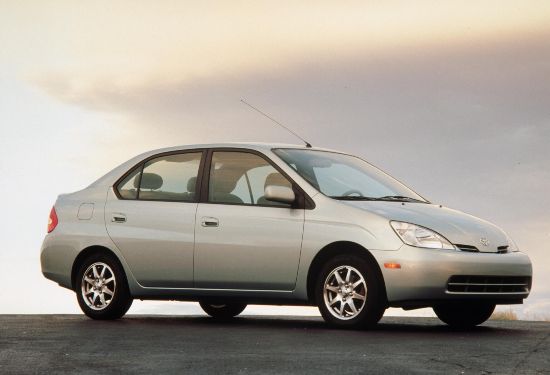
In 2011, at least 17,500 electric cars were sold in the U.S., including 9,674 Leafs and 7,671 Volts--against 5,562 Priuses and 3,788 Honda Insights in 2000.
In the second year on sale, which was 2002, the number of hybrids delivered rose to 20,282 (15,556 Priuses and 4,726 Insights), against roughly 53,000 plug-in electric cars last year.
So how would that graph look now?
We love data, but it's important to understand the context around the data sets you pick to make a point. In this case, we think Car and Driver chose an inappropriate vehicle to start their comparison with.
We invite Car and Driver to redraw its graph, starting the electric-car era in 2011, the first year that plug-in cars were offered for sale in volume quantities.
+++++++++++
Follow GreenCarReports on Facebook and Twitter.
Have an opinion?
Prius sales began in 1997, but it was only available in it's home market of Japan for the first couple of years.
http://en.wikipedia.org/wiki/Prius#Sales
Volt sales began in 2010, but it was only available in it's home market of the U.S. and Canada for the first couple of years.
http://en.wikipedia.org/wiki/Chevy_volt#Global_sales
So if we compare apples to apples, the first 3 years of Volt sales in the U.S. and Canada (32,958) are about the same as the first 3 years of Prius sales in Japan (33,200).
For a completely new type of vehicle, it takes years ramp up sales. For example, the Prius didn't break 100K units/yr in global sales until it's 8th year of production. Let's see what Volt sales look like in 2017.
But for long-term EV fans, the question is really about support from the car companies. If sales are bad enough, car companies may pull away from EVs, which would really indicate a failure.
As long as car companies see enough glimmer of hope to continue with cars that have plugs, I would save EVs are doing well, horse-race or no horse-race.
a rational player and TOYOTA both have plug in EREVs on the market.
Toyota PiPrius and Ford ENERGI line are a solid product and an attempt to gain practical field knowledge and train the sales staff and customers.
Here's the relevant excerpt:
1997
Audi became the first manufacturer in Europe to take a hybrid vehicle into volume production: the Audi duo based on the A4 Avant. The vehicle was powered by a 90 horsepower 1.9-litre TDI in conjunction with a 29 horsepower electric motor. Both power sources drove the front wheels. A lead-gel battery at the rear stored the electrical energy. The Duo was not a commercial success and therefore discontinued, prompting European carmakers to focus their R&D investment on diesels.
http://www.hybridcars.com/history-of-hybrid-vehicles
That was why I didn't point out that the Venturi Fetish had gone on sale in 2006 (for $700,000!). If it hadn't been restricted to cars in the U.S., that would have been as logical a starting point as 2008 for the Car and Driver graph.
Sorry that driving 80-90% in EV mode isn't good enough for the purists out there.
So even assuming we conflate tax credits (which take up to 15 months to realize) and rebates, the $49,900 you describe applies only to California buyers. FYI.
My point is, there are almost no options under $60K. I'm not going to wait a year for a vehicle, ever, and the only versions of the Model S I would consider would be the two upper versions, so not even close to $49K, of course.
My point was also very clearly directed at someone who was attacking either GCR for reporting on PHEVs like the Volt in the EV section, or the drivers themselves. Hence the comment about driving in EV mode 80-90% of the time.
The $60K thing is for mass sales, not me. I'll be in a Tesla, BMW or other great EV when my Volt lease ends. Yes, I'm jealous!
I did learn my lesson and cancelled my subscription the moment I graduated from high school....
And while you can say that it's unrealistic for C/D to compare a $100,000+ BEV to a $20k Prius, the Prius was introduced during a year when the average price of a gallon of regular was $1.70, not twice that or more -
http://www.davemanuel.com/2010/12/30/historical-gas-prices-in-the-united-states/
In short, market break-in for the Prius, a small, noisy car that sacrificed every other driving quality for the sake of fuel efficiency at a time when Americans were enamored of hulking SUVs, may have been tougher than that of BEVs in the post-recession oughts.
If December is the launch month for a car's sales, the first month is almost always vanishingly low (the Volt was an exception). That month's sales are usually irrelevant to the total, so it makes more sense to ignore that first month. My 2 cents, anyhow.
Either way, even though they were all niche cars, I think it's a mistake to compare Insight/Prius sales with say Leaf sales straight up, without recognizing the very different market circumstances they faced. I think the comparison is semi-useful but hardly definitive, as the differences make the comparison too vague. Although each technology has their limitations and advantages, the hybrids can be driven just like any other car; not so with
BEVs, which require many more adjustments by the owner.
You say "EVs are not selling well, period." In comparison to what? Full-size pickup trucks, which sell hundreds of thousands a year? Subcompact economy cars? Two-seat sports cars?
It's unclear what you're basing a subjective judgment on. Please provide your data.
Of course, the fact that they do get the insanely large tax credit but can't pull sales faster than the hybrids tells us something.
"In the second year on sale, which was 2002, the number of hybrids delivered rose to 20,282 (15,556 Priuses and 4,726 Insights), against roughly 53,000 plug-in electric cars last year..." tells us something.
Also, for the record, hybrids qualified for tax credits from 2006 through 2010--though you're correct to say those were not their first years on sale.
The first 60,000 hybrids from each carmaker qualified their buyers for a Federal income-tax credit up to $3,400. That's lower than the $2,500-to-$7,500 range for electric car credits (depending on battery-pack capacity) but hybrids DID qualify for credits for five years.
And what a shocker, a brand new (I know, in recent times, etc...) technology that most consumers are ignorant about seels less at first than a technology that has been around for many years.
Were you also stunned that VCRs still outsold DVD players years ago? Because that's just about as dumb a comparison.
Have an opinion?Join the conversation!