Martin Winterkorn, CEO of Volkswagen AG, speaks at opening of VW engine plant, Silao, Mexico
Enlarge Photo
Hydrogen Aston Martin Rapide Completes First...
Electric-Car Deliveries? Mercedes-Benz Says...
Russian Billionaire's Natural-Gas Hybrid...
2012 Honda Civic Natural Gas Sedan Priced At...
2012 Honda Civic Natural Gas: First Drive
Leave it to the Germans to be blunt.
Volkswagen Group CEO Martin Winterkorn has rendered his company's verdict on the future of hydrogen fuel-cell vehicles: They're not viable.
Fuel-cell cars suffer from a lack of infrastructure, he said, will be far too costly for consumers, and use a fuel that cannot be produced in the required volumes.
As reported in Automotive News, Winterkorn's full statement (through a translator) was:
I do not see the infrastructure for fuel cell vehicles, and I do not see how hydrogen can be produced on large scale at reasonable cost. I do not currently see a situation where we can offer fuel cell vehicles at a reasonable cost that consumers would also be willing to pay.
The CEO made the comment one week ago today, during a press conference question-and-answer session at VW headquarters in Wolfsburg, Germany.
Since 2010, when it launched its first hybrid vehicle, Volkswagen has expanded its lineup of hybrids while simultaneously pushing its TDI diesel technology for fuel efficiency.
The group also plans to launch an all-electric e-Golf version of its seventh-generation Volkswagen Golf, and a plug-in hybrid version of the upcoming all-new Audi A3.
While Mercedes-Benz recently partnered with Ford and Nissan on fuel-cell development, buried in its January announcement was a two-year delay in its plans to offer a hydrogen-powered production car.
Winterkorn's pithy statement neatly lays out the three concerns analysts have had for years over hydrogen, sometimes called "the fuel of the future that always will be".
Fueling infrastructure
As General Motors discovered several years ago during its "Project Driveway" launch of about 100 Chevrolet Equinox fuel-cell vehicles, hydrogen fueling stations don't necessarily fall under any sections of existing municipal zoning codes.
That means that to build one, even in an area or town that wants one (as did White Plains, New York), first the zoning code has to be changed, then the station must be approved, with a lot of public education needed too. (One word for you: "Hindenburg".)
The fully-loaded cost to build a single hydrogen fueling station in an accepting community approached $2 million, insiders say. Roughly 15,000 would be needed to cover the U.S. *if* they were ideally spaced.
Powertrain cost
The auto industry is very good at squeezing cost out of complex electromechanical devices produced in volume. But lately, auto companies seem considerably more pessimistic about the costs to consumers of production fuel-cell vehicles.
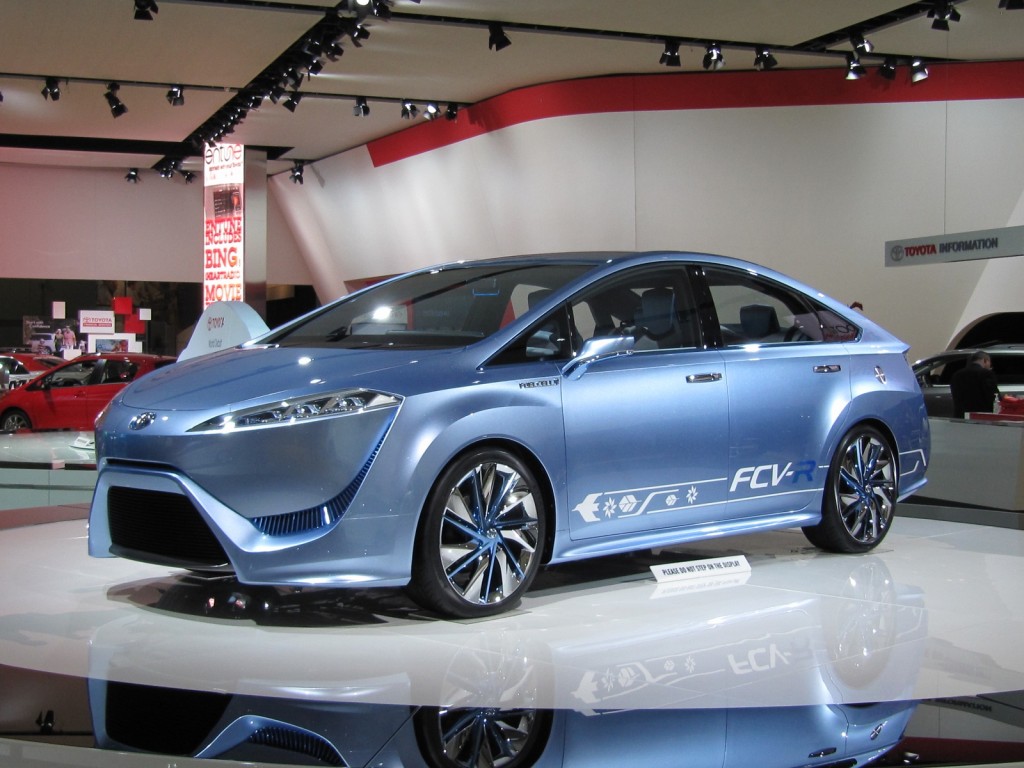
Toyota, for instance, plans to launch a hydrogen fuel-cell car in 2015, and says it hopes to bring the car to market at a cost of $50,000.
Honda says it does not expect its planned fuel-cell vehicles to break even before 2025.
Hydrogen production in volume
Even assuming a distribution infrastructure could be funded, perhaps the most challenging issue for hydrogen as a vehicle fuel is producing it in bulk.
While hydrogen gas is now a byproduct of many industrial processes, it's also used as an input to other processes--so sufficient volumes to fuel even hundreds of thousands of vehicles would require dedicated production.
And because hydrogen is a very good energy carrier, it requires a great deal of energy to produce by separating the hydrogen molecule from the more complex molecules into which it binds--in natural gas, urea, water, or any other compound containing hydrogen atoms.
Question of carbon footprint
As plug-in electric-car advocates frequently point out, using electricity to create hydrogen from any feedstock then gives you an energy carrier that has to be stored, transported, pumped at high pressure into a vehicle, and run through a fuel cell operating at roughly 50 percent efficiency to produce electricity that actually powers the car.
That leads to a carbon footprint for driving a mile on hydrogen fuel that's far worse than simply using the same electricity to charge a battery pack and use that battery to run an electric motor--with roughly 80 percent efficiency between plug and wheels.
So, what do you think? Is VW's Winterkorn right, or will hydrogen have a role as a future vehicle fuel?
Leave us your thoughts in the Comments below.
+++++++++++

Follow GreenCarReports on Facebook and Twitter.
Have an opinion?
1. To power space craft. (Cost is no issue and half the time the launch vehicle is powered by burning hydrogen anyway.)
2. To delay the the introduction of BEV's. (Convincing consumers that the "true" solution to moving away from fossil fuels is just "round the corner".)
I can see why the automotive industry would consider it money well spent, creating test deployments of fuel cells, which increase their credibility as something that might one day happen. They make their money on petrol and diesel engined vehicles. For the most part they don't have either the technical knowledge or will to move to BEV's. At least not yet....
The technology people have done a great job advancing hydrogen fuel cells, but I think the economics, ecology, and infrastructure are still against it.
Facts are even an ICE can be as eff as H2 full system is which isn't saying much. And at a few % of the cost.
Vs EV's that are 65-70% eff. Which do you want to pay for fuel for?
And an EV only needs 1kw of solar PV, now selling for under $1k/kw, sunelec, to power it for 25 yrs!!
http://www.automobile-propre.com/breves/ep-tender-le-range-extender-sous-forme-de-remorque/
Now put a fuel cell on the Tender and a relatively cheap basic FEV can run from the grid 360 days and either hydrogen or gasoline on occasional long trips: this allows fro sharing the fixed cost of the fuel cell amon d 20 cars, ans a progressive buildup of hydrogen distribution with major routes at first.
There remains the cost of producing hydrogen.
Winterkorn is incorrect as is this article. Also, VW supports H2 fuel cells. Winterkorn is just the CEO of VW. That doesn't make him knowledgeable in the field of H2. [e. g. Gerstner, IBM]
Peace
I'd like to have your rebuttal to each of his points, since you feel his point of view is "incorrect". I think that would be a good contribution to the discussion, if you're amenable.
"I do not see the infrastructure...,"
The infrastructure for H2 depends on methods used for production. [H2 can use existing pipelines or be on-demand, for instance.]
"...and I do not see how hydrogen can..."
Recent developments in the H2 industry include generating 11x the H2 by adding one element, dropping H2 through states generating 200x the energy realized from burning it, 30 gal/min on-demand at low energy use/draw...
"I do not currently see a situation where we can offer fuel cell vehicles..." [Winterkorn speaking for himself]
[Advances in electrolyzers advances fuel cells; advances in fuel cells advances batteries; advances in batteries advances fuel cells...]
The above statement may hold true for VW, but for others...
... it can be a different story.
On the other hand...
"VW supports H2 fuel cells"
...Had you continued your reading of the page of the article you cited, you would have discovered their HyMotion demo cars [FC's] program and their partnership with a fuel cell company a week before the statement. [The same company that sold their automotive division to Daimler and Ford]
For the moment, VW is pushing diesel/d-hybrids. There is no need for them to push anything else as they are getting close to knowing what others in the high mileage arena already know or they already know but are not going to talk about it for a long time.
Peace
Heating fuel dealers wouldnโt have to change their tanks overnight. Cars arriving for fuel could probably be filled by the hoses that fill their trucks. Car-fuelโs dealers would presumably add a tank somewhere on their property. New designs for vehicular drive trains donโt take over immediately either. Cars are expensive; most families donโt immediately change cars as soon as they come out, though they might like to. To be honest, they just lack the money.
Would people have domestic storage tanks for their automotive fuel? Maybe some, whose furnaces use it. They would pump it directly into their carโs tank from the big one.
Cars arenโt bought @ $89k to 105k, by a family of 4, struggling on $30,000/yr. A heating gas tank might be outside their home, though. That can probably be rigged to include cars. These would apparently be able to block H2-sized molecules since they work w/ Germany's methane/H2 mix.
All this will be once they are available, perhaps have been around a while, and their prices have approached what todayโs petroleum-powered cars cost (correcting for inflation).
Any other advances also completely apply to EVs, because a HFCV IS and electric car (with a range extender). HFCVs do not offer superior acceleration over EVs, nor do they have more efficient climate controls. And even on cost, HFCV have no advantage, because you can't actually buy one, only lease them. Those that are available the drivers are beta testers, not owners.
Therefore, all modern fuel-cell cars have battery packs to store energy to handle high power delivery when it's needed. Those packs aren't as large as those of battery-electric cars, but all H2FC cars DO actually have them--along with the associated power electronics.
As for electrolysing water with solar + wind, electric-car advocates will ask: Why not use that energy to charge batteries? You get far more road miles per kWh than you do by creating hydrogen.
Maybe in the old days of lead acid batteries.
These days all EVs come with an 8 year warranty minimum, not 5 years. So where does the 5 year number come from? Please enlighten us.
The show where last season they recommended unplugging EVs from charging station just for fun
The problem with Electric cars is that they have a range, it doesn't matter how far they go they'll need to be charged and batteries have never lasted forever, eventually they will need to be replaced and thats not a cheap fare, or envionmentally friendly (If thousands of people a year need new car batteries). Also, what about public transportation, Taxis, a range isn't a good thing for vehicles that need to keep running day and night, and I'd hate if my tax money has to replace thousands of bus batteries because they use the "fast charge" method (That shortens battery life). This is anothor option for those who need more from thier vehicles.
Have an opinion?Join the conversation!