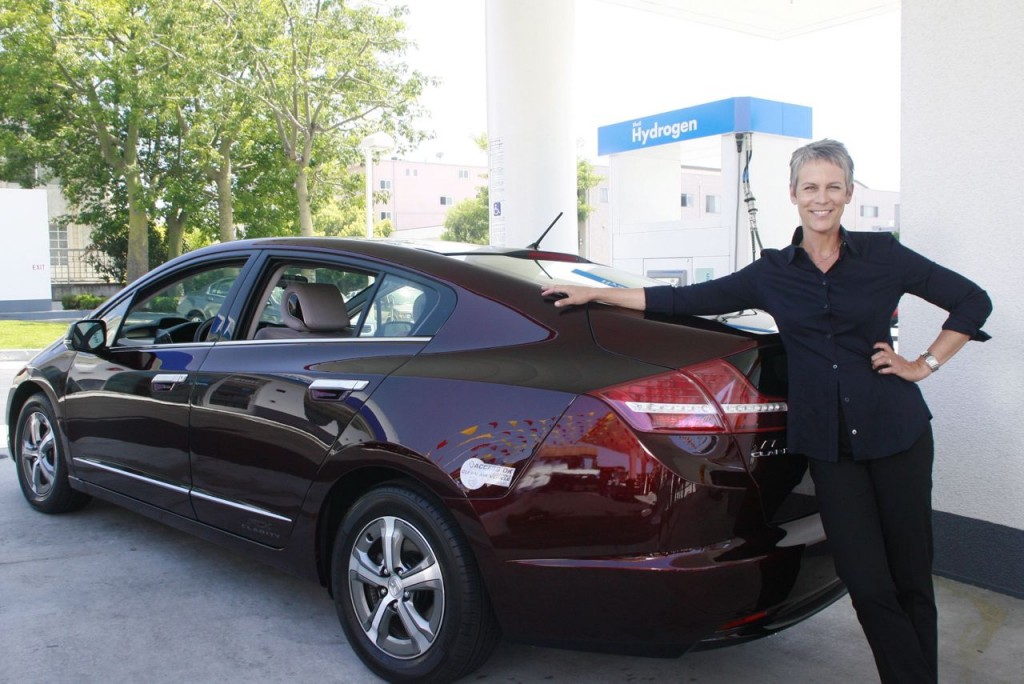
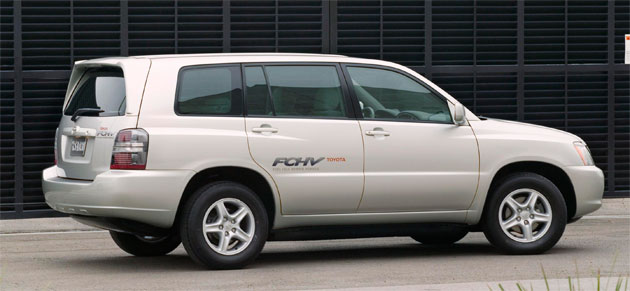
Toyota Highlander Fuel Cell Hybrid Vehicle (FCHV)
Toyota's first production vehicle powered by a hydrogen fuel cell will be a sedan model with the range of a gasoline model, said a company executive last week.
It will be priced at roughly $50,000, and go on sale in 2015.
That's more expensive than upcoming electric vehicles like the 2011 Nissan Leaf, to be priced at $32,800, and the 2011 Chevrolet Volt, which hasn't yet been priced but is expected to cost $40,000 or less. For both cars, a Federal tax credit of $7,500 helps offset the price.
The new date is a year earlier than scheduled due to changes in California's ZEV mandate
Enlarge Photo
The ongoing field-testing of GM's hydrogen fuel-cell-powered fleet involves 3,400 people
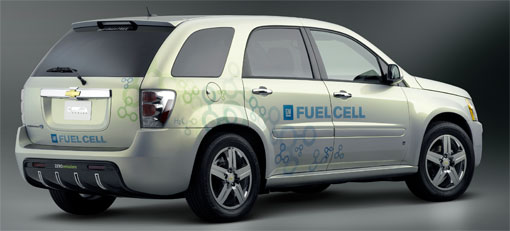
Enlarge PhotoAt a price of $50,000 (minus any applicable Federal and state tax incentives), the market for such a car would be "small," said Toyota's Yoshihiko Masuda. He also indicated that Toyota hoped to cover its production costs at that sale price, but declined to speculate on sales.
Cutting costs aggressively
Toyota's 15 years of experience in developing hybrid-electric vehicles like its iconic Prius may have given it unparalleled experience in squeezing out costs from new propulsion technologies.
Indeed, Toyota says its cost to build a hydrogen fuel-cell vehicle has fallen 90 percent in less than 10 years, from as high as $1 million apiece for early prototypes. To price that first production car at $50,000, it said, it would have to cut its current cost by half again.
It accomplished this by reducing the amount of platinum in the fuel cell and creating less expensive thin films for the cell, as well as more economical high-pressure tanks to hold the compressed hydrogen fuel.
Test fleets from GM, Honda
Many other carmakers have ongoing hydrogen vehicle programs, including General Motors, Daimler, and Honda, whose FCX Clarity model is the only hydrogen car in "volume" production today.
Honda has now leased almost two dozen FCX Clarities in the Los Angeles area, which currently has 10 hydrogen refueling stations. Many have gone to celebrities, including actors and politicians.
The largest hydrogen vehicle test program is GM's "Project Driveway," which numbers more than 100 Chevrolet Equinox crossovers converted to hydrogen fuel cells on the road. Other makers have smaller fleets of hydrogen vehicles as well.
Many of those makers have said they will offer fuel-cell vehicles for sale by 2015. BMW is reportedly developing a hydrogen hybrid Mini concept, following its experiments with the Hydrogen 7, whose combustion engine could burn either gasoline or hydrogen.
Two problems
We tend not to think hydrogen will be the "fuel of the future," for two reasons. First, its "wells-to-wheels" carbon balance is highly suspect, because it takes an enormous amount of energy input to produce pure hydrogen from more complex molecules.
And second, the utter lack of a nationwide hydrogen fueling infrastructure--and the cost and legal challenges of creating one from scratch--have dimmed the prospects of hydrogen as a widespread vehicle fuel. Such a network would likely cost tens of billions of dollars.
DoE: EVs are the way
Electric vehicles, on the other hand, have at least the basic of a widespread "refueling" system in place already: the electric grid.
As EVs move closer to volume production, the U.S. Department of Energy has granted billions of dollars for EV research in its advanced technology vehicle loan program--but substantially cut funding for research into hydrogen vehicles.
Meanwhile, the latest hope for hydrogen fuel cells could lie in using them as self-contained power stations for office buildings and factories.

Have an opinion?
The usual Toyota oil-fired car costs about $6,000 in materials and labor; Toyota sells it for $30,000, which amortizes design costs, dealer cost, transportation, finance, compliance, etc.; and profit.
Now, Toyota is expecting us to believe that they are anxious to spend research dollars to LOSE money on each fuel-cell hoax???
The Toyota RAV4-EV, still running fine over 100 miles range after 100K miles on Nickel Metal Hydride batteries, only cost $42,000, and Toyota made money on each one.
Here, Toyota is expecting us to forget that the fuel costs $17.75 per kg (gallon gas equivalent); the stack only lasts 3 years (up from 2, dies because of carbon in the air it uses for O2), and when the tanks fail, they cost more than the value of the vehicle.
How gullible do the evil fuel cell folks think we are, anyway??
If you believe in fuel cell hoaxes, just one question: why not CNG?? It's here, now; Toyota made a CNG Camry, and Honda has a CNG Civic, Ford made a CNG car and truck, and any oil-fired car can be converted to CNG; the fuel is clean (you can ride in the car pool lanes, just like an EV!), plentiful, cheap and the infrastructure is already in place.
So, if you have fantasies of fuel cell follies, WHY NOT CNG??
Darryl Posted: 5/10/2010 9:22am PDT
EV advocates tend to gloss over this issue, which is critical to mass adoption by normals. Instead, you hear them say " if there was a fast charger between LA and SF, you can drive for 3 hours, take a 2 hour break, and then complete your trip." Only the most enthusiastic early adopters would even consider that.
Sandy Thomas Posted: 5/10/2010 9:48am PDT
Christof Posted: 5/10/2010 12:15pm PDT
It's so frustrating to see hydrogen get such a complete free ride from uncritical (and ill-informed) mainstream journalists. The result is that the public thinks that hydrogen is emissions free -- completely. It isn't. It's only as clean and emissions free as the source of energy used to produce it.
Electricity for EVS constantly gets hit (as it should) on this. Now, if only the mainstream media would make hydrogen (the 'magic' fuel) pony up on this too. Of course, Honda (which is very clearly anti-EV and pro-hydrogen, just like Big Oil -- and which therefore won't be getting my business again) and Toyota are all fine if we all we continue to see is totally misleading and uncritical coverage of hydrogen and hydrogen vehicles. Honda, along with the Big Oil companies, who want to replace the current completely un-democratic, top-down fueling structure we have now with another one just like it. The centralized hydrogen fueling system contrasts sharply with EV-PV, which one can do by oneself, as Doug K.(above) already does!
americanengineer Posted: 5/10/2010 6:37pm PDT
Now if you use steam, you are burning natural gas!!! So once again, you are using, of course, MORE ENERGY TO GET THE H2 THAN THE H2 CONTAINS. This is elementary physics going back to the middle ages: you can't get something for nuttin.
Now if you think you need to refill after each 300 miles, I wonder what kind of day you have?? For long distance, it's better to take a train. I once had a 130 mile commute, it took 4 hours!!
Fuel Cells are an article of FAITH, way to talk to the "faithful". But for those who can still think, ask yourself this: WHY NOT CNG?? Any car or truck can be converted to CNG; it's clean, you get HOV sticker just like an EV; CNG is cheap; the infrastructure is already in place (there are 40 CNG pumps in So Cal); it doesn't require a $100k fuel cell stack that only lasts 3 years, nor high-tech tanks that cost more than the vehicle. Fuel cell vehicles need a battery anyway, because fuel cells don't do regen and don't give instant power.
We call it the "ox", a big, fumbling POS that costs more than 20 standard cars to build. GM is only doing it to cover up their past lies. In 2003, GM claimed to CARB that, if CARB would just let them crush EVs, there would be "thousands" of fuel cell cars in 5 years. Obviously, they failed. Now, CARB is letting them off their past promises again!
There are only 109 OX fuel cell monstrosities, and NOT ONE is owned by the public!
THERE ARE OVER 300 OWNED TOYOTA RAV4-EV, LAST SOLD IN NOV., 2002.
THERE ARE OVER 1000 OWNED TESLAS.
Fuel cells are so stupid, technical people get this little smirk when the gullible mention it. Just a GM-Toyota scam to justify killing the EV.
wintermane Posted: 5/13/2010 4:23am PDT
First off no the fuel cell does not need special h2. One of the advancements made has been to allow the fuel cell alot more ability to tolerate limited contaminates in the h2.
Secondly it doesnt require 70-100 kwh to make a kg of h2 and compress it. it requires under 50 kwh to do this and that number is dropping as they make better units.
Finaly the fuel cell itself doesnt cost much to make. Right now the real cost of one is around 5-8000 bucks. What costs is the lab they make it in and all the techies they employ. By 2015 The real cost of the fuel cell will be around 3000. By 2025 it will be 1500.
What will realy determine the cost of the fuel cell is the point they go from the lab/techie method to the factory/common slob method of manufacture and start making 1 million a year.
Here, Honda only produces .5 kg, enough driving for 30 miles; if the same energy (17 kWh) were instead put directly into an EV, it would yield 70 miles (and only 1/5 the cost of the array!).
Honda and its co-conspirator GM only "places" these FC cars for 9 months, to get ZEV credit; after that, the stacks are ruined.
"...integrated unit to fit in the user's garage, Honda's next generation Solar Hydrogen Station...producing enough hydrogen (0.5kg) via an 8-hour overnight fill for daily commuting [30 miles per day]..."
The fuel cell stack only lasts at most 3 years (up from 2 years), because impurities in the OXYGEN still befoul the stack. To make it work, you'd have to carry tech-grade O2 as well as H2.
wintermane Posted: 5/14/2010 8:21am PDT
All the solar panel does is make sure the system over a week is at LEAST making up for the power the thing consumes each night so they can claim rightly that its carbon neutral. You coulkd just as well have 16 kw of solar and still would only get .5 kg of h2 in an overnight fueling.
David Peterson Posted: 5/25/2010 6:33pm PDT
GreenCarReports feel free to edit the Myths propagated by the commenters. Honestly, the majority of your readers will not miss their input.
Paul Staples Posted: 2/12/2011 6:53pm PST
Where do I begin. Doug, your comments are so pro-BEV, and your knowledge of hydrogen and energy production and costs (demonstrated exceptionally well by Sandy Thomas response to you), it boggels the mind you have the nerve to speak out. You only hurt your side by being so inaccurate. Most recently; Commercial Hydrogen purity is from 99.99% purity to 99.9999% pure. The requirements for fuel cell use is below 99.99% purity. As your cost projections on BEVs vs FCEVs is way off. The FCEV drive system costs are projected to be as low as $60.00/kw in 2015. Batteries are expected to be $300 - $400.00/kw for the foreseeable future. How can you say that BEVs will cost less than FCEVs. I could go on with several more miss-information statements in this column, including the author, but I have a life to live.
Paul Staples
Have an opinion?Join the conversation!