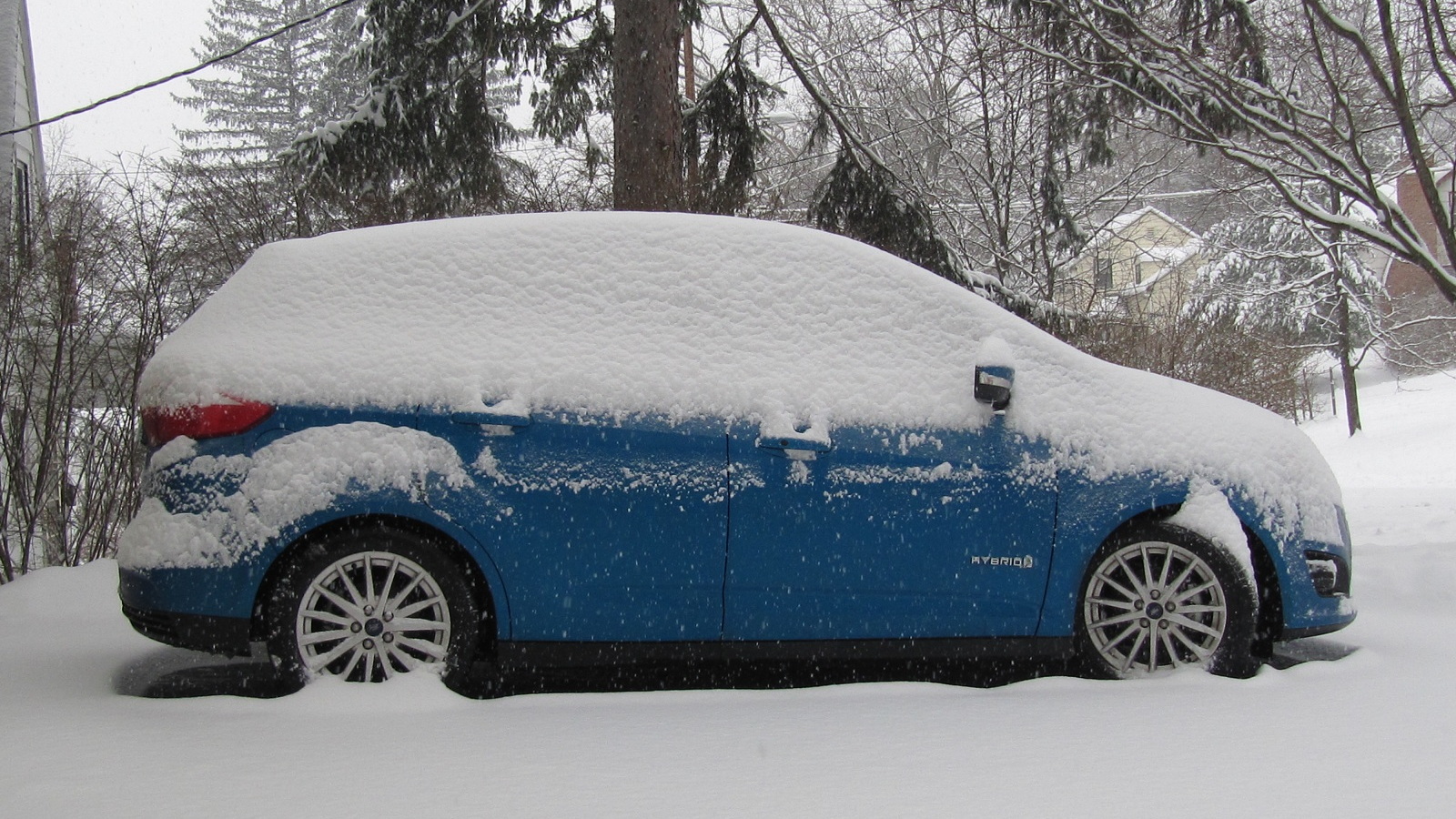
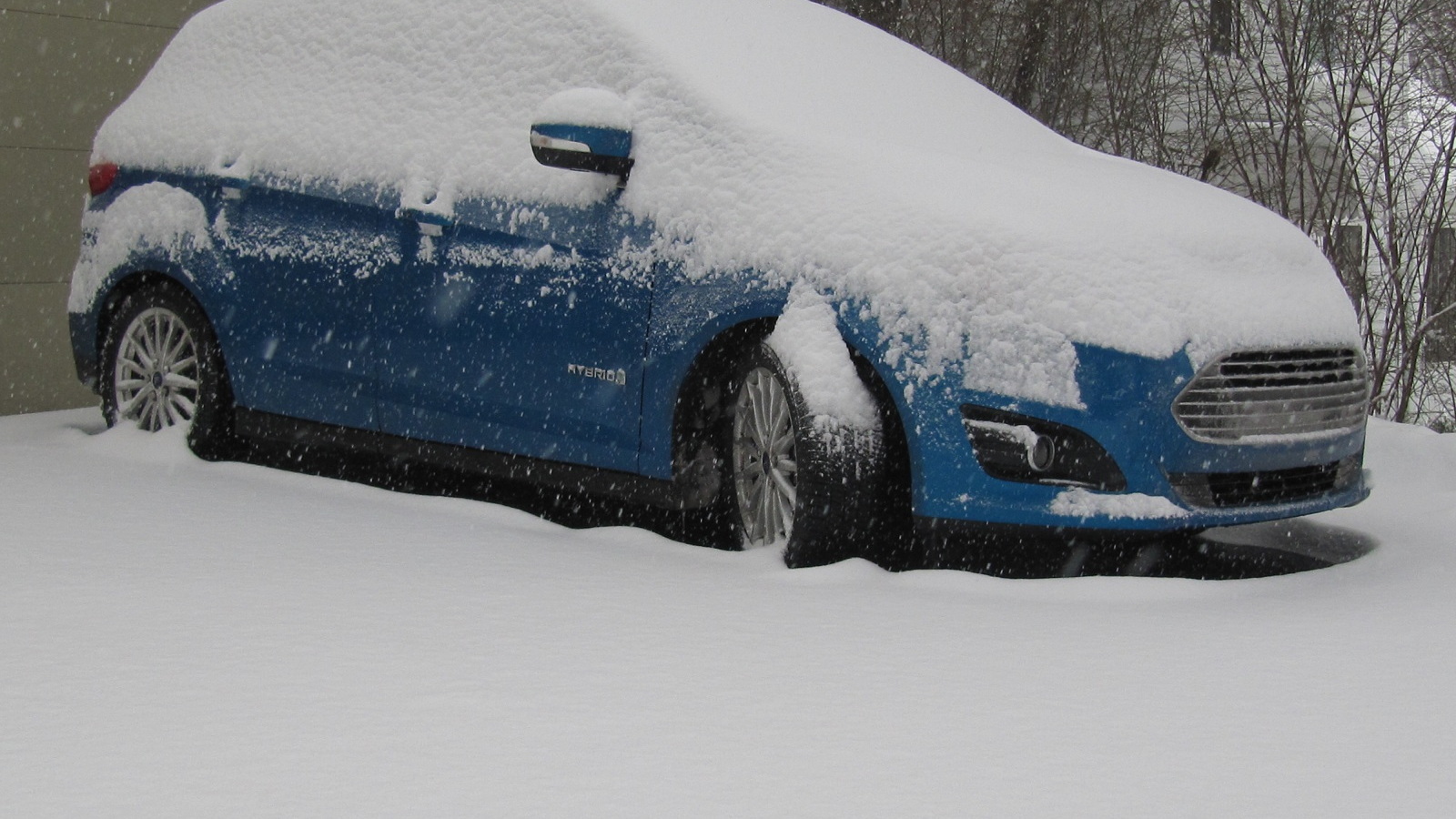

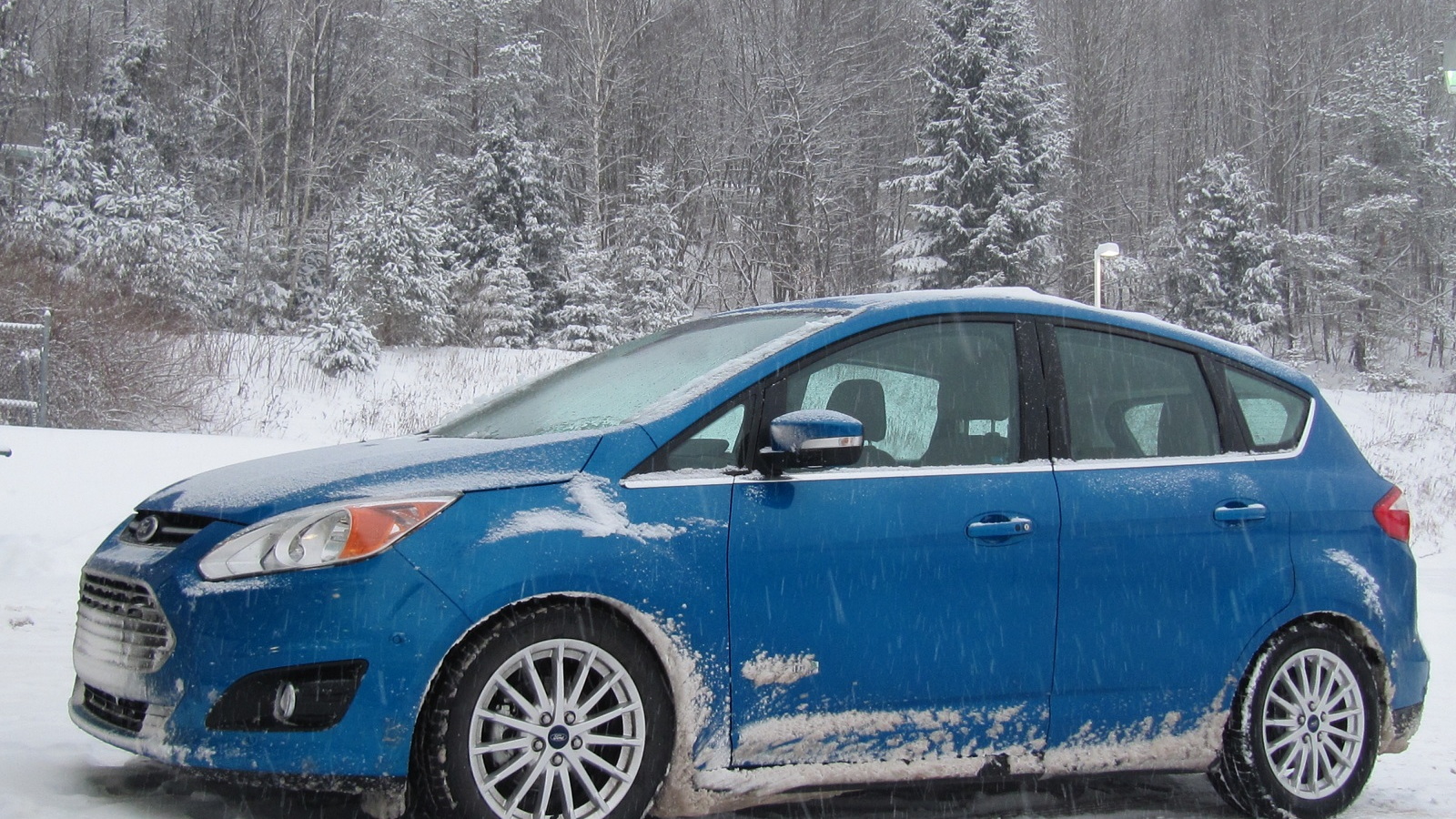
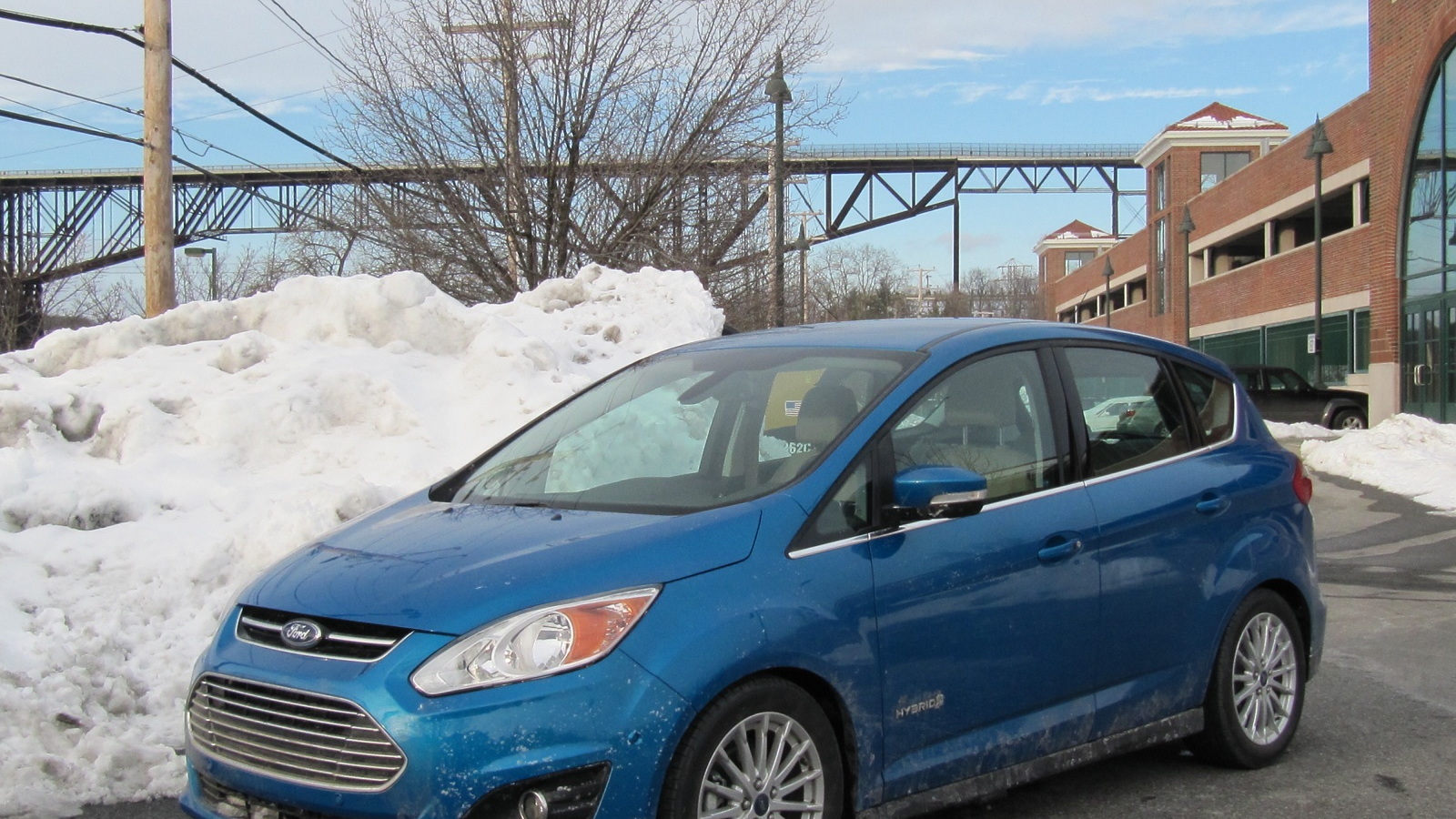
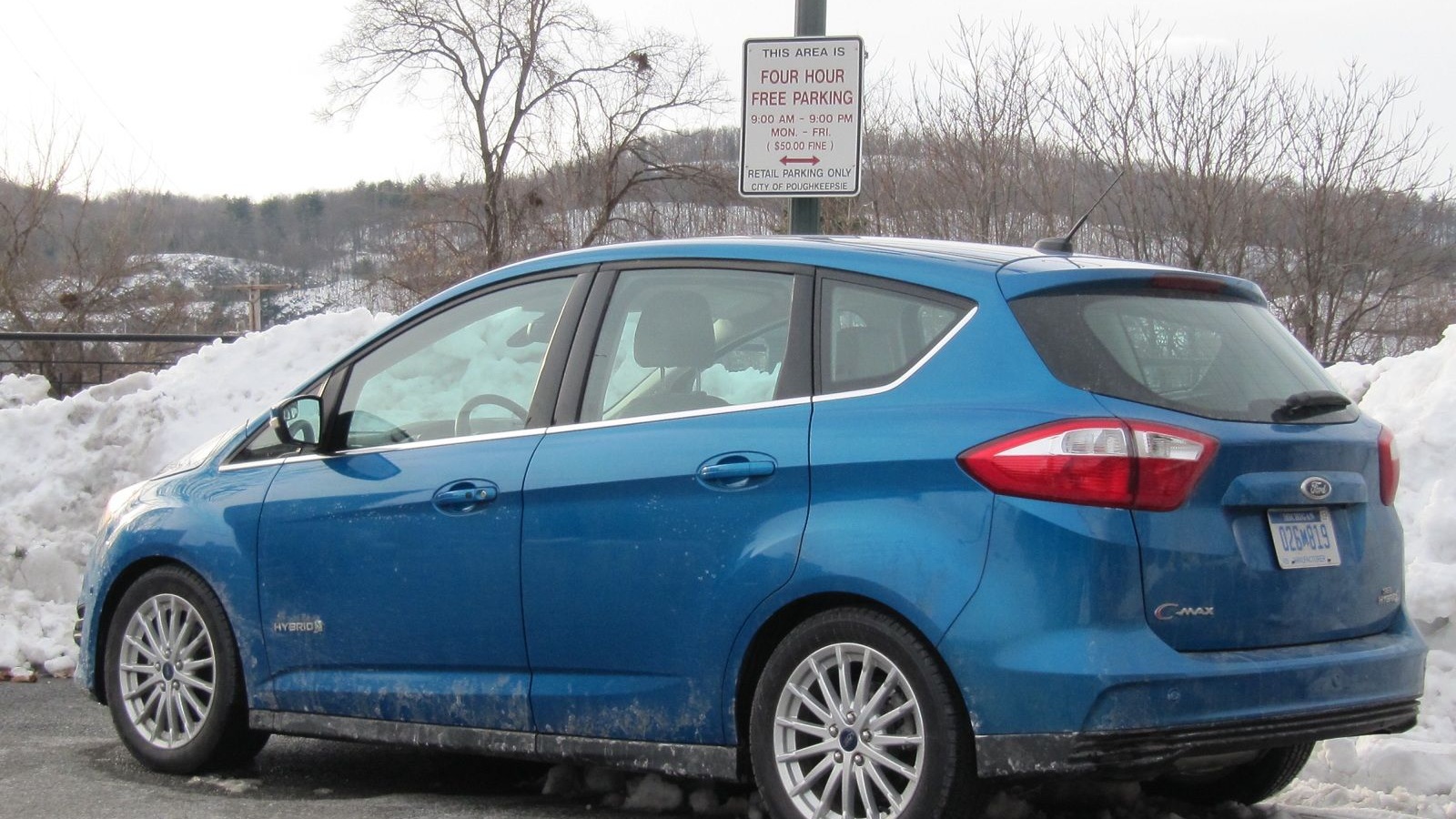
2013 Ford C-Max Hybrid, upstate New York, Dec 2012
The 2013 Ford C-Max Hybrid is a comfortable, quiet, well appointed five-door compact hybrid hatchback that appears to get 35 to 40 mpg in most real-world usage.
But it is not a 47-mpg car, from the bulk of the evidence available.
The C-Max is selling well--much faster than the original Prius did when it first went on sale, as Ford points out--and in many respects, it's a more pleasant car to live with than the Prius.
The engine is far better insulated, so it doesn't rev nearly as loudly and sound so desperate under heavy acceleration.
There's quite a lot more power from the combined hybrid-electric powertrain--188 hp versus 134 hp for the Prius--so it feels somewhat stronger under many traffic conditions.
And the interior is more conventional in its design, and considerably richer in materials than that of the Prius.
But in our experience, the Prius gets real-world fuel efficiency of 44 to 50 mpg in most circumstances. (Not all, but most.) It's rated at 50 mpg combined by the EPA.
And in those same circumstances, the C-Max appears to get 35 to 40 mpg.
That's a high number for a compact car, especially one as capacious as this, and would be admirable--except that the C-Max Hybrid is EPA-rated at 47 mpg combined.
It appears that few owners are able to get anywhere close to the EPA rating, as Consumer Reports and other outlets learned.
The usual caveats apply: Temperature matters, and driving style matters a lot, as do average speed, trip length, and a host of other factors.
But still.
You would expect a heavier, more powerful, and less aerodynamic vehicle (the C-Max) to get rather lower fuel economy than the Prius.
And it appears that's what happens in the real world.
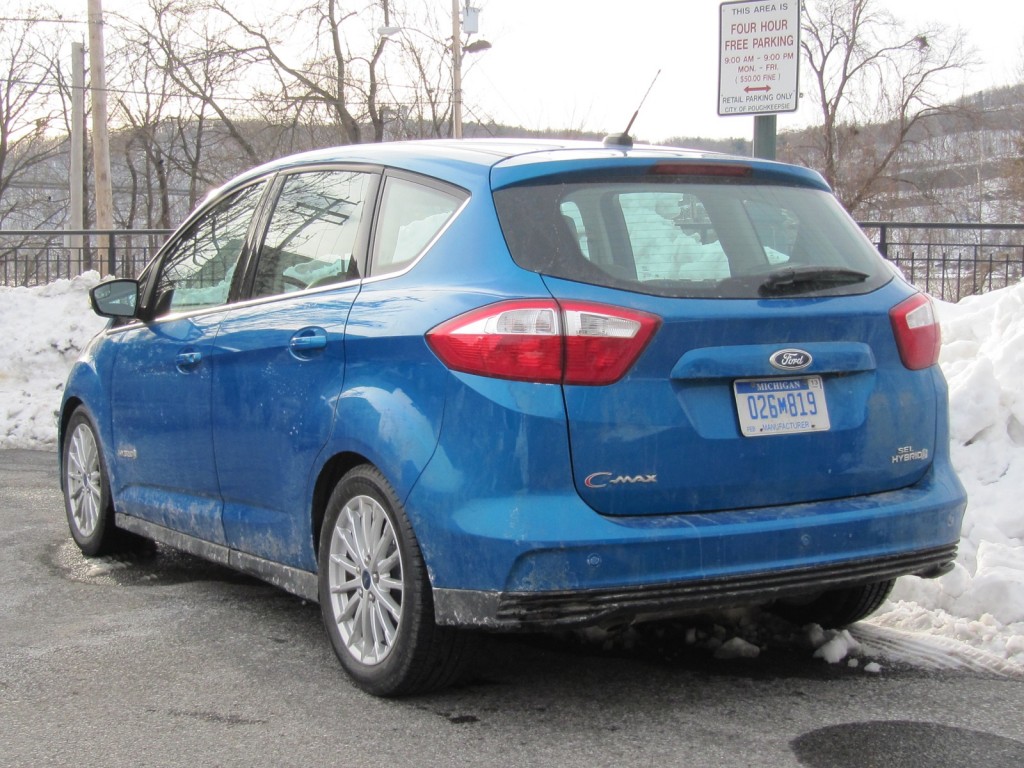
Previously Green Car Reports tested the C-Max Hybrid twice, the first time at Ford's media drive. We got 37 mpg over 50 miles of mixed freeway and urban driving.
The we got a C-Max to test over a quick weekend route that was meant to be a full road test, but had to be cut short for unrelated reasons. That time, we got 40 mpg over 240 miles, mostly at freeway speeds.
To spend several days of varied use with a C-Max, we borrowed one over the end-of-year holidays--the same one, as it turned out, we'd borrowed last fall.
And we blended freeway driving, snowy weather low-speed driving, running around town, and everything else into a six-day test that covered 650 miles.
The results? Over that distance, we achieved 34.5 miles per gallon. That mapped closely to its lifetime gas mileage, which--according to the end-of-trip readout--was 35.5 mpg.
By that time, the C-Max had 5,600 miles on it, hardly a new car, so we assumed it was fully broken in. Of that distance, 1,574 miles (28 percent) had been covered solely on electric power.
Hybrids get notably lower mileage in the winter, due to reduced battery performance and greater use of power-sapping heating.
So we'd expect the same route at the same speeds to produce fuel efficiency readings more like 38 to 40 mpg in temperate spring or fall weather.
On the other hand, a lot of our winter driving was on slippery or icy roads where 30 to 50 mph was the maximum safe speed. In the summer, we could have covered the same ground far faster--cutting fuel efficiency.
Don't get us wrong: We like the C-Max, and we think it's an excellent and competitive addition to the ranks of green cars from Ford.
We just think that its EPA ratings are far less representative of what most owners will get in real-world use than are the ratings for almost any other car--including the Prius lineup.
And we worry that will become a problem for Ford in selling this important new model.
The EPA said last month it will study the issue of C-Max Hybrid gas mileage, as well as that of the new 2013 Ford Fusion Hybrid that shares its powertrain.
Would you take the C-Max, with its advantages, at 35 to 40 mpg over the known-quantity Prius at 45 to 50 mpg?
Leave us your thoughts in the Comments below.
+++++++++++
Follow GreenCarReports on Facebook and Twitter.
Have an opinion?
https://www.facebook.com/photo.php?fbid=4048781410171&set=a.1234956706312.2035660.1001015277&type=1&theater
That is still pretty good.
Winter temperature impact efficiency due to many things. Tires get less pressure, engine needs more time to reach optimal operating temperature, especially with Atkinson cycle engine where the max efficiency is extracted out. If you don't operate it at higher RPM/higher speed, the temperature also sack out more battery power.
A/C doesn't use nearly as much power as heating related power draw. Defrost/Defog are power hogs. Headlight/Heater are all large power draw.
When cars get more efficient, any energy use will show up in the final calculation.
A BEV such as Leaf will fair even worse in the winter.
Defog also kills Volt's EV range as well.
If you park outside then clearly humidity levels will be high enough to create fogging as it preheats.
I use seat heating to reduce reliance on the cabin heater, the mileage isn't hit as hard that way.
But it rains a lot here in Northern California (or Pacific NW) during the winter. Defogging is a "must" feature.
Another way is, of course, to stop breathing during your drive. :-)
But heat is a "killer" too.
I should have noted that I live in the Boston area. So winters are somewhat cold.
I am actually curious on what the percentage is for PIP buyers? Just about every PIP owner that I know are former or current Prius owners. So are all the ones commenting on the newsgroup.
C-Max, Volt and Leaf have all done their share of "conquesting" of other buyers. But how much has PIP done so far? Is it really just "securing" former/current Prius owners?
The fuel cost saved essentially provides lifetime free maintenance on a Prius. (not including the Toyota care thing).
I guess it depends how badly you want to get to 60 2 seconds faster and have a little extra room.
GCR tested the C-Max in the summer, in the fall, and now we've tested it in the winter. And we were careful to indicate all that, along with the things that affect mileage.
That's why we're careful to peg the C-Max at a range of 35 to 40 mpg, just as the Prius seems to return about 45 to 50 mpg for most people. (John Briggs' recordkeeping is superb, but his 42-to-52-mpg spread covers the extremes of all his readings).
The 52 in the summer is a typical mid-summer number, not the highest ever number recorded. The highest number recorded is likely to be due to an error in the automated shutoff at the pump.
The same goes for the 42 mpg in the winter. This is a typical middle of the winter number, not the lowest ever achieved.
Journalists have the challenge of only having vehicle for a short time. I look forward to seeing more Fuelly data.
1. Cold weather can have a 5mpg impact
2. The break-in period for the C-Max Hybrid is 6,000 miles(primarily due to the lithium battery pack) which can cost 5mpg. So there were only 250 miles driving after break-in.
3. C-Max competes with the Prius V(combined 42mpg), not the prius lift back so the mpg comparison with the prius liftback there is not valid.
4. The previous article from the spring, traveling the same route, states testing the C-Max on the freeway was a steady 75mph. But when testing the Prius v, the speed was a slower 58 due to lack of power with the gas peddle to the floor. Understanding the C-Max hybrid drive works up to 62, it would have done much better at a slower 58mph also.
- C-Max Hybrid average mileage range from 31 to 55mpg (most not reaching the 6k mile break in yet)
- Prius v average mileage range from 35 to 53mpg
What's called 'real world' is based on an individual owner's driving habits, and as you can see from C-Max Hybrid and Prius v owners, there is a wide range of driving habits and mpg.
'13 C-Max: 38.6 (Hybrid only, discounting Euro versions)
'12 Prius: 48.7
'12 Prius V: 42.1
So yeah, YMMV, but averages don't lie.
http://autos.yahoo.com/blogs/motoramic/2-000-mile-ford-c-max-hybrid-road-204605768.html
33.5mpg. OUCH!
I think my Volt has done way better than this in extended range mode even during winter with 10% ethanol fuel...
I know the climate in the UK is much less extreme but begs the question.
Ford why did you bother spending all that money developing the Hybrid when you could have spent 25% of that budget marketing a more efficient car (that you already make in multiple regions) to a sceptical US market.
To help you understand U.S.-market thinking on the part of companies like Ford, see this:
http://www.greencarreports.com/news/1051249_five-reasons-small-diesels-wont-dominate-the-u-s-car-market
Note that diesels will be offered for 2014 in two high-volume U.S. vehicles, the Chevy Cruze compact sedan and the Jeep Grand Cherokee sport-utility. Their relative success may offer some indication of diesel's potential in the U.S.
http://www.greencarreports.com/news/1075775_one-in-10-new-vehicles-will-be-diesel-in-2015-bosch-says-heres-why
If v gets more real world mileage (though worse EPA rating) and has a lot more room, why would I get C-Max ?
My findings mimic this exactly. Overall mileage on the trip was 35.3, and in the low 20s a few days it was really cold. Conditions, temp, etc. varied, but never more than 50F, and little wind. Ironically enough, I averaged 38-39 in the mountains of WV. I think that the car is much better than a Prius and I wholeheartedly agree with this article's overall assessment. That said, I'll say what I've (and now most others) have noted all along- 47mpg is a stretch and only under extreme conditions and driving habits could it be done.
I didn't like the way the C-Max bumped up the cargo area floor by 2 inches to accommodate the battery pack. Also, there is no spare tire in the C-Max. You get a Fix-a-Flat can.
I've experience enough failed tires to make Fix-a-Flat a deal breaker.
On top of that, I got a $3,000 better deal on a equivalently priced Prius v.
The fuel mileage difference between the two vehicles was irrelevant in my mind.
Onward!
This is winter where it is cold and he used heat the entire way.
When he arrived in the Venetican Hotel in Vegas, he got a free charging as well.
I concur with findings listed above. I purchased a C-Max on Dec-18-2012 and have driven 860 miles. I applied all recomendations from ford on increasing fuel mpg, momitoring my driving chareteristics via "green Leave"and on board accel, braking, and crusing montioring tools. I am averaging 35.6 MPG and have both highway and city mixed into analysis. Very DISAPPOINTING. I was about to call the dealer ship to see if there is a adjustment needed to the onboard computer or? Do you know what options I have with ford? Chromie
Unfortunately my experience in that regard hasn't been good. I have 4800 miles on mine now and I am still pulling- ironically- 35.6. I like you have done everything, even driving with the coach on, and the most optimal output gauge, to no avail.
Worse, I did take mine to the dealership at about 1500 miles and they said they couldn't do anything/ nothing was wrong. The tech told me it could be 15,000 before it gets close to stated MPG.
Honestly, at this stage, I've begun giving up. I hope things will change for you, but I've reached the point where I've accepted 35.5 is all its capable of and just drive it like a regular car. We'll see what happens when the EPA releases it testing on it. Good luck in the meantime.
(btw it will fit with no other changes)
In the end, I think the C Max will continue to be popular and take a portion of the Prius fan base to Detroit.
This all electric range is what I'm really interested in. Anybody else have info. on their real world all electric range?
Thanks.
I thought my 2013 C-MAX would be a Prius Killer? NOT! As a returning Ford buyer I feel deceived. I want to support US companies and US jobs. What was Ford thinking when they published 47/ 47/47 estimates? Based on the advertised EPA estimates, I would have been ok with low 40's but 28-33 mpg is not even in the ballpark. This is not an issue about EPA testing standards, but rather an issue about setting false customer expectations in order to promote sales. Ford's "47MPG" marketing campaign tarnished what should have been the roll out of a truly remarkable vehicle, the CMAX. Real world MPG estimates should have been promoted in the mid-30's.
Peter Fragale
Have an opinion?Join the conversation!