![BMW ActiveE electric car at closed NJ gas station after Hurricane Sandy [photo: Tom Moloughney] BMW ActiveE electric car at closed NJ gas station after Hurricane Sandy [photo: Tom Moloughney]](http://images.thecarconnection.com/med/bmw-activee-electric-car-at-closed-nj-gas-station-after-hurricane-sandy-photo-tom-moloughney_100408477_m.jpg)
BMW ActiveE electric car at closed NJ gas station after Hurricane Sandy [photo: Tom Moloughney]
Enlarge Photo
VW Talks Future Tech: Plug-Ins, Natural Gas...
2013 Nissan Leaf: Driven Through Tennessee...
Could Small 2015 Chevy City Express Van Offer...
For many of us, lines at gas stations and homes without power are no more than news, but millions on the U.S. East Coast are still coping with the aftermath of Hurricane Sandy.
Many areas are still without power, and gasoline is a worryingly rare commodity for a transport system utterly dependent on it.
But for many with electric cars, the latter hasn't been such a problem.
Even those without power to homes have been able to charge elsewhere--rather than queueing hours for gas to find the pumps have run dry.
Friend of GreenCarReports, BMW ActiveE owner Tom Moloughney, is one of those still able to travel to work in New Jersey every day.
In fact, it's almost business as usual for him, reports The New York Times.
Between charging at home--using a natural gas generator since the power went out--and charging at his restaurant, Moloughney hasn't experienced any problems on his 100-mile round trip each day.
And Moloughney isn't the only electric car driver avoiding the chaos--those using the three free chargers at his restaurant are likely getting by okay too.
When an earthquake and tsunami struck the east coast of Japan in 2011, meltdown at the Fukushima power plant left huge areas without power.
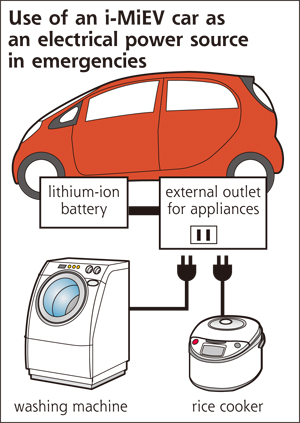
Mitsubishi 'i' Emergency Power Supply
There, the role of the electric car has taken on a different level of importance. With large battery packs, several Japanese carmakers are turning electric cars into backup power units--able to provide electricity to those with zero access to power.
Whether a similar system would work in the U.S. or not is a different matter--North American homes typically use three times the power of their Japanese counterparts. But it may be enough to keep essentials like the refrigerator or cooker up and running during power outages--as Doron Shalvi has found, using his Nissan Leaf as a power source.
Not that electric cars are perfect in disasters.
If power is truly out, then it's only a matter of time until your EV runs out of juice. Even worse, the car itself could be underwater. Or its charging station submerged.
But in some parts of New York and New Jersey right now, electric cars are suddenly making a whole lot of sense.
+++++++++++

Follow GreenCarReports on Facebook and Twitter.
Have an opinion?
Safely feeding the panels DC directly into the car traction battery would require a lot of custom electronics and interconnects -- doable but unrealistic IMHO.
I've looked into this problem a bit in the past, and so far my not-so-optimal but reasonably cheap solution would be to wire the solar panels so that they can be disconnected from the grid-tie inverter, and put in groups of a voltage adequate for regular DC-DCs (150 to 350 VDC). Use either a big one (pricey) or tie a couple smaller ones together to end up with, say, a clean 48 VDC 40+ A. Hook that to a regular 1.5kW+ 120V inverter, which in turns feed the trickle-charger -- and/or possibly other things, e.g. fridge etc.
On/off-grid systems, designed from the get-go for such situations, do exist. However they require batteries and are therefore a lot bulkier, and more expensive to buy and maintain.
I found no standard system which provide "limited, daytime only" backup power, ie without battery.
Hence the above idea to simulate the battery using the solar panels and DC-DC converter(s), when needed. This is mutually exclusive with the grid-tie inverter, and has limited output so it will only power specific appliances.
The problem with Leaf is the fact that it still depends on the electric grid to "fill up" the car. If the grid is down for extended period of time, then you lose "mobility". In this case, some of the owners are able to charge at "work" where there are power. But if there are no power at home or work, then you probably don't want to lose the ability to "leave" if you choose to.
Cars such as Volt or other strong Plugins can operate on either energy source. So, it gives you more freedom. The more choice you have, the better it gets during diasters.
If Volt can be converted to operate on "multi-fuel" it would be even better.
It doesn't have to be the "end of world" situation. I have lived through some of those diasters where there no electric power for over a week and still need mobility.
A Leaf would work in those situation. But most Leaf owners aren't single car owners...
You can see the details at www.evadc.org .
Have an opinion?Join the conversation!