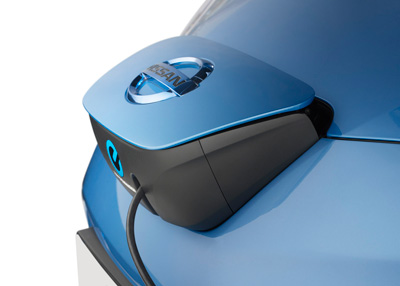
Nissan Leaf Charging Port Cover
Why? Because they haven’t signed up with the right utility plan.
According to a recent survey from the California Center for Sustainable Energy (CCSE)—reported by the Union of Concerned Scientists—nearly one third of plug-in vehicle owners remain on their utility’s standard plan instead of a TOU (time of use) rate.
The idea of TOU billing options is nothing new, and it’s been tested for decades, but only in recent years has it become a widespread billing option for households, thanks to networked (and relatively inexpensive) ‘smart’ meters. In short, you pay only slightly more, typically, for electricity use during peak hours (typically afternoon into early evening) yet pay a deep-discounted rate for off-peak (overnight) use.
According to the CCSE survey (of those who’ve owned plug-in vehicles for six months or longer), most do already charge up at night, when the electricity supply is most abundant (and generation is most efficient). Meanwhile, 71 percent report access to public or workplace charging (or both), while 91 percent say that they’ve installed some kind of home charger and 56 percent received a free or subsidized Level 2 charger.
A difference of $400 a year
The Union of Concerned Scientists sums that the annual savings from switching to a TOU billing option could add up to $400—or as much as $1,000 for some who are really racking up all-electric miles.
The CCSE survey also found that, among plug-in owners, 85 percent were using their plug-in hybrid, electric vehicle, or extended-range electric vehicle as their primary vehicle—covering an average of 802 electric miles per month.
That figure is based on two California utilities—SCE and PG&E—but in Portland, Oregon, where two of us on the High Gear Media staff occasionally test plug-in vehicles, the public utility also offers a plan that could be favorable for EV owners.
“If adding an electric vehicle significantly changes your home electricity use, you may be able to save money by choosing our Time of Use rate plan rather than the Basic Service plan,” states Portland General Electric, advising that an electric vehicle driven 1,000 miles per month may use 250 kWh just for the vehicle.
Run the numbers for yourself
Prices per kWh vary greatly across the U.S., as a quick survey of our staff once indicated. Here in Portland, for instance, residential electricity costs about 13.3 cents per kWh on-peak, 7.5 cents mid-peak, or about 4.4 cents off-peak. That’s potentially a huge savings if you do most of your charging off-peak.
Portland General, like some other utilities, also offers a simple calculator to help determine if TOU billing is for you.
In any case, it helps you take note of how much you’re paying to charge your EV, and to the idea that electricity has different costs—monetary and environmental—depending on the time of day.