2013 Nissan Leaf: Spy Shots Of New...
2013 Nissan Leaf: Longer Range, Faster...
2013 Nissan Leaf: Driven Through Tennessee...
Perry also declined to comment on independent tests conducted by electric-car advocate and Leaf owner Tony Williams, which took place in Phoenix recently and appeared to show range loss comparable to the indicated capacity loss in 12 Leafs tested.
"I understand what he was trying to do," Perry told Green Car Reports, "but it's hard to comment because we weren't there."
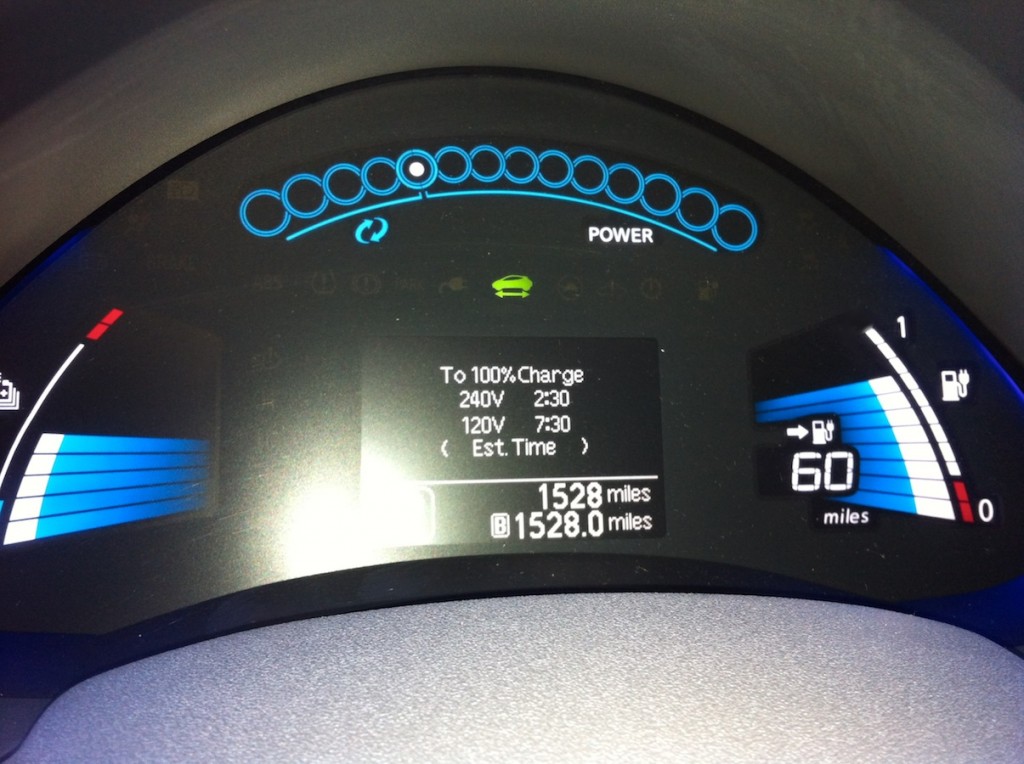
A further issue, Perry said, the battery capacity meter in the Leaf dashboard errs on the conservative side.
Thus, he said, a loss of three of the 12 capacity bars doesn't translate to exactly a 25-percent loss of capacity. In fact, not all the bars represent equal fractions of capacity.
This had previously been discussed by Andy Palmer, Nissan's executive vice president, who alluded to capacity-loss reports as stemming from a faulty battery level display.
Perry wouldn't specify what proportion of pack loss those three bars did represent, saying it could vary with each car's use.
The company would have to dig into its data on each individual pack to get those individual figures for each Leaf, he said.
Communicating with owners
While the Leaf batteries are behaving as the company expected, Perry admitted the challenge may be that the battery capacity losses may not have been what the owners of those electric cars expected.
Our analogy for battery capacity might be something like tire wear: The more miles you put on your tires, the more they wear.
Nissan Americas requires each buyer of a new Nissan Leaf electric car to sign a disclosure form in which the new owner acknowledges that battery capacity will decline over time.
The form also suggests ways the owner can maximize battery life.
Goodwill at risk
And that may be the real issue here.
"This ceased to be a technical issue a while ago, and has long been a goodwill issue," said electric-car advocate Chelsea Sexton, "based in what the drivers perceive as a lack of adequate communication."
And, she continued, if Nissan takes a position that 'there's still nothing wrong with your cars," that message is "unlikely to go over any better than it did the last time they said it."
On the other hand, electric-car advocate Mark Larsen takes a more nuanced view, decrying the angry tone adopted by some of the Leaf owners.
Your mileage may vary?
After analyzing the 12-car independent test data published by the owners, Larsen suggests that, in essence, "your mileage may vary."
His conclusion is that the Arizona heat affects "what data the capacity gauges are gleaning from the pack, but not the capacities themselves, according to miles driven."
This all indicates that there's likely to be much more to come on this story. Stay tuned.
+++++++++++

Follow GreenCarReports on Facebook and Twitter.
Have an opinion?
JB: Of course I want it - I've never seen anything like that and the chicks will be all over it. Here's your hundred dollars! And call me, baby!
Nissan: So, you remember this car you ordered a couple of years ago? It's just missed the tsunami in Oppama and it's on its way. Where's the rest of our money at?
JB: What did you say? I can't hear you! The line is breaking up. Click! ...I was just trippin', man. Now, gimme my hundred back :-)
Nissan states in this article that Leafs in Arizona can expect to get slightly less life out of their batteries.
Food for thought:
If there were also 450 Leafs in Alaska would there be outrage at the low annual average range obtained because of cold temperatures, also warned about in the owner's manual?
If temperature is the sole factor who can explain why the other Leafs in Arizona do not all have the same loss of battery capacity considering that they have all been exposed to the same temperatures?
Is part of the issue with heat due to the lack of liquid cooling, and can we expect better performance from EVs using liquid cooling.
And is the problem with 15,000 miles/year (41 miles/day) more an issue of high DOD (depth of discharge) than the miles? Is taking these LEAF batteries from 100% down to near 0% too often rapidly degrading the batteries, and is this reason to have 150 miles model S and limiting it to 90% of full charging? Does it also show the huge advantage of Chevy's approach of keeping SOC between 20-80%?
For those of us in cooler climates, and shorter commutes, is it safe to get a LEAF?
Honestly, I find this news a depressing reality check.
"UPDATE: After this article was published, Nissan used the actual mileage of the seven cars in the test to provide additional data. "The average mileage for the cars investigated was 19,600 miles, and the average in-service time was 14.7 months," wrote the company's Katherine Zachary. "Average annual mileage [of those cars] is about 16,000 per year, more than double the average Phoenix customer mileage of 7,500 miles per year."
Thought this might add to your discussion.
" Perry wouldn't specify what proportion of pack loss those three bars did represent, saying it could vary with each car's use."
which is saying its not consistent across cars! That means the bars have little predictive value for anyone, anywhere.
Since the AZ test by Tony et al ran the cars to turtle, it does not really matter what the gauge says.. they measured range on a full charge with ranges from 59 to 76 miles before they were towed. Of course Nissan won't comment - it contradicts their "answer" to why there is no problem.
So glad I got a Volt instead. 9500EV miles and same SOC on my R/T, still >50mi per charge!
1)three of the 12 cars exceeded new car specs.
2)some gauges actually were off.
3)that half of the cars were within 5% of new car specs
4)eleven of the twelve were with 10% of new car specs
5)the worst car, the one that traveled 78% of the distance of a new car had 29,000 miles on it.
Using 76 instead of 84 like Tony did you find:
1) three of the 12 cars performed as well as a new car would.
2) half of the cars were within 5% of "new" car specs
3) eleven of the twelve were with 10% of "new" car specs
4) The worst car, the one that traveled 78% of the distance of a new car had 29,000 miles on it.
Russ, instead of endlessly arguing this and insinuating that a deliberate error was made, please take a brand new Leaf, submit it to the same test protocol, and report back your findings. What you will find is that 84 miles correspond to 21 kWh of usable battery capacity, which is typical of a new car. Good luck with it.
10% of the cars tested by Tony had inaccurate gauges, suggesting that 10% of the cars in Arizona may have inaccurate gauges.
They picked a nice round attainable number to market. Range is a function of how you drive. At 80 mph you won't get very far. At 30 mph you can exceed 100 miles. If it were not for the exponential nature of wind resistance, we could all go 40 mph on a bicycle. Yet the concept remains incomprehensible to the average citizen. I saw this coming
statements. A claim has been made that the Casa Grande cars had significantly lower mileage than indicated. As John said in his article, let's see what happens next and hope for the best. Nissan needs to address the issue honestly and heads-on if they hope to be a major player in the EV market.
"UPDATE: After this article was published, Nissan used the actual mileage of the seven cars in the test to provide additional data. "The average mileage for the cars investigated was 19,600 miles, and the average in-service time was 14.7 months," wrote the company's Katherine Zachary. "Average annual mileage [of those cars] is about 16,000 per year, more than double the average Phoenix customer mileage of 7,500 miles per year."
Thought this might add to your discussion.
"UPDATE: After this article was published, Nissan used the actual mileage of the seven cars in the test to provide additional data. "The average mileage for the cars investigated was 19,600 miles, and the average in-service time was 14.7 months," wrote the company's Katherine Zachary. "Average annual mileage [of those cars] is about 16,000 per year, more than double the average Phoenix customer mileage of 7,500 miles per year."
Thought this might add to your discussion.
"I lost my first capacity bar today. Only 6,771 miles. Manufactured 6/21/2011, took ownership 7/25/2011. Received all 5 stars at my first annual. I only charge every other day or so. I start to charge at 6 in the morning and usually leave around 9 so my Leaf doesn’t even spend much time at 80% charge. My Leaf has spent 90-95% of its time between 3 and 8 SOC bars. My long term average is 5.7 m/kwh and I drive on the frontage roads, not the highway, so I never exceed 45 mph. Exclusively in Eco. It is parked under a carport. Tucson is about 6 degrees cooler than Phoenix."
"...capacity bar losses were largely in line with the measured range loss, with some exceptions."
That's what I said.
Nobody said that heat wasn't a major factor.
I read your report. One car had 29,000 miles on it.
Two of the twelve met Nissan specs. One was within 5% of specs. One was within 10% of specs, all but one had more that 80% of original capacity.
New Actual % mileage
80 59.3 74.13% 29,000
80 66.1 82.63% 17,500
80 67.3 84.13% 22,500
80 69.3 86.63% 23,000
80 69.7 87.13% 12,500
80 71.8 89.75% 11,500
80 71.8 89.75% 15,000
80 72.5 90.63% 14,000
80 73.5 91.88% 17,500
80 76.6 95.75% 7,000
80 79.6 99.50% 2,500
80 79.7 99.63% 16,000
I have DOZENS of test runs similar to what we did in Phoenix) on my previous LEAF (and my current LEAF, that the car will go 84 miles. Unfortunately, both 2012's were already down on range from new, which in itself is a HUGE problem (both manufactured in April 2012, and my "Black782" was specifically tested when new, and demonstrated multiple times to meet that 84 mile standard in June 2012)
"...According to Nissan, they are ALL within specs, and normal ...George, actually 4 of the 12 cars were at Casa Grande."
By "all" you mean the four they looked at. I'm sure they were within specs. But because they were not "new" they of course, would not likely meet "new" car specs. There is a big difference between a used battery being within "used battery" specs based on mileage, acceleration, speeds, charge rates, and temperatures, and a battery that is within "new" car specs--a car with one charge that has never moved.
3 of the 12 performed like new, 4 more performed to within 5% of new all but one was within 10% of new.
A car with 12 bars went as far as one with 10, both met new specs.
http://bit.ly/UvBAJd
http://www.casteyanqui.com/ev/capacity_kerfuffle/index.html
1)three of the 12 cars exceeded new car specs.
2)some gauges actually were off.
3)half of the cars were within 5% of new car specs
4)eleven of the twelve were with 10% of new car specs
5)the worst car, the one that traveled 78% of the distance of a new car had 29,000 miles on it.
No one in this comment field has suggested that heat isn't the main contributor, and neither has Nissan.
"UPDATE: After this article was published, Nissan used the actual mileage of the seven cars in the test to provide additional data. "The average mileage for the cars investigated was 19,600 miles, and the average in-service time was 14.7 months," wrote the company's Katherine Zachary. "Average annual mileage [of those cars] is about 16,000 per year, more than double the average Phoenix customer mileage of 7,500 miles per year."
Question, Mr. Perry -- why aren't high mileage LEAFs from cooler climates showing these problems?
Nissan - currently trying out for the part of the villain in the upcoming film, "Who Killed The Electric Car, Part 2".
"...Those projections, based on battery testing during development of the Leaf, assume the car covers 12,500 miles a year, in climates largely similar to those of Los Angeles (50 to 90 degrees F, with an average temperature of 68 or 70 degrees).
Phoenix has also just had one of its hottest summers ever, he noted.
Looking at 450 Nissan Leafs now in Arizona, Perry said, using data each car transmits to a Nissan control center, it appears that Leafs in Arizona are "on a glide path" to average battery capacity of 76 percent after five years rather than 80 percent..."
One guy at today's Plug-in America event in Maryland drove his Leaf over 85 miles to the event. Part of it was 55mph and 50psi tires. But on the east coast, Leafs don't seem to be losing bars.
76.5 miles at that rate of energy use is within 5% of what the Nissan technical bulletin estimates you should have gotten. In other words, there is nothing wrong with your car.
My "information" to you, and the readers who are a bit more open to information, is that my car, Black782, has a range 10% less than when new based on actual performance; not parsed Nissan data.
Whether you spew out "normal", or "within spec", or whatever other platitude you may have, 10% loss within 4 months is just a fact.
You returned one car that you thought was damaged, got another, and although you said on your blog the "car has never been exposed to the heat of Phoenix," you think it is also damaged. What are the odds? I'm an experienced mechanical engineer. Are you familiar with the term "statistically significant sample size?" Did you understand the significance of having one of your cars with 12 bars go as far as one with 10 in a sample size of 12 cars?
http://bit.ly/UvSdoa
http://www.casteyanqui.com/ev/capacity_kerfuffle/index.html
Good point. A quick Google search turned up the headline "Ouch! First Extended Volt Test Yields 33 Mile EV Range and 32 MPG"
I just went back and read the article under the headline: 31.67 mpg city, 38.15 mpg highway, for 35 mpg combined, which does not support the headline, as is often the case. Mileage will vary, and with the Leaf, so will your battery life ; ) Let me rephrase my original comment:
Volt is a fine car if you don't mind the price, four seats, and 38 mpg (combined) on a road trip. I swap my Leaf for my wife's 50 mpg (combined), five seat, Prius for those trips.
Volt also drives far better than Leaf and Prius. I guess if you don't care about handling, acceleration and braking, Leaf and Prius combination is fine. But I will take my Volt over those two in "driving dynamic" anyday...
Some prefer not to pay so much to drag around gas, a gas tank, reciprocating engine, oil, oil filter, oil pump, air pollution control equipment, radiator, radiator fluid, spark plugs, spark plug wires, fuel pump, fuel injectors, and on and on when 99% of the time a Leaf will get you there with none of that.
Meh, Leaf beats Volt 0-30, ergo, Leaf is more fun to drive in the city ; ) http://www.youtube.com/watch?v=rkgio9YvOfo
Sure, Volt has a lot of "baggage" to drag around. But it is also those "baggage" that can get me anywhere I want to go without "pre-planning" it.
Don't get me wrong. Leaf is a nice car. But I like something with a bit more performance. Sure, Leaf is faster in 0-30 by about 0.1 second. But 0-30 is more like an useful thing for neighborhood driving. Most cities are allowing up to 35 to 45mph.
One of the most annoying feature of Leaf to me is that you can't have "eco" mode and "max regen". Volt allow you to drive in L-mode (max regen) regardless whether you are in sports or normal mode...
Keeping max regen in eco mode is a nice feature. Maybe the Leaf will pick up on that. Certainly, I would not recommend a Leaf for a one car family.
Most Volt drivers I talk to are reporting over 40 mpg when the gas engine kicks in. We have both the Volt and the Leaf from January 2011 and our Volt always returns 40+mpg under ICE operation.
You have to compare third party to third party. The EPA is the best source for doing that which gives 38 and 50 combined for Volt and Prius respectively. 38 mpg for a hybrid is an indication of the amount of engineering compromise the design required to achieve 30 miles on just battery power.
I think the Volt is a fine car. I just like to point out what was compromised from an engineering perspective.
Check out cooling degree days in your city and compare it to Phoenix. You will see heat won't be an issue for 99.9% of you.
Thanks for the information.
What you have to do instead is look at the amount of time spend in different 10-degree wide temperature bands, apply Arrhenius Law, and compute the effective temperature. What you will see then is that, roughly speaking, batteries degrade three times faster in Phoenix when compared to Seattle. The daily peaks or even averages have no bearing here.
According to some information an owner gleaned from a conversation with a Nissan engineer, normal degradation seem to be 10% in the first year. Given the climatic patterns, this translates to 5% in Seattle and 15% in Phoenix.
http://bit.ly/citytemprofiles
You claim he is wrong, then say the same thing:
"...roughly speaking, batteries degrade three times faster in Phoenix when compared to Seattle"
either way, the mileage stance is questionable. if you have 20% after 5 years at 12,000 miles a year and the degradation is not linear and assuming 10 the first year and 2.5% the next 5 years and 24,000 miles representing 12.5 % expected loss, then half exhibited more loss.
another note; most had 15,000 miles OR LESS. so the high mileage statement needs a review
The answer is in front of us. It's heat. Not miles.
Clearly operating a vehicle while it is suffering from heat exhaustion will only make a bad situation worse, so yes miles do matter if the car is having a heatstroke.
Nissan are giving us half truths. hopefully they are just buying themselves time until they can engineer a remedy. That hope fades with each passing day.
That is really going to "Help" the case of spreading EVs around the world...
Why doesn't Nissan just add active cooling/heating of the battery like JUST ABOUT EVERY AMERICAN DESIGN FROM TESLA, FORD TO GM...
Personally I prefer Tesla's approach. Sure, I can't afford a Tesla S yet. But I am looking forward to the $30k Tesla.
"...NISSAN estimates that battery capacity will be approximately 80% of original capacity after five years, although this is only an estimate, and this percentage may vary (and could be significantly lower) depending on individual vehicle and Li-ion battery usage...To prevent damage to the Li-ion battery do not expose a vehicle to ambient temperatures above 120 degrees F for over 24 hours."
always just charged to 80%
parked in shade at work and home.
never fast charged
Drive light, average 5.6 miles/Kwh since new
STILL LOST 20% from HEAT in AZ !
Nissan acknowledges that heat is a major factor, and things like high speeds, high annual mileage, etc exacerbate the degradation, as the owner's manual also warns.
If heat were the only factor, there would be 450 Leafs in Arizona with bars missing from their capacity meter.
Nissan projects that Leafs in Arizona will have shorter battery lives. In Fairbanks Leaf owners would have lower than average range because of cold weather.
Nissan has acknowledged that the heat will reduce the battery life in that area. Nobody is saying otherwise.
Nice find on the driver demographics. 15,000+ miles a year ...you people spend a lot of time in your cars.
What we don't know yet is:
1) How much average capacity will be left in five years for Leafs in that area.
2) Is Nissan responsible for compensation considering that the owner's manual and release form both warn that battery life will vary as a function of use and temperature. For example, 19,000 miles at 120 degrees verses my Leaf, 7,000 miles at 70 degrees.
That's all we know for now. The rest is conjecture and anecdotal evidence. Time will tell.
They may have to recall and retrofit 400 cars, or not.
http://bit.ly/leafbatterydisclaimer
"The rate of reduction cannot be assured ...this is not guaranteed. This number may be higher of lower depending upon usage and care. Factors that will affect and may hasten the rate of capacity loss include, but are not limited to: exposure to very high ambient temperatures for extended periods of time etc etc."
"On the July 23rd, when our car was taken to Casa Grande for testing, it has 20,803 miles on the odometer. We purchased our car on March 21, 2011, 16 months prior to the test. This equates to 1300.1875 miles per month or 15,602.25 miles per year.
According to the Federal Highway Administration (http://www.fhwa.dot.gov/ohim/onh00/bar8.htm) the average US driver, in our demographic drives 15,291 miles per year.
I have seen the milage and manufacture date for 3 of the other Casa Grande cars, and they are WELL below 19,000 per year."
"UPDATE: After this article was published, Nissan used the actual mileage of the seven cars in the test to provide additional data. "The average mileage for the cars investigated was 19,600 miles, and the average in-service time was 14.7 months," wrote the company's Katherine Zachary. "Average annual mileage [of those cars] is about 16,000 per year, more than double the average Phoenix customer mileage of 7,500 miles per year."
Owners want to know "what" & "why" some vehicles are effected, even if it is not their personal vehicle. Since reports seem to be constrained to only a few geographical areas; are there plans to supplement instrumentation in a sample of vehicles to quantify the effects of their operating environments? Data would help to ease fears by owners worrying about what appears to be effecting only a small percentage of vehicles.
The average American drives just 1,000 miles more than the 12,500 number assumed for Leafs.
http://www.fhwa.dot.gov/ohim/onh00/bar8.htm
Per Andy Palmer, this is based on 7,500 mile/yr driven, only 60% of what an average car is driven annually.
I can only drive my car 60 miles on a charge now and my car is 15 months old at 15,000 miles. My battery will need replacement at 30 to 36 months when I'll still have another 24 to 30 months of payments on this $40,000 disaster. Why aren't you helping buyers like me Nissan? Please don't buy a LEAF.
Have an opinion?Join the conversation!