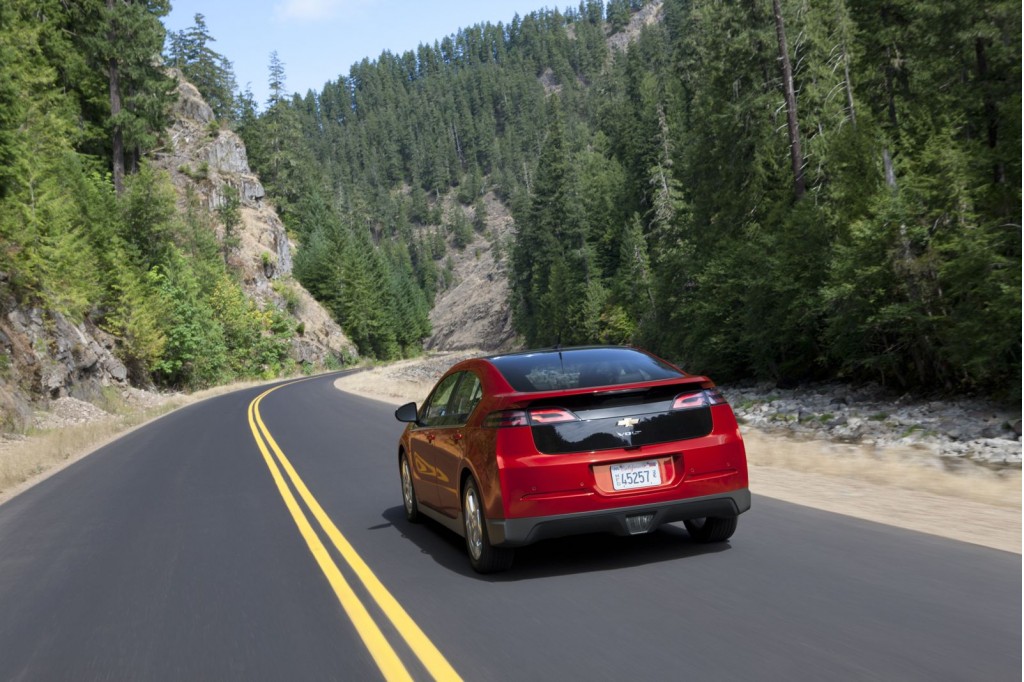
2011 Chevrolet Volt Ultimate Guide
Chevy Volt Production To Halt For 5 Weeks Due...
Could Opel Ampera Outsell Its Sibling The 2012...
Imagine the following scenario: you and your partner are rapidly approaching retirement, looking to downsize your car, and trying to plan for your financial future.
You’re ready to buy a new car, but you want something that’s relatively green and cheap to run.
Could the 2013 Chevrolet Volt offer you everything you need in a retirement car?
Running costs
Many retirees find they only make regular short trips in an average day, with the occasional longer road trip a few times a year.
Thanks to its on-board 16.5 kilowatt-hour battery pack, the Volt can travel an EPA-approved 38 miles per charge without using any gasoline, meaning daily trips out and about town can be made without worrying about gas prices.
For longer trips across state, the range-extending gasoline engine can provide enough range to get you between cities without worrying about recharging.
Better still, because it comes with a 110-volt Level 1 charging station as standard, you won’t have to shell out for an expensive, 240-volt, Level 2 charging station to be installed in your home unless you really want one. It’s worth noting however, that charging at 110-volts takes a lot longer than it does at 240-volts.
Refined, comfortable interior
While the 2013 Chevrolet Volt is no luxury car, its interior is comfortable enough on long trips to keep most passengers happy.
Adjustable, heated front seats also help provide instant heat on cold days, whilst a pre-heating setting allows you to program the car to heat or cool itself up before you get in.
Cabin noise is also kept to a minimum, with transition between electric and gasoline power sources smooth and made without fuss.
When it comes to load space, the Volt’s load bay floor, while easy to reach, only provides 10.6 cubic feet of space.
However, the rear seats fold down to give a more useful, flat load bay area of 18 cubic feet.
Downsized
Because your kids have grown up, left home and have cars of their own, you won’t need a minivan or SUV any more.
And while it’s always nice to have the extra room an SUV offers, you’ll find yourself paying extra for the privilege in gas-bills.
While the Chevrolet Volt is classed as a compact car, its two front and two rear individual seats ensure there’s more than enough room for all but the tallest of drivers and passengers, while adequate lumbar support makes driving it long-distance a pleasure.
Power
Even if you’re retired, it doesn’t mean you don’t like the thrill of accelerating fast.
Although the Volt’s 1.4-liter engine isn’t exactly what you’d call exciting, its 111 kilowatt motor provides more than enough torque to let you out-run all but the sportiest of cars at the stop light.
And because it’s got a continuously-variable transmission, there are no unpleasant automatic gear-shifts to worry about either.
Downsides?
While the Chevrolet Volt does provide comfortable, efficient motoring for those retirees who want to travel beyond the range of an all-electric car, it isn’t the easiest of cars to get in and out of if you have restricted mobility.
Then there’s cost.
Starting at $39,145 before state and federal tax incentives, it also isn’t exactly cheap to buy.
If you’re downsizing from a two-car household to a one-car household however, you may be able to offset some of that high cost with a double trade-in.
Add in the $7,500 federal tax credit and any local incentives however, and you could find that $39,145 drops significantly.
Is it for you?
As always, we recommend you take a test drive before making any purchase decision, but with one of the highest levels of satisfaction of any car on the market today, the Chevrolet Volt could give you many happy years of retirement motoring.
Do you have alternative suggestions? Do you disagree?
Let us know your thoughts in the Comments below.
+++++++++++

Follow GreenCarReports on Facebook and Twitter.
Have an opinion?
It does look nice though. It is on my radar for replacing the Accord in my family. Accord also has a Plugin version coming.
MrEnergyCzar
"While the 2013 Chevrolet Volt is no luxury car"
What is your "definition" of "luxury" car? Ammenity, comfort, performance, quietness, Price?
Which one of those category did the Volt fall short? Was Lexus HS250 and 200CT considered as "luxury" car? If so, why is Volt NOT?
Pay off your mortgage, install home photovoltaic panels and get a plug-in vehicle and your retirement will have way less monthly financial stress.
The Ideal Retirement Car For Independant Thinkers
Most of the Volt pih drivers I talk to say forget the EPA numbers, at 65-70mph on flat highway they get 30 miles electric range before the engine turns on. They say they would like their pih so much better if it had a real 60 mile electric range.
All plug-in vehicle (EV or pih) can charge at level-1, so those words are moot. But it be good to explain your statement of 'a lot longer'. The Volt's level-1 charger (EVSE you carry on-board) is ~1.4kW. Its on-board charger recharges at a 3.3kW (half-powered). That means charging at level-1 is ~2.5 times slower that at a level-2 3kW rate.
Personnally, a 100 mile EV is enough for me.
{brucedp.150m.com}
I am NOT sure where you get the 30 miles number from. Most Volt owners that I talk to or on different Forum get easily 45 miles range with 65-70mph driving on flat. I drive fast and aggressive and I have NEVER get less than 39 miles in range. That was with few 95mph spurs... The ONLY way I can see the range drops to 30 miles is if the owners didn't pre-heat the article and it is really cold outside so the car has to heat the battery and the cabin at 65-70mph... A/C doesn't make too much difference in range, maybe 2-3 miles in reduction with Comfort setting and 1-2 miles in range with Eco.
I agree that 60 miles range would be better (I don't have to charge at home anymore). But that would mean a 25KWh battery and more weight.
should be: if the owners didn't pre-heat the car and it is really cold outside
I don't know where the word "article" comes from... Silly me.
The Level 1 charging is limiting for ALL EVS. That is regulated by the NEC code. The maximum allowable draw is 12A (120V) on a 15Amp outlet sustained...
Charging will slow down (some energy gets diverted) if the A/C compressor or heater has to come on to regulate the Volt battery in extreme temperature condition during charging...
I am MOST eager to see the overall specs on the BMW i3 with the range extender and on the Cadillac ELR, both coming NEXT year.
The 2013 Volt has even more features that we love. $238 a month and not gas bill!
Go drive a Volt and see. Living with one reveals it's true value as you realize you just stopped burning and buying gas.
The most gas we have used was to drive San Francisco-L.A. and back on 12 gallons of gas. Once there, we charged our battery at the hotel, just plugged into a regular 120 volt outlet overnight and drove around on electrons each day. What a marvel this one of a kind car is!
Come on GM lets get this car over 60 mile on electric.
I'm driving a BMW ACTIVE electric car now with 100 miles love the range but would love to have the back up that the VOLT has.
Also, "old" people don't like to fly (at least the ones that I know).
Solvang to SF is about 4 hours (fast and without traffic). And there is NOTHING to do there.
I used to make SF to SB trip monthly... Most EVs won't cut it...
Also, that is assuming you can charge in between and NOBODY else will take your spot...
Plus, I have seen plenty of Prius Plugin "hogging" PUBLIC LEVEL 2 charging stations for more than 3-4 hours... (It only needs 1.5 hr to fully charge it)
Have an opinion?Join the conversation!