When a potential engineering or safety problem with a new or nearly-new car arises, the task of reassuring concerned owners normally falls to the relevant press departments and middle-management.
But growing public concern about the rapid battery capacity loss exhibited by some Nissan Leafs in Arizona has prompted Carla Bailo, Senior Vice President of Nissan America’s Research and Development team, to write an open letter to Nissan Leaf owners in an attempt to explain what Nissan is doing to resolve the problem.
Posted a week after Mark Perry, Nissan North America’s Product Planning and Advanced Technology Director admitted that Nissan was investigating Arizona’s wilting Leafs, the letter was posted in full on the very web forum where the loss of Leaf battery capacity was first reported.
Although Nissan emailed us a copy of the letter in response to questions we’d asked it earlier this week, we note that curiously, the letter is not present on Nissan’s main news site, where corporate news items are usually posted.
Owners valued, concerns shared
In opening her letter, Bailo is careful to thank Leaf owners for their loyalty to the Leaf so far, and also acknowledges the MyNissanLeaf forum’s role in highlighting the problem.
Three Nissan Leafs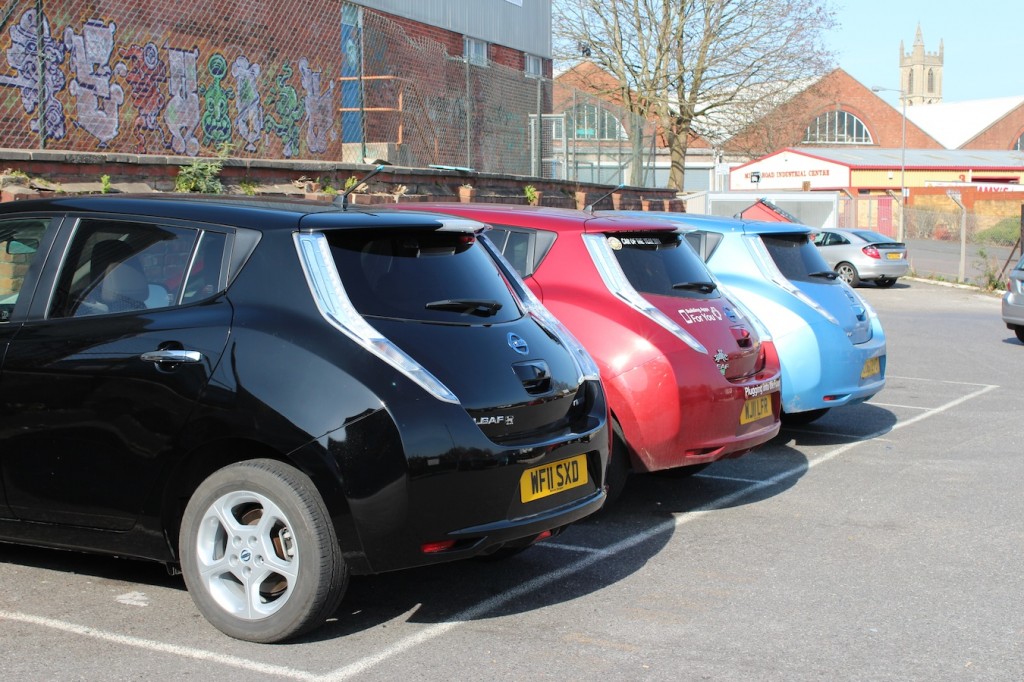
“At Nissan we consider ourselves fortunate to have such passionate and engaged customers -- especially within our Leaf family,” she writes.
“Recently, we learned from the Nissan Leaf community -- and specifically from some Phoenix-area Leaf owners -- of growing concern about battery loss with their electric vehicles,” Bailo continues. “The Forum’s discussion around battery capacity loss has reached a point where I feel it important to personally address what is being debated, to provide Nissan’s viewpoint and, most importantly, to explain the actions we are taking to work with owners.”
A tiny proportion
In keeping with past statements from Nissan on the issue of premature battery aging, Bailo reiterates that to her knowledge, the number of Leafs affected by the issue remains tiny.
By Nissan’s own calculations using battery data collected from Nissan Leafs, less than 0.3 percent of all Leafs in the U.S. -- equivalent to around 40 vehicles -- have experienced a loss of any battery capacity bars.
“Overall, this universe of vehicles represents a very small fraction of more than 13,000 Nissan Leafs on U.S. roads,” she writes. “Also, data received globally from other Leaf vehicles shows that this condition typically occurs to high-mileage cars or those in unique operating situations.”
2011 Nissan Leaf SL
Case-by-case investigation
According to Bailo, Nissan is in the process of reaching out to individual Leaf owners affected with the problem in an attempt to understand exactly what is happening.
“We are now reaching out to individual owners to start this process to ensure that we fully understand these events and all potential causes, and pledge to provide an update as soon as possible,” she explains.
Continuing caution, with caveats
Although Nissan is now formally investigating premature battery aging in Leafs from warmer climates, Bailo takes great pains in her letter to reiterate that predicting the lifespan of an electric car lithium ion battery is difficult.
Many factors, such as the way in which the car is charged and used, its mileage, and external temperature all have an impact on battery life.
“All lithium-ion batteries lose capacity with use and age. This is normal and expected. In general, lithium-ion batteries exhibit a higher loss of capacity early in life, with the rate of loss decreasing over time,” Bailo explains.
“Nissan has projected that Leaf batteries will generally have 80 percent of their capacity under normal use after 5 years, and 70 percent after 10 years,” she continues, reiterating the same battery life predictions Nissan has given us for many years.
That doesn’t mean however, that Nissan is ignoring battery capacity loss cases.
2011 Nissan Leaf SL
“Until we know more about each customer’s unique situation, it would be premature to declare what is happening with the Nissan Leafs in Phoenix, and whether their performance is within the range of expectations or not,” Bailo cautions.
“Nissan engineers from our Arizona Testing Center and around the world will study each customer case, work to discover the root cause and will determine next steps to satisfy our customers,” she promises. “While we do this, we pledge to provide an update to our customers as soon as possible.”
Mixed reception
So far, Bailo’s open letter on behalf of Nissan North America has received a mixed reception from Nissan Leaf owners.
Some have called Bailo’s letter nothing more than “corporate speak to head off hysteria,” while others view the letter as proof that Nissan is finally working to resolve the issue.
With many Leaf owners still furious with Nissan over premature battery capacity loss, we hope that Nissan’s investigations are thorough and provide a conclusive solution for affected owners in a timely fashion.
What do you think? Does Bailo’s letter mark the start to a resolution to the issue, or do you think Nissan needs to do more to appease concerned Leaf owners?
Let us know in the Comments below.
+++++++++++