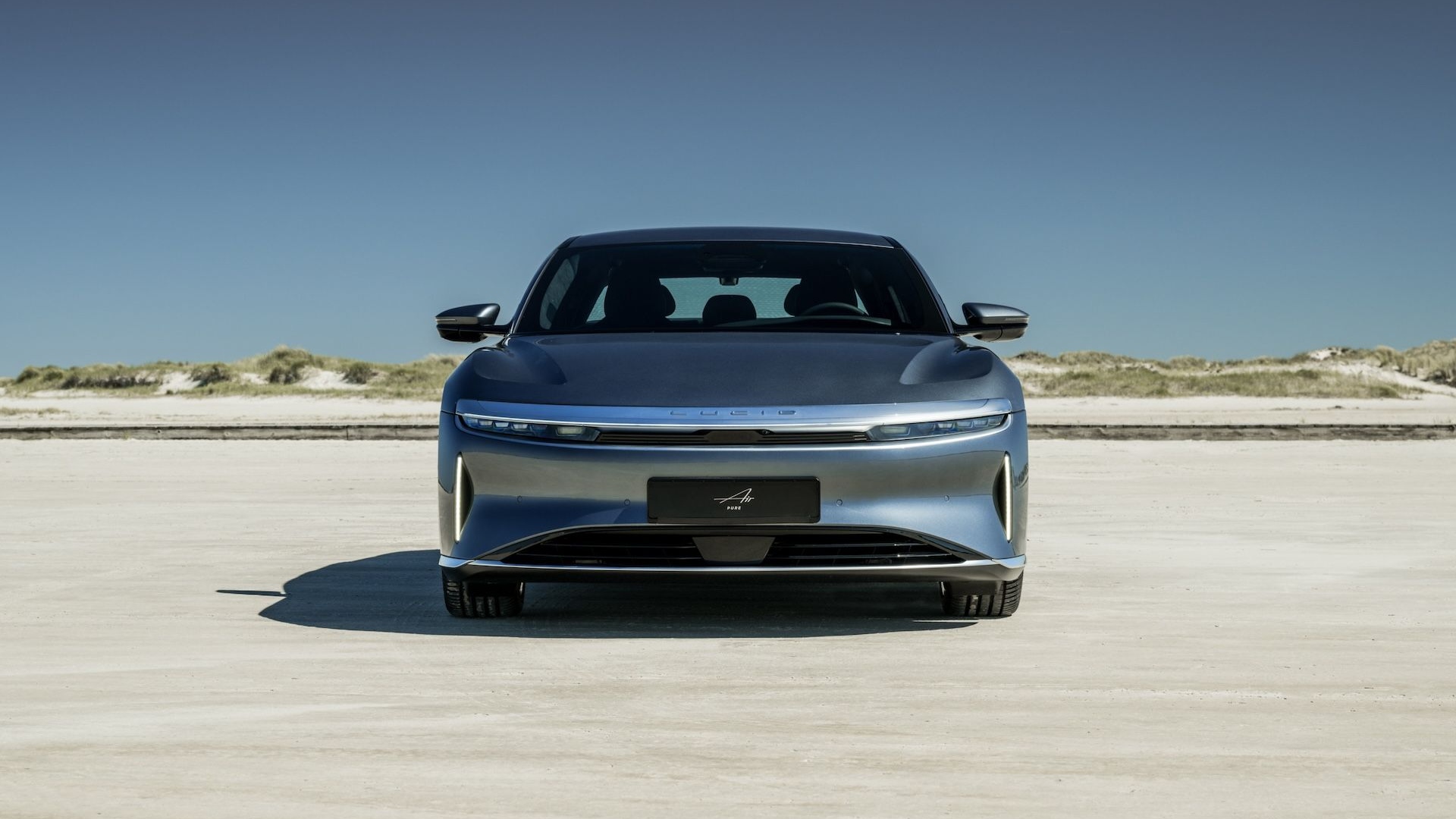
Monthly gas price vs. electricity price in $/gallon equivalent 1976-2012 (Edison Electric Institute)
Enlarge Photo
Gasoline, Diesel, Hybrids And Plug-Ins: The...
Could Small 2015 Chevy City Express Van Offer...
VW Talks Future Tech: Plug-Ins, Natural Gas...
Car buyers are notoriously fond of focusing only on the purchase price of new vehicles, without much thinking about the total cost of ownership.
For electric cars that may cost twice or more what a similar-size gasoline vehicle does, that's a problem.
Still, two separate pieces of evidence begin to make a compelling case for the huge running-cost advantages of plug-ins.
They'll prove useful in conversations over the next few years, as friends, relatives, and neighbors question electric-car buyers about their new vehicles: why they did it, how much hassle it may be to plug in, and--of course--how much it cost.
First is a post entitled Buck-a-Gallon Gas for Life?
Author Max Baumhefner, a Natural Resources Defense Council staffer, simply plots the equivalent cost of gasoline and electricity under different oil-price scenarios.

Gasoline vs. electricity price in $/gallon equivalent, under 3 scenarios (by Max Baumhefner)
Enlarge PhotoGasoline is high, higher, or very much higher; electricity stays cheap regardless of what happens to oil prices.
Even more compelling is a chart (at top) from the Edison Electric Institute, showing the volatility of gasoline prices and the minimal variation in electric costs over the same period.
In other words, plugging in your electric car to recharge it is the equivalent of paying a dollar a gallon for gasoline--forever.
Second is State of Charge, a study issued last month by the Union of Concerned Scientists on a variety of electric vehicle issues. (We'll cover more of that study later on.)
It found that electric-car owners in 50 of the largest U.S. cities who cover 11,000 miles a year will save from $750 to $1,200 annually compared to traveling the same distance by buying gasoline at $3.50 a gallon.
While most early electric car buyers have other reasons than saving money, the running-cost advantage has to be better explained if plug-in cars are to reach a broader audience.
And while payback may still be hard to achieve, the lure of "buck-a-gallon gasoline forever" or "$1,200 a year in your pocket" may be enough to get fence-sitters more interested in plug-in cars.
Whereupon they may go for test drives, and discover one of the benefits that automakers (inexplicably) haven't focused on: Electric cars are simply nicer to drive.
What do you think? How would you make the case that electric cars can save someone money?
Leave us your thoughts in the Comments below.
+++++++++++

Follow GreenCarReports on Facebook and Twitter.
Have an opinion?
How would you like to make your argument and then hear that the Tesla 300 mile battery pack, which Tesla is claiming lasts around 5,6 or 7 years perhaps,will set you back $40,000?
Until EV enthusiasts get realistic about battery costs,any
economic arguments they put forth are fatally flawed. The simple fact is that electrics are more efficient and cost effective in every conceivable way,EXCEPT for battery costs. At this time
Leading up to that day, as experiences is demonstrating to me, I expect to save at roughly $2000/year by not
having to pay for expensive gas, oil changes, radiator flushes, engine cleanings, belt replacements, spark
plugs, etc. By my calculations, I am spending only about 2 cents per mile for electricity, rather than the 20+
cents per mile I am spending in gas for our other cars.
By way of example Tesla Model S has along the order of 70% fewer moving parts. Simplified heating, cooling and mechanical systems result in significant reductions in yearly mechanical repair costs.
Future drive-by-wire integration means SYSTEM simplification impossible with the ICE.
It is amazing the amount of maintenance that isn't required for an electric car.
Taking My FPL bill and comparing it to cost of gasoline.. And e-gallon cost almost the same as a gallon of Petrol. Its been very consistence.Of course the big advantage of electric, is that 130miles per e-gallon.It becomes hard to ignore..At least that is my assessment here in Florida ...
EV's can enable America to Fire OPEC. Which has a ton of positives including reduction of our Military Presence in the region which could save us $50 Billion or more per year. Additionally American stop funding terrororism when they stop buying oil from places like Yemen.
We can stop paying $7 Billion a year to big oil in the form of foreign tax credits and subsidies... yeah... they're poor.
We can grow jobs in America by building the infrastructure to support EV and our expertise with the technology which can result in a tangible export.
I love the green aspect - but appealing to people on multiple levels is necessary.
But, I'm preaching to the choir, eh?
To make make it easy for ICE drivers out there thinking of buying an EV, I can offer you this simple running cost comparison advice (having driven a petrol van DIY converted to an EV every day for 18 months doing a 40 mile round trip commute - see evalbum.com/2092). Take the petrol cost and divide it by 9. (electric cost of around US$0.06/kWh)
Leaf; drove 1341 miles, Electricity $28 and change. do the math. its not even close. obtw, Prius also did oil/filter change. $58 (i work at car dealership so it this is cheap! WA has outrageous oil recycling cost!!)
battery replacement? ya, ok. i sold a car to a young lady yesterday because her Civic was sitting in her front yard. just paid $1200 to fix some stuff and 4 months later she is looking at a new engine at $4339.XX. she is driving a Fusion this morning. granted, not electric, but you get the point
Electricity consumption is NOT expected to increase "5 fold over the next 10 years." The impact of electric cars on the grid has been covered quite extensively, including on this site:
[citations in 2nd message)
The degradation rate of chemical reactions in Li-ion cells varies enormously among the different chemistries sued in different cells. Do you know which of the chemistries are used by the highest-volume electric cars now on sale in the U.S.?
http://www.greencarreports.com/news/1051199_gm-exec-chill-volt-electric-cars-wont-bring-down-the-grid
and
http://www.greencarreports.com/news/1047352_electric-vehicles-as-clean-as-the-grid-powering-them
and
http://www.greencarreports.com/news/1047023_no-electric-vehicles-wont-bring-down-the-u-s-power-grid
and
http://www.greencarreports.com/news/1038392_will-electric-cars-destroy-your-neighborhood-power-grid-no-but
In additon to DoD cost savings via cutting Middle East oil dependency, consider also healthcare savings realized by reduced air pollution. Less asthma, for instance. Perhaps a case could also be made for slowing global warming, but that would be incredibly hard to quanitify.
says. We all know this analysis is pure hokem and pure bunk. Why?
The price and lifespan of the batteries, which MUST be figured into the calculations, and fraudulently never are. I even doubt that the amount of juice actually consumed is correct - one must correct for losses going into, coming out of , and leaking from the batteries. Figure every 8 years or so paying for a new battery pack. NOW do your price calculations. EVs are going to continue taking hits as long as EV enthusiasts are living in an economic dream world. EVs are many things, but they are not economically competitive at this point, due entirely to the high battery costs (both initial and replacement)
Have an opinion?Join the conversation!