Sixteen months ago, General Electric announced it would place the "largest order in history" for electric cars, to be used by its employees who are issued company cars.
Now, those cars are starting to arrive and be placed with employees.
And where changes are made, personnel policies are sure to follow.
A person inside GE recently forwarded a memo to us that covers some of the nuts and bolts of using the 2012 Chevrolet Volt range-extended electric car. It's from the fleet operations manager for GE Healthcare.
Among the interesting points:
- "All sedans ordered in 2012 will be the Chevrolet Volt"
- Crossovers and minivans will be replaced by electric-vehicle sedans, i.e. the Volt
- Field engineers (who presumably have to carry equipment and spare parts) are the exception to the Volt-only rule
- Home assessments for installation of a 240-Volt Level 2 charging station will be provided to all Volt drivers
- If it's not possible to install a Level 2 station, employees should use standard 110-Volt charging
- If no electric power is available, driving the Volt using only its gasoline range extender is permitted
- Employees should expense both public charging-station costs and the Volt-recharging portion of their monthly electric bills
- If new GE drivers opt out of the fleet-vehicle program and choose to use a personal car, GE will not reimburse those expenses
- Existing drivers will not be reimbursed for personal-vehicle use after January 1, 2013
Stand by for shrieking from certain segments of the media about how "GE Forces Employees Into Electric Cars!"
But, more seriously, why is GE pushing the Volt so hard?
First, its fleet managers have likely calculated that over the multi-year lifetime of the Volt, the company will save money on operating costs.

GE WattStation Electric Car Charging Station
Fleet managers are notoriously hard-nosed spreadsheet jockeys, and are willing to spend more upfront on a car (the 2012 Volt starts at $39,995 before the $7,500 Federal tax credit) if the running costs end up saving money over the total mileage it covers.
The cost of a mile driven on electricity is generally one-third to one-fifth that of a mile driven on gasoline (depending on gasoline and electricity prices and the gas mileage of the comparison vehicle).
So GE likely figures that paying recharging costs will end up saving it money on gasoline over several years.
Second, GE makes electric-car charging stations, and its WattStation ads have been heavily publicized.
For the company, championing electric cars is a good way for employees to get familiar with plug-in vehicles that need to be recharged. In Silicon Valley, they call that "eating your own dogfood."
The GE order could add many thousands of vehicles to Volt sales in 2012, and we suspect that most GE drivers will warm quickly to the smooth, quiet experience of electric propulsion.
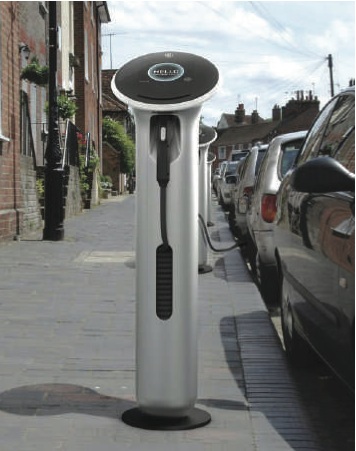
GE WattStation Publicity Shot
One note of concern: The electric-car advocate who sent us the memo was deeply disturbed that all-gasoline running was allowed.
We're not quite so worried about that, since its ability to run on gasoline once the battery pack is depleted is the heart of the Volt's flexibility--no range anxiety.
Since most GE Healthcare employees will use their company cars on fairly predictable daily travels, many of them less than 40 miles, their Volts are likely to spend the vast majority of their miles running on battery power.
After all, Level 2 charging or not, everyone's got a 110-Volt socket somewhere.
For all we know, GE may have a deal with GM's Onstar to get access to the detailed usage data for its Volts--which would allow the company to learn exactly how its employees drive its Volts.
A year hence, we may see a GE press release touting all the gasoline it has displaced by running on grid power. We hope so, anyhow.
We've reproduced the entire text of the memo, addressed to GE Healthcare's "Americas Team," on the next page.
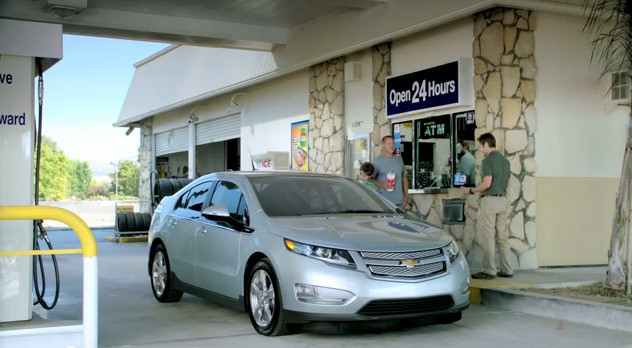
2012 Chevrolt Volt Gas Station Advert
Americas Team,
GE is playing a leadership role in moving Electric Vehicles (EVs) from anticipation to action – and you are a part of this movement! Jeff Immelt announced a game changing global commitment to purchase 25,000 EVs as part of a plan to convert half of GE’s global vehicle fleet by 2015. This is the largest commitment ever to an EV fleet. http://www.gereports.com/in-largest-single-commitment-ge-to-buy-25000-electric-vehicles/
GE’s commitment to EVs is part of our Ecomagination business strategy to accelerate the development and deployment of clean energy technology through innovation and R&D investment. Further, it serves as an important market validation of new vehicle technologies and the associated charging infrastructure. EV’s are an important step toward energy independence and a way to reduce our dependence on oil. By deploying EVs into the GE fleet we can accelerate the market acceptance of EV’s, and gain insights into potential new business opportunities for charging infrastructure and smart grid technologies…while reducing emissions from our fleet.
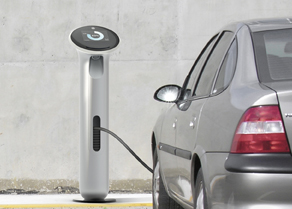
General Electric GE WattStation charging
"Electric vehicle technology is real and ready for deployment and we are embracing the transformation with partners like GM and our fleet customers." "By electrifying our own fleet, we will accelerate the adoption curve, drive scale, and move electric vehicles from anticipation to action."
……..Jeff Immelt
GE Businesses across the USA have piloted and deployed over 300 EV’s in 2011. GE is now moving this project forward from the pilot phase into full scale deployment. GE Healthcare is at the forefront of this effort, with about half of the entire GE fleet worldwide.
Please embrace the new vehicle technology, the Chairman’s initiative, and the positive environmental impact of EV’s.

2012 Chevrolet Volt
CHANGES for 2012 Fleet Program
- All sedans ordered in 2012 for GEHC will be the Chevrolet Volt. http://www.chevrolet.com/volt-electric-car/
- All crossover and minivan vehicles will be migrated to an EV sedan when the current vehicle is up for replacement. The current EV sedan is the Chevrolet Volt. Field Engineers are an exception, and will be able to order larger vehicles based on job requirements. FE EV’s are expected in future years.
- Drivers ordering Volts will be set up for a home site assessment/estimate for 240V electric charger installation. If a dedicated 110V home outlet is available, the vehicle can be charged on 110V until the installation of a 240V charger is completed. There may be instances where home 240V charger will not/cannot be installed, therefore charging on 110V home outlet, public charging stations or all gas use will be justified.
- Monthly home electric reimbursement will be via T&L. Rates are determined using state DOE average KW rates and will be updated periodically.
- Public charging expenses to be expensed via T&L using AMEX card.
- To encourage EV deployment, if an employee is eligible for a fleet vehicle, a fleet vehicle will be made available. If a new driver opts out of the fleet program and elects to drive a personal vehicle, there will be no reimbursement. For current employees who qualify for a fleet vehicle, but have chosen to drive a personal vehicle, reimbursement by GEHC will stop as of 1/1/2013.
· GEHC will no longer offer all-wheel drive vehicles beginning this order cycle.
+++++++++++