Ask any automaker, and they'll tell you they believe most early electric cars will be charged at night, in garages attached to private houses.
That would seem to cut out residents of multiple dwellings, from rental apartments to condominium complexes.
But electric car owners are resourceful; they'll find a way to charge using any available outlet.
That was what Mike Nemat, a resident of the 160-unit South Keys condo complex in Ottawa, Ontario, did when he bought a 2012 Chevrolet Volt.
He plugged his Volt into an outlet on the top floor of his garage each night, using (by his estimation) about C$24 a month of electricity (or "hydro," as Canadians often call it).
Now his complex is threatening to deactivate the plug, according to local news reports--despite Nemat's offer to pay them $50 per month.
It's unclear whether the condo board has a bias against electric cars, as Nemat suggests, or whether it doesn't believe his calculations.
The math is simple: The Volt uses a maximum of 10.4 kWh from its 16-kWh lithium-ion battery pack, so allowing 13 kilowatt-hours for a full charge (plus thermal conditioning) each night for 30 nights would total 390 kWh. At the local cost of C$0.062/kWh, that works out to C$24.18 per month.
Robert Charette, the condo corporation's general manager, appears adamant. He said he "didn't care" if Nemat offered $100 a month; he said the condo "wasn't prepared for it."
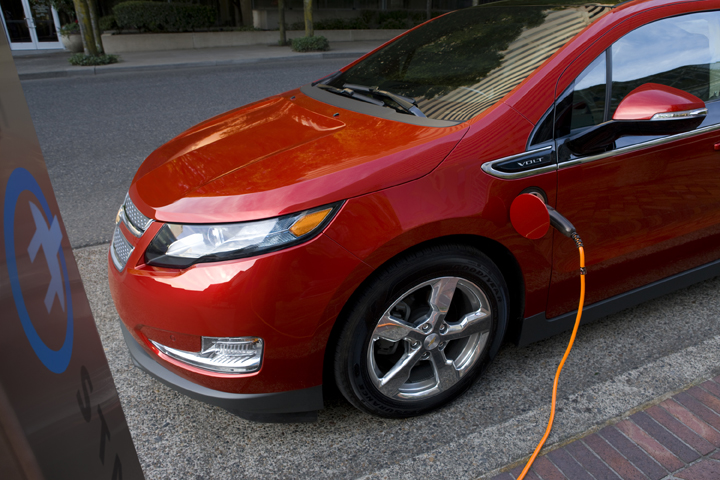
2011 Chevrolet Volt
The building has suggested that Nemat pay the cost of installing a separate electric meter to measure the power going to the 110-Volt socket he uses. That would cost him more than C$2,000, money Nemat isn't prepared to spend.
But Charette seems to dismiss the notion of electric-car charging in the building altogether, saying that when electric cars "become a factor in the world," perhaps "someone will set up (power) stations in the area."
The condominium has now turned the matter over to its lawyers.
The oddest part of all this is that Ottawa, like many Canadian cities with frigid winters, is quite used to seeing cars with electric cords hanging out the grille.
They're for electric block heaters to keep the oil from getting too viscous, and plugging in cars during winter is a well-established practice in parts of the country.
One rather wonders whether Charette or the building's lawyer have prohibited residents from plugging in their block heaters.
What do you think? Should Nemat be allowed to use the 110-Volt plug in his condo garage? What should he pay for the power he uses?
Leave us your thoughts in the Comments below.
+++++++++++