Here at GreenCarReports, we often hear excuses from people who say they want to buy an electric car but feel unable to.
Aside from increased sticker price, one of the more common excuses given is the worry that an electric car won’t meet their mileage needs due to range limitations per charge -- despite historical data suggesting that electric cars could easily handle around 80 percent of all daily driving in the U.S.
Now a new study by two doctoral students at the school of Engineering and Applied Science at Columbia University has increased that figure, estimating that electric cars could meet as much as 95 percent of all daily driving needs of U.S. citizens.
Using data obtained from the Department of Transport’s 2009 National Household Travel Survey (NHTS), Garrett Fitzgerald and Rob van Haaren analyzed the travel data of survey participants, concluding that 95 percent of the 748,918 recorded single-trip journeys by car were under 30 miles.
More astonishingly, around 98 percent of all single-trip journeys were under 50 miles in length, with trips over 70 miles in length accounting for just one percent of all single-trip journeys.
The average single-trip distance? Just 5.95 miles. And while rural respondents naturally traveled further on average than their urban counterparts, 95 percent of all rural-based trips were still under 50 miles.
Analysis of Car Distance Trips in U.S. (Rob van Haaren)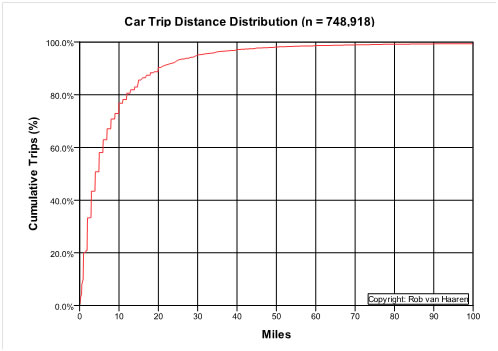
But as Fizgerald and van Haaren point out in their study, with limited public charging stations for electric cars, single-trip distances aren’t the best way to evaluate just how suitable electric cars are for the average consumer.
As a consequence, they turned attention to both average U.S. car commute distances, and total number of miles driven in a single day.
Of the 106,681 survey participants who drove to work every day in a car, 95 percent of them travelled less than 40 miles to work, with the average commute distance being 13.6 miles.
Because of how the study was conducted, 39 percent of cars owned by participating households in the 2009 NHTS were not driven on study days examining total mileage drive. But of the 179,848 cars examined that were used on what the study calls the Travel Day, 93 percent of them drove less than 100 miles.
The average daily drive total for urban-based cars was just 36.5 miles, while rural-based cars drove an average of 48.6 miles.
Admittedly, considering the number of cars on the roads of the U.S. today, it is only right to acknowledge that the sample size is a tiny proportion of the actual number of cars being driven daily.
However, given the source of the data, we’re inclined to think it has been impartially and carefully collected.
Now that plug-in cars have been categorically proven fit-for-purpose for even more U.S. citizens than previously thought, the real hard part begins: making electric and plug-in cars affordable for those who want to own them.
And that takes more than just statistics.
+++++++++++