2013 Smart Electric Drive To Offer Battery...
VW Talks Future Tech: Plug-Ins, Natural Gas...
2013 Nissan Leaf: Driven Through Tennessee...
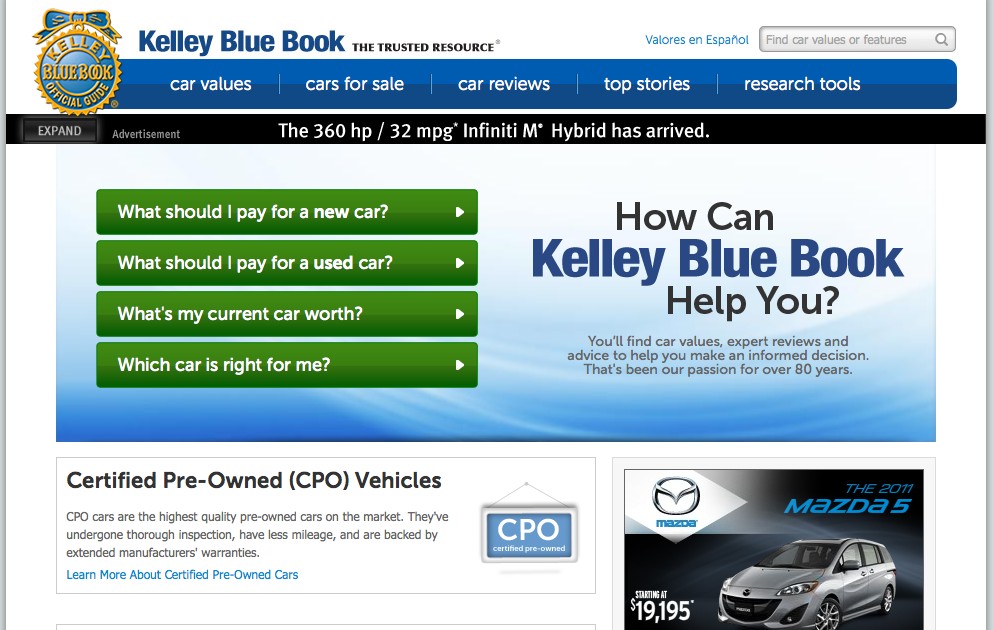
For over 80 years, the Kelley Blue Book has been valuing new and used cars for the benefit of the auto industry. Used by automakers, car dealers and consumers alike, it has become the ultimate go-to guide for realistic valuations on virtually any age or condition of car.
But although the Kelley Blue Book is now providing valuations for all of the electric cars on the market today, it remains skeptical about just how much electric cars will be worth in a few year’s time.
Are the Kelley Blue Book estimates correct? Or are they ultimately hurting electric car sales and consumers?
2012 Chevrolet Volt considered best resale value electric car
Last week, the Kelley Blue Book crowned the 2012 Chevrolet Volt the Best Resale Value award in the electric car category, claiming that the Volt will depreciate the least of all electric cars on the market today and retain around 42 percent of its value in three years’ time.
Put that into cold, hard cash, and according to the Kelley Blue Book an average base-level 2012 Chevrolet Volt will be worth just $16,797 in three year’s time. It’s similar to the valuation given last year to the 2011 Chevrolet Volt.
Gas guzzlers worth more, but cost more to run
Interestingly however, look at the Kelley Blue Book top ten best resale cars for 2012 and you notice one thing: The cars Kelley Blue Book expects to retain the most value are SUVs or Crossover SUVs.
The winner -- the 2012 Jeep Wrangler -- is predicted to retain 68 percent of its sticker price in three years’ time, but with the worst fuel economy of its class, it is guaranteed to cost a lot to run.
An unknown field gives ‘worst case’ valuations
While the Kelley Blue Book has over 80 years of valuation experience to pool when it comes to gasoline cars, trucks and motorcycles, it hasn’t got very much experience evaluating electric cars.
And with no hard-and-fast evidence to pool on battery life for lithium-ion derived battery packs, Kelley Blue Book Valuators are erring on the side of caution when it comes to predicting residual value.
That equates to an expectation that battery packs will not retain their initial capacity beyond the manufacturer's warranty period, even if automakers and electric car advocates disagree.
Lousy predicted values mean higher initial costs
Ultimately, the Kelley Blue Book valuations -- and similar valuations from other firms -- are driving up the cost of owning an electric car in order to protect the investment of firms leasing and producting electric cars.
For example, if you lease your car, the amount you pay on your monthly lease is directly influenced to the car’s predicted value at the end of the lease agreement.
Since the finance or lease company needs to know it will make a profit on every agreement, it needs to make sure that it can recover any expected depreciation during the lease agreement. In essence, the person leasing the car reduces the finance company’s investment risk.
In other words, the higher the expected depreciation, the more you’ll pay per month.
Why we disagree
So far, demand for electric cars is still high, due to early-adopting demand, but we think that demand will continue as electric cars become more mainstream and more and more consumers feel the pinch of the gas-pump.
One year after launch, cars like the 2011 Nissan Leaf and 2011 Chevrolet Volt are still performing as expected, with many early-adopting owners reporting no perceptible drop in battery capacity after months and many thousands of miles of use.
What’s more, many owners of previous-generation electric cars -- like the 1998-2002 Toyota RAV4 EV, are still happily driving their cars with over 100,000 miles on the battery pack without major pack capacity loss.
With states like California offering High Occupancy Vehicle (HOV) lane access to electric cars regardless of the number of occupants, expect white-HOV-lane sticker plug-in cars to become as sought after as the hybrids which preceded them.
+++++++++++

Follow GreenCarReports on Facebook and Twitter.
Have an opinion?
But if the cost plummets, which research from Kung at Northwestern, PolyPlus and others indicates will occur within 2 or 3 years, then the Volt doesn't make sense anymore. Remember, the Volt only makes economic sense in a world of extremely expensive batteries. The Volt was not designed to be an electric car and suffers enormously when compared to cars that were, such as the Tesla Model S. Regardless of where battery prices go, the Volt resale prices are going to suffer, for one reason or another.
So for now buying an EV is just going to be a leap of faith for consumers; the EV producers should be involved in leasing since they have the inside take on battery replacement cost.
That's also the point at which the value of the car plummets to around $0, when the cost of battery replacement equals the value of the car. Less than six years.
If you do the math: a 24KWH battery like the Leaf's would last about 300K miles over 15 years (charging it ones a day) if it did. With numbers like that we wouldn't have this high depreciation forecast problem, EV's would be a more solid investment than gold in a financial armageddon...
Mind you, the Honda Fit's lithium titanate battery comes pretty close at 4000 cycles. Too bad that one is lease only so no investment opportunities here....
The bottom line is: EVs will NOT hold their value, in my opinion. Assuming normal daily driving, if you won't drop another $8k - $10k at year 5-6 for new batteries, your car's value is zero at that point. And if you elect not to drive it every day just to save the batteries, what's the point in owning it?
Interestingly the residual capacity problem should affect the Volt less than the Leaf since it will remain 100% functional, just less economical. The Leaf might need it's battery replaced before capacity drops even to 70% because of unacceptably low range. So maybe Nissan should have fitted the Leaf with a bigger battery("spare capacity") or room for extra modules for an economical capacity upgrade (why throw away a perfectly good battery with 70-80% life left in it?). OTOH maybe the Leaf's battery lasts long and better tech makes replacement affordable...uncertainty.
like anything else, a current buyer needs to ascertain whether his expenditure is worth it, for the time that it does its job.
batteries will no doubt improve. but if the ev industry does it correctly, one should be able to place in a current battery when the original battery dies, without getting rid of the car. just like one puts in a new engine, transmission, etc.
as the years go by, new gas cars will depreciate even faster, since no one will want to put big bucks into a dinosaur technology.
I think it's just the uncertainty about the batteries that causes these very conservative residual value estimates. Too bad because these gloomy forecasts are not going to help EV adoption at all obviously.
1) today they are being sold at a premium, simply because they can be sold at a premium.
2) batteries will improve a lot, just as with all new technology.
but as i stated, if you buy with the intent of using it, and it lasts as long as it was supposed to, then you got your money's worth.
resale value only means something IF YOU ARE GONNA SELL IT.
with a very limited supply, prices are high. and almost all the current buyers are somewhat well-to-do.
in a few years, supply will dramatically rise, thus cutting the price a lot, and bringing in a whole new group of buyers.
each of us in turn will join one such group, when our needs are better met by an ev, as opposed to an ice.
each year that goes by will bring more people into the ev group, and less people into the ice group.
the typical snowball rolling down the hill. or the example of doubling a dollar. after 5 years, you have 32 dollars. after 10 years, you have 1024 dollars.
When considering the LEAF as a replacement for my Nalibu, I assumed the worst case scenario i.e. zero resale value at 100,000 miles. The car still makes financial sense even given this dire outcome. If gas skyrockets in price, then I will be rewarded with a much higher resale value than I had anticipated.
See http://wp.me/p1sK3k-i for my detailed analysis.
That's a great deal for those of us that like to purchase our cars used.
Increasing gas prices in step with falling battery prices will decrease EV costs in the coming years. The air will be glad.
Future estimates here: http://www.evsroll.com/Electric_Vehicle_Markets.html
EVsRock!
however, unlike most products, oil prices are controlled to a large degree.
but fuel savings is not the only advantage that evs have.
maintenance, smog checks, etc.
evs are simply better in every way, from a quality standpoint.
price and range are its only disadvantages, and those will continue to improve as the snowball rolls down the hill.
i am the only person i have seen who from day one has stated that 10 years in the process, new ices will become almost extinct.
that includes all the so-called "experts". they were predicting 2 and 3% - what a joke that is. anyone making that dumb of a guess must be owned by big oil.
On October 8, 2012 I leased a new 2013 Volt with all the options My drive off was $1300 an month payment for 36 month is $375. The MSRP is $42,079. The residual value, after 36 months is $28,596...a whopping 68% residual.
Obviously, GM anticipates a significant aftermarket when the lease terminates in 2016. The Volt is a great car, well engineered and great interior ...first GM car I've ever drive and I've been driving 48 years. All my driving for 2 weeks has been electric only...yep!
Have an opinion?Join the conversation!