We read a lot of stuff about green cars and, lately, most of it's about electric cars.
Sometimes the coverage is unquestioning and adulatory. More often it's cranky and dismissive. But major media outlets are working hard to understand the complexities of what is a huge, slow, expensive, and very complex transition to another type of vehicle and powertrain.
A piece with yesterday's date in The Wall Street Journal entitled, "Bumpy Road For Electrics," got most of the essential elements right.
Familiar concerns
Writer Mike Ramsey notes that 20-odd electric models will be offered in the U.S. market within three years, and that some manufacturers (Nissan, with its 2011 Leaf all-electric hatchback) are far more optimistic about sales prospects than others (he names Ford, Honda, and Toyota).
He also cites "experts" who reel off a by-now-familiar litany of concerns: "Electric cars are too expensive, take too long to recharge and don't provide enough driving range before they run out of juice to be practical for most Americans."
And he quotes Alex Molinaroli of Johnson Controls Inc., whose research found that "the pool of U.S. customers for whom an electric car makes financial sense—those who travel many miles a year, but on short trips—is very small, about 3 percent of drivers."

2011 Nissan Leaf
Missing global context
Which leads us to the first of our two major criticisms: The article lacks any kind of context to give readers a sense of the likely pace of electric-car rollout. Which, despite those 20 models he cites, is going to be slow.
Specifically, most industry analysts expect pure electric cars to represent at most 2 percent of global production fully 10 years hence, in 2020. Nissan CEO Carlos Ghosn's suggestion that 10 percent of his company's production in 2020 will be electric cars is widely considered an outlier.
The missing context: Even 1 percent of the global market in 2020 might represent 1 million electric cars. And, in that same year, those same analysts expect hybrids to be more than 10 percent--even if they're no longer labeled "hybrid," with all the cultural baggage that name carries.
Almost 1 billion vehicles globally
That's because the world produces about 80 million vehicles a year (roughly 10 million of them in North America), perhaps reaching as high as 100 million by 2020. (There are now about 800 million vehicles on the planet, which some say could rise to as many as 2.5 billion over the next 30 years.)
The auto industry has long lead times (it takes 4-5 years to develop a brand-new car), and new cars are brutally expensive. It will take several iterations of design to make today's costly lithium-ion battery packs affordable enough that electric cars can compete head-to-head on purchase price. (They already win on running costs per mile.)
We wish Ramsey had added that context, since we often hear an assumption that in three to five years, electric cars will be close to dominating the market. And that's wildly unrealistic.
Range anxiety, sure...if you only have one car
A Honda executive, Robert Bienefeld, has experience to back up his assessment: He was involved with Honda's EV Plus electric-car efforts in the late 1990s.
He cites the oft-used "I might not be able to take my kid to the hospital at 2 am" concern over battery electric vehicles with 100 miles of range that may not have recharged. It's known as range anxiety.
Yes and no: First, the average U.S household has more than 2 cars, and no one will make all three battery electrics with limited range. There will likely always be one car with gasoline power for long trips or emergencies. Day to day, families will plan around an EV's range just as they now plan around their cars' carrying capacity and number of seats.
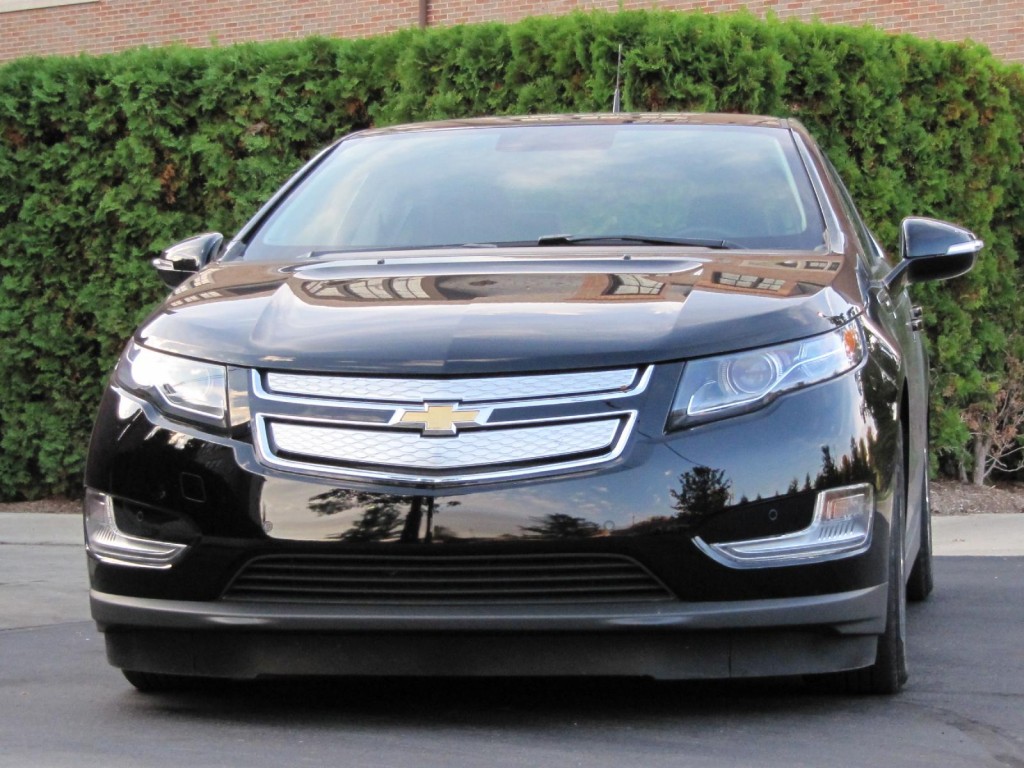
2011 Chevrolet Volt test drive, Michigan, October 2010
Second, there's an entire class of plug-in cars that run some distance on electricity--the 2011 Chevrolet Volt, for one--that also have gasoline engines as backups for greater distances.
Aside from a single throwaway reference to plug-in hybrids, this category of car is largely missing from the article, though battery electric cars are far from the only plug-ins.
It's not ABOUT payback
But it's the payback argument is where Ramsey really goes off the rails--or, rather, JCI's Molinaroli does when he discusses the 3 percent of consumers for whom EVs "make financial sense." The best parallel here is hybrid vehicles, which themselves have captured 2 to 3 percent of the U.S. market after 10 years.
But as we frequently point out, hybrids aren't sold on the basic of payback--just as most HUMMERs weren't bought on the basis of their ability to ford rocky streams. They're bought to make a statement about the owner's green beliefs.
The nice thing is that plug-in cars running on grid electricity actually have a cost-per-mile that's one-fifth to one-third the cost of standard gasoline cars, so they're already further ahead than hybrids by that measure.
Yes, it really does take time
By the time buyers can actually assess electric cars as a less expensive way to drive--which some energy analysts expect to happen after 2015, on the theory that oil prices may not have risen substantially before then--the technology will have evolved. It will likely take that long for a lithium-ion cell manufacturing infrastructure to evolve as well.
In any case, we don't have serious beefs with the Journal's coverage of electric vehicles in this case; a certain skepticism about such a major evolution is appropriate.
We just wish the paper had the space to add more social context around an issue that is neither black nor white, but many, many shades of interwoven grey.
And, we suppose, green as well.