The 135 pages of Cash-for-Clunkers regulations rules require the dealer who sells you your new, more fuel-efficient car to 'disable' the engine of your traded-in clunker.
But how do those dealers actually destroy the engine? Three words: sodium silicate solution. It's a combination of water, silica, and salt; two quarts are added to the engine after its oil is drained and disposed of.
As the engine warms up, the solution hardens with heat and seizes the engine. Case closed.
Revving it to death in 46 seconds
The video above from Wayzata Nissan shows the process in detail, along with annotations.

Cash for Clunkers tradein: Mercury Sable
The clunker in question is a 1995 Oldsmobile Aurora (combined EPA rating: 17 mpg), with 240,000 miles, a rusted-out muffler, and "every warning light illuminated on the dash".
In the video, it takes exactly 46 seconds of revving. The NHTSA rules, however, require up to seven minutes to ensure the engine is well and truly frozen. We're a little nervous about the 46 seconds of blue-grey smoke pouring out of the twin tailpipes, though.
Given that the Clunkers program may have run through its $1 billion of allocated funds in little more than a week, a Friday change from the NHTSA makes sense: Now, dealers can wait to destroy that engine until up to seven days after they receive their rebate from the Feds.
That way, if the program does actually run out of money and they don't get paid, at least they'll own a running clunker. Dealers are allowed to keep $50 of the scrap value they receive for the disabled clunker to cover the time and cost of disabling it.
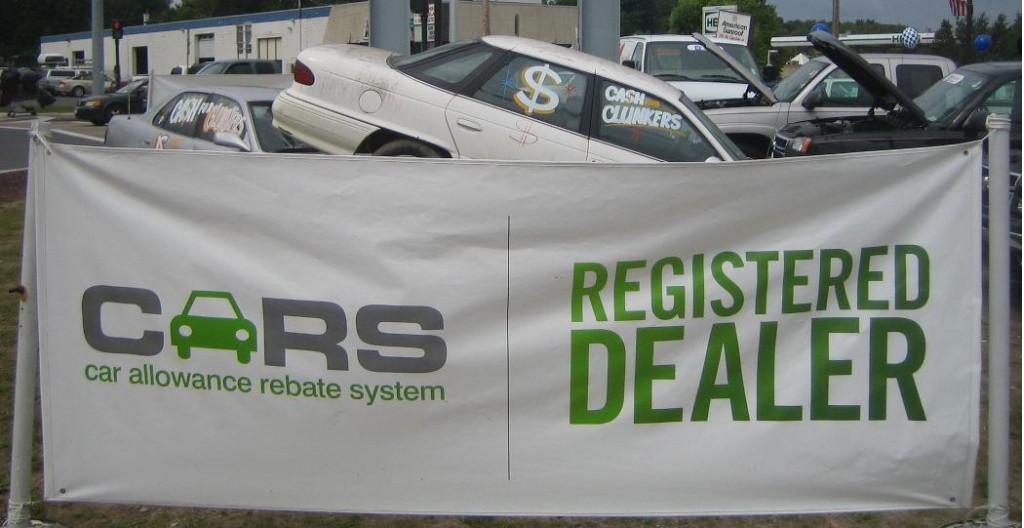
Cash for Clunkers banner with Mercury Sable, Albany, New York
From crushing to seizing
Originally, by the way, the provision was going to require that the tradein be crushed entirely. But after high-volume shrieking from the auto-salvage industry (read junkyards, or if you're being more polite, dismantlers), this was changed to just destroying the engine.
Even still, there's been whining here and there that this prevents individual engine components--pistons, crankshafts, etc.--from being reused.
Well, yes.
Rules: 22 mpg or more for cars
Under the trade-in scheme--its official name is the Car Allowance Rebate Systems (CARS) program--owners of 1984-2002 vehicles with a combined EPA mileage rating of 18 miles per gallon or less could receive a $3,500 voucher towards the purchase of a new car rated at 22 mpg or better.

Consumer data from Maritz study on Cash For Clunkers program results, March 2010
The highest voucher, for $4,500, was available to those whose new car rated at least 10 mpg higher than the clunker that was traded in.
A different system was used for trucks: To qualify for a $3,500 voucher, the replacement vehicle had to be rated at 18 mpg or better, and also be 2 mpg more efficient than the trade-in. The full $4,500 could be earned by buying a new vehicle whose mileage was 5 mpg or more higher.
While most dealers have welcomed the increased showroom traffic and sales, it's hardly been smooth sailing. Dealers have grumbled about paperwork, allocated employees solely to processing the documentation, and experienced repeated timeouts by the NHTSA computer system.
Many automakers, from Smart and clean-diesel makers BMW and Volkswagen, have piggybacked new marketing campaigns on consumer interest in the clunkers program. Sales results for July will be released today, offering some insight into the program's effect on retail car-buying behavior.
[Bloomberg; Detroit News; and TheRealAutoBlog on Twitter]