VW Talks Future Tech: Plug-Ins, Natural Gas...
2013 Nissan Leaf: Driven Through Tennessee...
Could Small 2015 Chevy City Express Van Offer...
Compared with gasoline cars, electric cars are cheap to refuel, especially when charged at night using specialist electric car rates.
Designed to encourage the charging of electric vehicles at night time when grid demand is naturally lower, electric car rates are substantially cheaper per kilowatt-hour than normal day rates, incentivizing electric car owners to charge at night time.
But according to the second annual United States Smart Grid: Utility Electric Vehicle Tariffs (Volume II) study published today by research firm Northeast Group, only six percent of all utilities in the U.S. offer special rates to electric car owners.
When the study was compiled at the end of June, only 22 utility companies across the U.S. had launched specialist energy products for electric car owners.
Interestingly, while California and the Pacific Northwest are considered among the states where electric cars are the most popular, Hawaii, Michigan and Nevada are the states with the most electric-car friendly utility companies.
In those three states, 90 percent of all customers are able to choose an electric car charging rate should they so wish.
With 80 percent of all customers having access to an electric car charging plan, California and Georgia come next, despite utilities in California being among the first to offer electric car price plans.
For the rest of the U.S. however, access to specialist electric car electricity rates is much more restricted, with only 6 percent of utilities nationwide offering cheaper electricity rates to electric car owners.
Depending on the utility company, the way electric car charging rates are metered varies from place to place.
In some instances, the utility company will install a dedicated electric-car electricity meter, only offering discounted or fixed-fee electricity for the charging of an electric car.
In other cases, utility companies offer lower than usual night-time rates to customers with an electric car registered in their name, allowing the electric car owner to use the cheaper rate electricity for everything from charging their car to running their washing machine at night.
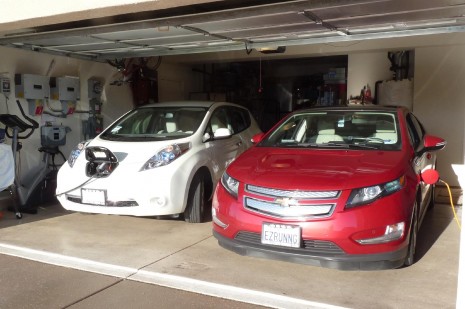
2011 Nissan Leaf and 2011 Chevy Volt, with charging station visible; photo by George Parrott
Despite what seems like a low overall availability of specialist electric car charging rates, the report points out that year on year, many more utilities offer electric car rates than did last year.
Do you charge your electric car using a special time-of-use or electric car rate from your utility company?
How much do you pay per kilowatt-hour, and how much money has it saved you over standard electricity rates?
Let us know in the Comments below.
+++++++++++

Follow GreenCarReports on Facebook and Twitter.
Have an opinion?
I actually pay an even lower rate (I have a Volt) by also belonging to a SmartCurrents program at DTE. They installed an electricity-monitoring device to better understand current usage requirements and future needs and I get cheaper rates for them to get access. I live in Novi (Detroit suburb, for others), so it may not be available to everyone, but probably worth a call to DTE to ask.
Since DTE isn't only the big cities, it's worth a try. Search DTE + EV rates.
http://www.consumersenergy.com/content.aspx?id=3367
I'm sorry if there's also a Consumers Power and this doesn't help but even when I searched for Consumers Power, the search took me to Consumers Energy. Possibly a recent name change? I'm actually from Traverse City myself, but haven't lived on that side of the state for a long time... Let me know if this helps!
Off Peak runs from 7:00 pm to 7:00 am weekdays and all day weekends and holidays.
I plan to charge my Tesla Model S (when I get it!) at night.
1. PG&E only allows you to switch plans once a year. So, if you get on the EV plan, but you decided to change back for varous reason, you will be stuck for 12 months.
2. PG&E currently offers two "EV plans". E9-A and E9-B.
E9-A is timing vary rate that allow you to use electricity as cheap as $0.037/KWh during the summer and as cheap as $0.0468/KWh. Sounds great, right? Well, look deeper... Those are off peak rate for Tier 1 usage.
Tier 1 is the baseline rate. So, it is almost impossible to stay under Tier 3 for most Bay Area resident who actually have a family and own a "normal" home without solar. Under E9-A, the peak rate for Tier-1 starts at $0.31/KWhr and goes up to $0.50/KWh for Tier-3 and $0.544/KWhr for Tier-4 at Peak time. Sure, you will save money for EV charging, but the extra demand will push all your typical household usage into Tier 3 to Tier 4. So, your total monthly cost will go up significantly. The "peak time" usage is between 2pm-9pm. Hard to avoid for anybody. The tier 1 baseline is about 9KWh/day. So, if you charge a Leaf or Volt or a Focus EV, you will easily use up to 12-16KWh per day for charging if commute 40-50 miles daily
Now let us talk about E9-B. E9-B is great that it will seperate the usage for EV charging by installing a seperate Meter so your baseline is lower and your normal household usage is NOT affect by the EV charging. And you can actually take advantage of the off peak charging. But here is the gotcha. A seperate meter will cost you $280 from PG&E. Then about $5K in various installation and connection fee.
For $9k to $10k, you can get a 3KW solar leasing program installed. It is almost silly NOT to do it. I have decided to stay on the flat rate E-1 plan and charge whenever I want. (about $0.25/KWh average over Tier 1-Tier 4).
It looks like they don't really want EVs or really want people to install solar...
Have an opinion?Join the conversation!