Whenever a new car hits the market, there’s always a website somewhere on the Internet keeping track of how real-world gas mileage differs from the EPA’s official quotes.
So it’s no surprise that owners of the 2012 Toyota Prius C have started to keep track of the gas mileage of their car on websites like PriusChat.
One post, What Is Your Lowest M.P.G?, caught our attention, as it highlighted one simple fact we sometimes forget.
Even in a hybrid car, your gas mileage will vary.
Under 50, over 50
In ultra-controlled EPA gas mileage tests, the 2012 Toyota Prius C is rated with a city gas mileage of 53 mpg, and a highway gas mileage of 46 mpg, resulting in a combined gas mileage of 50 mpg.
2012 Toyota Prius c ECO Score Display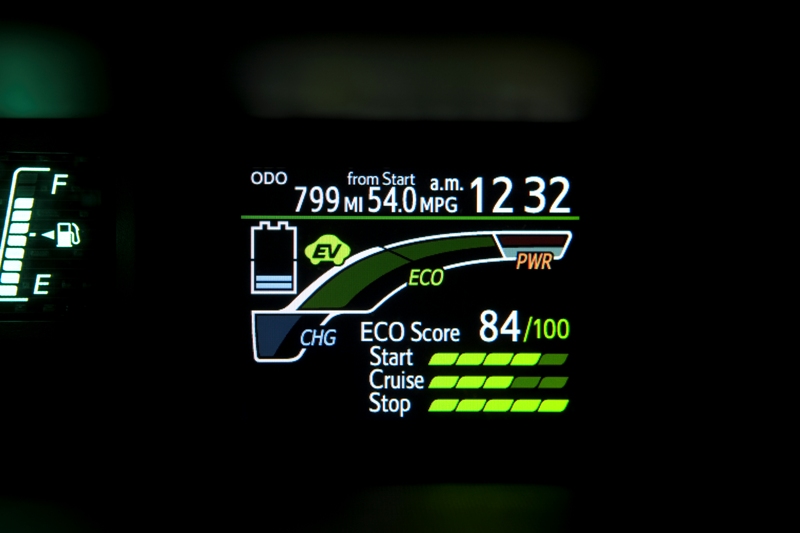
We’ve encountered people who have achieved much higher gas mileage figures, but as some Prius Chat participants have discovered, the opposite is also possible.
One poster describes a short, 5 minute trip up the road resulting in a gas mileage of just 31 mpg, while another jokes about a mad dash to the local hospital resulting in a fuel economy of 36 mpg.
As another points out, the faster you go, the worse the fuel economy, citing just 22 mpg while traveling at 100 mph in a Prius liftback.
Urban lover
Although it will work as a long-distance car, cars like the 2012 Toyota Prius C are designed to be urban cars.
With an engine tweaked for efficiency rather than power, the 2012 Toyota Prius C’s engine will be less efficient traveling at 70 mph on a freeway for extended periods of time than it will be driving around town at an average speed of 35-50 mph.
In fact, at speeds above 60 mph, the engine in the Prius C does most of the work to push the car along, while at lower speeds it works in tandem with the electric motors to produce the most efficient power blend.
All the usual suspects
2012 Toyota Prius C
Just like other cars too, the gas mileage of hybrid cars like the 2012 Toyota Prius C will be influenced by the same issues that non hybrid cars have.
These include poorly inflated tires, poor maintenance, bad weather, a tired driver, an overloaded car, and of course, running the air conditioning.
It’s worth remembering too, that in cars like the 2012 Toyota Prius C, running the air conditioning will still have an effect on energy efficiency, even though it is powered by the car’s traction battery pack.
Sit in traffic long enough with the AC running, and the Prius’ traction battery pack will become drained, causing its gasoline engine to kick in and your gas mileage to drop.
Tips for better Prius C gas mileage
As we’ve said before, the best way to get good gas mileage out of a Prius is to accelerate smartly away from a stop light if you’re NOT in electric mode, so one motor can recharge the battery from the gasoline engine while the other contributes torque to accelerate the car along. Coast, then repeat.
This is different from single-motor hybrid cars, where power cannot be generated and used at the same time.
Secondly, ensure that you’ve followed our handy tips on getting better gas mileage, and make sure you know which commonly-believed gas mileage tips are myths.
Thirdly, remember that gas mileage will and does vary from day to day. Instead of obsessing about a particular trip’s efficiency, examine your gas mileage every week or month instead of every trip or day.
You might find it isn’t as bad as you first thought.
And remember. Your. Mileage. Will. Vary.
Do you have any Prius gas mileage tips? Leave them in the Comments below.
+++++++++++