When anything is referred to as "not dead yet," it's usually dead--or very close.
But despite the headline reference to a legendary Monty Python skit (NSFW), a recent post from Pike Research makes the case that hydrogen fuel-cell vehicles likely have at least a limited role to play in future green-car lineups.
Real hurdles
Given the current wording of California Zero-Emission Vehicle rules, each hydrogen fuel-cell vehicle is worth more in clean-air credits than an electric car of similar size. That alone may put some number of hydrogen-powered cars on California roads.
As Pike Research writer Lisa Jerram notes, "it’s clear that companies are still committed to this effort even though there are real hurdles in the way."
The carmakers who remain most serious about selling hydrogen fuel-cell cars are Toyota, Honda, Daimler, and perhaps General Motors.
At last month's World Hydrogen Energy Congress, those makers reaffirmed their intentions to offer production fuel-cell vehicles in or around 2015.
Volume pushed out to 2020
What has changed, Jerram notes, is the timing for "large-scale uptake," which makers now say won't happen until 2020 or so.
By that time, by comparison, the global fleet of 1 billion vehicles will likely contain 1 to 2 million plug-in cars, with hundreds of thousands more coming off production lines every year.
To make that large-scale production of fuel-cell cars practical, there's got to be a hydrogen fueling infrastructure in place, at least in the regions where they'll be sold.
That's now happening in a few places. While several hydrogen stations in Los Angeles have closed in recent years, several new ones are scheduled to come online this year and next.
CA to get 68 hydrogen stations by 2015
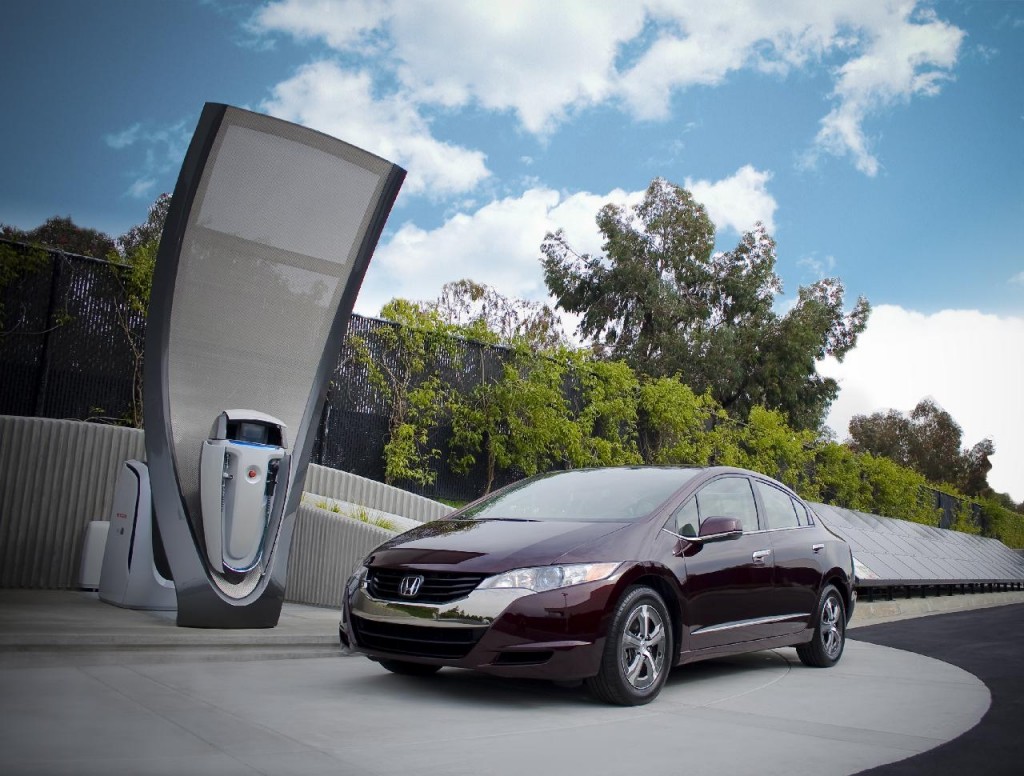
Honda Solar Hydrogen Station prototype with 2010 Honda FCX Clarity hydrogen fuel-cell vehicle
Honda's Steve Ellis says that by the end of 2015, a total of 68 hydrogen fueling stations is planned to be operative in the Los Angeles Basin, Santa Barbara, San Diego, and the San Francisco Bay Area--with a few along the freeway corridor between Los Angeles and San Francisco to permit long-distance travel.
That total contrasts with the more than 10,000 gasoline stations found today in the state.
The California Fuel-Cell Partnership, he notes, will focus on locating future hydrogen fueling stations within existing gas stations--which are already established at major traffic locations and which fit the existing travel patterns of California drivers.
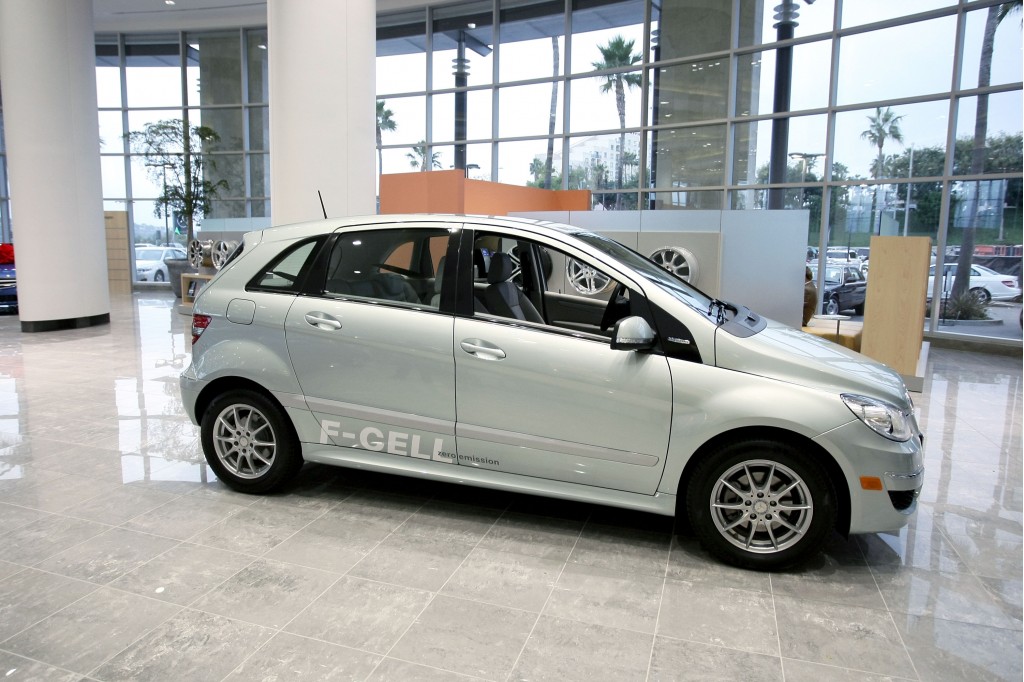
First Mercedes-Benz B-Class F-Cell hydrogen fuel-cell vehicle delivery, Newport Beach, Dec 2010
In Germany, Federal and state funding to build a network of hundreds of hydrogen fueling stations now totals in the hundreds of millions of dollars.
But the current political climate makes that kind of funding seems highly unlikely in the U.S. And Jerram notes that Toyota, Honda, and Daimler representatives at the conference "were unanimous that they should not have to foot the bill for infrastructure build-out."
Pros and cons remain
The advantages of hydrogen fuel-cell vehicles over battery electrics continue to be both longer range (up to 500 miles versus perhaps 300 miles) and quick refueling (5 to 10 minutes versus 30 to 60 minutes for a quick charge to 80 percent of pack capacity).
The drawbacks, as always, are the lack of a widespread hydrogen fueling infrastructure, the cost of the fuel cells themselves (expected to come down over time and with volume production), and the carbon footprint of hydrogen production itself.

2009 Honda FCX Clarity
And, as electric-car advocates point out, essentially every U.S. citizen lives in a residence with electric power--meaning that battery recharging infrastructure is a "last 100 feet" challenge rather than the million-dollar-plus cost of establishing a new hydrogen fueling facility from scratch.
Today, it looks like small numbers of hydrogen fuel-cell vehicles will start appearing in some markets around 2015, but volume production isn't likely to arrive for a decade or so.
By that time, will plug-in electric cars (of all varieties) have become the established green technology? Or is there still a role to play for hydrogen fuel?
Leave us your thoughts in the Comments below.
+++++++++++