2012 Honda Fit Vs 2012 Honda Insight Hybrid: High Gas Mileage Battle

 
Follow Antony

2012 Honda Insight EX with Navigation

2012 Honda Insight EX with Navigation

Enlarge Photo

If you're in the market for a fuel efficient vehicle your choice is better than ever.

Virtually every manufacturer now offers a high-mpg vehicle, but Honda could lay claim to being one of the first. Since the Civic arrived back in the 1970s, the Japanese carmaker has made fuel economy a high priority in its cars.

These days cars like the 2012 Honda Insight and 2012 Honda Fit are Honda's main contenders for inexpensive, fuel-efficient vehicles. But if you're looking to improve your gas mileage, reduce costs and go greener, are you better off with the hybrid, or the efficient gasoline option?

To help you choose, let's take a look at the numbers...

Economy

Ultimately, whether you're looking to reduce your environmental impact or simply save money on gas, economy is the most important factor.

Here, it's an immediate victory for the hybrid. Using a 1.3-liter variant of the 1.5-liter gasoline engine found in the Fit, and hooked up to Honda's Integrated Motor Assist (IMA) hybrid system, the Insight's 42 mpg combined rating soundly beats the 31 mpg of the automatic Fit.

The Insight's hybrid advantage can be seen in city mileage, with a rating of 41 mpg. The aerodynamic shape also helps the highway rating of 44 mpg. In comparison, the 1.5 Fit manages 28 city, 35 highway. With a manual transmission, those figures reduce to 27 city, 33 highway - so you're certainly better buying the auto.

Performance

Here, the Fit strikes back. There's not a lot that's "green" about higher performance, but it's still an important consideration. After all, you appreciate a little extra power every time you join the flow of freeway traffic, or need to overtake.

The Fit's 1.5-liter makes 117-horsepower, to the Insight's 98-horsepower. Along with lower weight (2,617 lbs plays 2,747), that helps acceleration, with 60mph available from rest in shortly over 8 seconds. By comparison, the Insight covers the same sprint in around 12 seconds. Both are easy enough to drive, with CVT transmission in the Insight, and a 5-speed auto in the Fit.

The Insight does counter with strong torque from low revs, thanks to the electric assistance. It makes 123 pounds-feet from only 1,000 rpm, where the Fit needs 4,800 on the clock to make its peak 106 pounds-feet.

2012 Honda Fit Sport
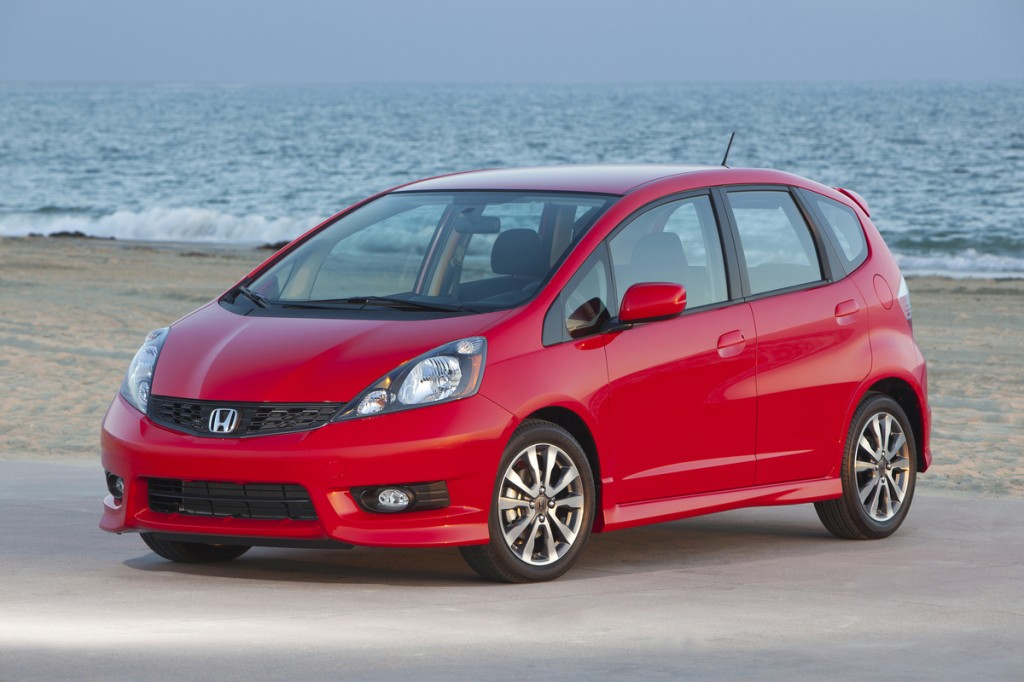
2012 Honda Fit Sport

Enlarge Photo

Equipment and practicality

Surprisingly, given the extra length of the Insight, the Fit actually has greater interior passenger and cargo volume, mainly thanks to its high roof-line.

The Fit also noses ahead on equipment. Though the Insight is available with many of the same options as the Fit, initial purchase price is higher so you can get a higher-specified Fit for an Insight of the same price. A base-spec Insight costs around $600 more than a high-spec Fit Sport with the auto transmission option.

Price

As hinted above, you need to spend extra on the Insight to bring it up to the same equipment levels as the Fit, and it's already a more expensive car.

A base-spec Insight starts with an MSRP of $18,350, and the Fit Sport Auto from our comparisons comes in at $17,760 - though if you're prepared to put up with less equipment, you can take another couple of thousand off that.

The Insight will begin saving you money on fuel though. The EPA estimates that over 15,000 miles, with a mix of 45 percent highway, 55 percent city driving, the Insight will cost $1,207 a year in gas. The Fit adds another $400 to that - and you can keep adding to it if your annual mileage is higher, or if the majority of your driving is in the city.

Conclusion

On the face of it, Honda's Fit seems to be a much better bet overall than the Insight. It performs better, has more space, and more equipment. To top it all, it's also significantly cheaper to buy. This could be why the Insight has so far failed to match Honda's sales expectations - turning in around 20,000 units a year, rather than a hundred thousand.

However, if economy and low emissions are your main concerns, then it can't get near to the Insight, and if you regularly drive longer distances the shorter tank range of the Fit - by more than 100 miles - would soon start to irritate.

Data on the EPA website also suggests that Insight owners are averaging comfortably over the EPA estimates - up to 50 mpg in some cases - so the fuel you save could be even greater.

If ourtight cost is your main concern, then the Fit offers a lot for your money and is still an economical vehicle - but the Insight is definitely the greener choice, and could save you more in the long-term.

+++++++++++

Follow GreenCarReports on Facebook and Twitter.


Follow Us


Have an opinion?Join the conversation!

  • Posting indicates you have read this site's Privacy Policy and Terms of Use
Comments (18)
  1. Let me just add, please test drive both. The Fit is a fun vehicle with a nice dash layout. The Insight is a little strange, and turns off the AC along with the engine at stoplights.

    2010 Honda Insight was billed as a Prius for thousands less when it came out. The Insight falls short of the Prius in almost every way imaginable, fuel economy, space, dash layout, etc.

    Might as well check out the Civic hybrid while you are at the dealership. 44 MPG, $24,000.
     
    Post Reply
    Vote
    Bad stuff?

  2. It would have been more interesting had Honda chose to bring us the Fit Hybrid instead of the 2nd Gen Insight. Then you would have the practicality of a Fit with excellent mpg's. Big mistake by Honda if you ask me. But that is what Honda has been good at lately.
     
    Post Reply
    Vote
    Bad stuff?

     
  3. Totally agree!
     
    Post Reply
    Vote
    Bad stuff?

  4. I am a 2010 Insight owner and have been averaging just over 50 mpg. I think the media needs to run some tests and report this. The EPA estimates are way off and have done a disservice to those who would buy this car if they knew the real world mpg. It is what it was built for: a more affordable version of the Prius. But it has one more trick up its sleeve that Toyota's HSD doesn't: if the hybrid system ever fails the gas engine will still get you home.
     
    Post Reply
    Vote
    Bad stuff?

     
  5. I believe you could do far better with a Prius. I own a 2010 Prius. My average is about 57 mpg. Half of my driving is at about 70 mph. My best record is 70.5 mpg after driving 46 miles on flat highway with little wind.

    Full hybrid is always more fuel efficient than partial hybrid.
     
    Post Reply
    Vote
    Bad stuff?

     
  6. I average "54" mpg on my Insight. I won’t get into the difference between what the dash displays and actual. Honda’s IMA is a full hybrid system - you could even say it’s a simpler and more elegent one. I do like the Prius, just not enough to pay $5K more.
     
    Post Reply
    Vote
    Bad stuff?

     
  7. @Boston Guy: Technically, your Honda Insight is *NOT* considered to be a "full hybrid," because it doesn't have the ability to move the car solely on electricity. The latest 2012 Honda Civic Hybrid can, under very limited circumstances, spend a few seconds at a steady speed in electric-only mode, but I don't believe your Insight has that ability.
     
    Post Reply
    Vote
    Bad stuff?

     
  8. Oh yes it does. It will even cruise at highway speeds on electric only, with a tiny 15 hp electric motor. On a flat road it’s only for a few seconds but you’d be surprised how often you use electric only mode on typical roads that have inclines and declines. I don’t want to get into a semantic argument on what a full hybrid is, but what most consumers care about is real world mpg that the media needs to do a better job at reporting – that would be you, John. Chop chop...
    Vote
    Bad stuff?

  9. This is the first time ever I heard that Insight is a full hybrid. No, it is definitely not. Go check with Honda dealers and read any expert review.

    Your average miraculously increased from "just over 50" to "54" in two consecutive postings! That is amazing!

    Anyway, a more fair comparison is using 2010 EPAs, 50 vs. 41. Assuming the average gas price is $4.00 per gallon during the life of a car, say 200,000 miles, you save 878 gallons, or $3512. The $3120 price difference is more than offset.

    Still, it is not quite a fair comparison. Prius and Insight are not even in the same category. You can not really compare two cars in two different categories. If size does not matter, would we compare with that dirt-cheap Nano?
     
    Post Reply
    Vote
    Bad stuff?

     
  10. A "partial hybrid" or "mild hybrid" is used to describe cars like BMWs sold in Europe with no electric motor and re-gen to a starter battery. The Insight does not fall into this category.

    What’s shown on the dash in both cars is about 3 mpg higher than actual. "54 is actually more like 51. Same goes for your "57".

    A fair comparison is the EPA website owner reported logs which show the 2 cars neck and neck in mpg.

    I have a lot of respect for e-journalists. They have to patiently put up with trolls who can’t read.
    Vote
    Bad stuff?

  11. @Boston Guy: Not quite right, I'm afraid. The start-stop system you describe that's common in Europe and just starting to arrive in the U.S. on a few models is called a "micro-hybrid" by some in the industry.

    A mild hybrid is considered to be one that has a separate high-voltage battery pack and an electric traction motor that contributes to propelling the car (neither of which are present in start-stop systems), but cannot propel the vehicle solely on electric power alone.
    Vote
    Bad stuff?

  12. My wife and I took a 2011 Insight for a test drive a few months ago. We really wanted to like it, but just couldn't. It was just a bad car. It was loud, and rough. There was just nothing clean or smooth about it. We were very disappointed. Hope they made the 2012 better.
     
    Post Reply
    Vote
    Bad stuff?

     
  13. I have read a lot of very discouraging expert reviews. Insight is not really ready for the market. I believe Honda will stop selling Insight soon after Prius C's debut.
     
    Post Reply
    Vote
    Bad stuff?

  14. The original Insight from Honda got over 70 MPG so why can't the new Insight put up stellar numbers twenty years later? Averaging 42 MPG's is commendable, but in comparison to the Prius C, is pretty ho-hum for only a few hundred dollars less. The CR-Z has a similar sad story when it comes to MPG's. NO wonder sales are disappointing for these models. THEY JUST COST TOO MUCH AND CAN'T COMPETE WITH THE PRIUSES.
     
    Post Reply
    Vote
    Bad stuff?

     
  15. The original Insight was an excellent and incredibly clever car, but Honda lost a lot of money on every single one they made. Volume was too limited to recoup the development and production costs, since most people don't want a very expensive, two-seater, bespoke aluminum-bodied subcompact!

    That's why the Insight and CR-Z are a) based on the Fit and b) not as thoroughly-engineered, as it's just too expensive to do so if you want to make money off them. Much as we'd love to see another Mk1 Insight (with modern developments I could see 100mpg being achievable), making money is still priority #1 for carmakers.
     
    Post Reply
    Vote
    Bad stuff?

     
  16. @Antony: Well said! I'd add two additional points.

    First, the original Insight was a two-seater. In the U.S. two-seat cars have never captured more than about 1% of sales. That alone severely limited the number of people who would even consider buying it, never mind the looks and the rest.

    Second, the first Insight was MUCH lighter, because it didn't have to meet far more stringent U.S. crash-test & occupant protection rules now in effect. Compared to the CR-X from 2 decades ago, today's CR-Z is 700 pounds heavier (both are two-door hatchbacks). Some of the gain is due to its hybrid system, but most is from a stronger safety cage, beefier door intrusion beams, and more airbags.
     
    Post Reply
    Vote
    Bad stuff?

  17. The ignorance of these comments baffle me. Not a *full* hybrid? Do you people even know the definition of hybrid? I don't know who your so called friends in the industry are, but a full y electric vehicle IS NOT a hybrid it's an EV. Any vehicle using a combination of gas & electric is a hybrid by the very definition of the word. By these comments it doesn't appear as if anyone besides Boston Guy actaully owns a hybrid, of course that doesn't stop the uninformed from passing off their opinions as fact.
     
    Post Reply
    Vote
    Bad stuff?

  18. Couldn't agree more with your conclusion that the Fit is a way more versatile vehicle and for many more people with people and stuff to move. I also second John Briggs' statement about the dash - and I'll add that the overall interior design is form and function.

    I realize that mileage may vary, but I routinely get 35mpg in my 2011 Fit doing everything from commuting to hauling groceries for my family of 12 to sacks of feed for our goats, chickens and horses.
     
    Post Reply
    Vote
    Bad stuff?


Have an opinion?Join the conversation!

Find Green Cars

Go!


© 2011 Green Car Reports. All Rights Reserved. Green Car Reports is published by High Gear Media. Send us feedback.