You'd think that if President Obama, two government agencies, and 13 of the world's largest carmakers supported a set of new regulations to improve gas mileage, they might be popular with auto dealers too.
Not so.
At a Tuesday public hearing on the proposed joint NHTSA-EPA standards for fuel economy in 2017-2025 vehicles, the National Auto Dealers Association (NADA) continued the battle against more stringent gas-mileage requirements it has waged since last year.
The new regulations will increase corporate average fuel economy to to 54.5 miles per gallon by the 2025 model year (or around 42 mpg in the real world).
Fuel efficient cars to sit on lots?
The group claims it's in favor of more efficient cars--but not that much more efficient.
As NADA representative Bailey Wood wrote, "Dealers support fuel economy increases. For reductions in greenhouse gases and the nation’s dependence on oil to decline, people will have to buy these new technologies and put them on the road.
Then Wood identifies the crux of the matter: "If fuel economy is raised too much, too fast and too soon prices will escalate substantially and consumer choice will be limited.
He continued, "Consumers will simply choose to buy used vehicles or hold onto their older cars longer. So there is no environmental, economic, or national security benefit if these new vehicles just sit on dealers' lots."
Given that the average U.S vehicle is now more than 10 years old--the oldest it's been since World War 2--that scenario seems somewhat unlikely. Eventually those vehicles will have to be replaced, even if at a slower rate than in past boom years.
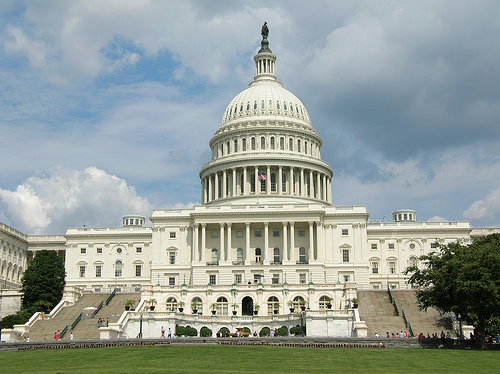
U.S. Capitol
Study: coming in future
New Mexico Ford dealer Don Chalmers, who chairs NADA's Government Relations committee, claimed at the hearing that the new rules would cost $5,000 extra per car.
His claim is to be backed up by a study the association plans to release "in several weeks," NADA said on its website.
The cost increase estimate is contradicted not only by projections from the agencies' required estimate of the new rules' effects, but also by industry analysts contacted by GreenCarReports.
The real problem: getting car loans
NADA claims the government's numbers are wrong, in part because the added cost--the government says $2,000 more by 2025--will increase prices enough that many buyers will not be able to get financing to purchase new cars.

Auto loan
That would indicate most buyers are opting for cars that take them right up to the limits of their creditworthiness.
Which doesn't seem like a good idea, though it obviously benefits the auto dealer who sells a more expensive car than one that costs less and gives the buyer more financial elbow room.
When it arrives, industry analysts will likely pore over the upcoming NADA study with interest.
Will MPG will destroy U.S. industry ?!?!?
Previous studies with highly dire projections have been analyzed and in some cases, largely discredited.
The best example may be one from the automaker-funded Center for Automotive Research that suggested fuel economy averages of 47 to 62 mpg would cost carmakers and consumers from $3,750 to $9,800 per vehicle, thereby slashing U.S. auto sales by half (eliminating 5.5 million sales per year), and destroying a quarter of a million jobs.

Used car salesman
That's way out of line with estimates from Boston Consulting Group ($2,000 or less per car for a 40-percent mileage improvement using existing technology) and from Phil Gott, managing director of industry analyst IHS Automotive, who viewed the $2,000 figure as being on the high end of likely costs.
All projections suggest that consumers will save far more than $2,000 over the life of the car.
Addressing NADA's premise, though, it's well known that consumers deciding what to buy typically overweight initial purchase price ("How much car can I get for the payment I can afford?") and underweight total cost of ownership (fuel, repairs, and how long they'll own the car).
Support for higher MPG
Most comments at the public hearings held so far have supported the tougher gas-mileage standards. The Detroit News reported that the public comments at Tuesday's hearing in Detroit were widely in favor.
Those came from automaker representatives, the United Auto Workers--who view plant retooling for more fuel-efficient engines as a source of continuing employment, and perhaps new jobs--and the general public.
Even the Alliance of Auto Manufacturers hasn't offered much criticism of the proposed rules. Its president, Mitch Bainwol, confined himself to stressing the need for a "rigorous" review of the new rules' impact midway through their 9-year term.
That review, which is meant to look at whether the higher gas-mileage standards are aligned with new technologies, consumer buying patterns, and cost projections, are built into the proposed rules--one concession the agencies made to automakers' concerns.
The final hearing in the series will be held January 24 in San Francisco. The public can also submit comments on the proposed regulations until February 13.
+++++++++++