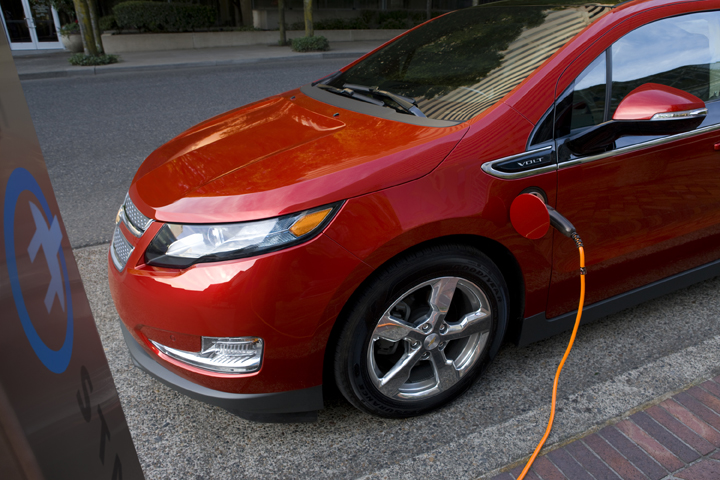
Few things seem to set off a certain part of the political spectrum like the Chevrolet Volt, the extended-range electric car from General Motors.
It's been on sale exactly one year, so we think it's rather too early to deem the Volt a success or a failure, though that hasn't stopped its critics.
When criticizing anything, however--the Volt included--it's usually incumbent on the critic to get the math right.
Off by a factor of 10,000
Yesterday, The Street posted a lovely takedown of the math offered by a critic who claims Volts carry quarter-million-dollar subsidies. The Street's contributor Anton Wahlman gently points out that the calculations were slightly off.
In fact, he suggests they were wrong by a factor of 10,000--or four orders of magnitude. That's what you would call an embarrassing error.
It's worth pointing out that Wahlman emphasizes that he is against government subsidies to industry, calling himself "somewhere way to the right of Rush Limbaugh" on that topic. Which makes his analysis all the more trenchant.
He also notes that, "the idea that the Volt was somehow a government invention is about as accurate as the idea that Al Gore invented the Internet. It has no relation to the truth whatsoever." He liked the Volt he tested, by the way.
Here's the story. Four days ago, we dissected in some detail Matt Drudge's uninformed war against the Volt. He promptly posted two more anti-Volt headlines the next day.
One of them linked to an article on Michigan Capital Confidential citing a study by James Hohman, assistant director of fiscal policy at the Mackinac Center for Public Policy.A quarter of a meeeeellion dollars !!
The report claims that every Chevrolet Volt is the beneficiary of a quarter of a million dollars of state and Federal subsidies. Yes, the car with a 2012 retail price of $39,995 carries $250,000 of Your Tax Dollars in its load bay.
Hohman added up all the known state and Federal incentives to obtain a "total value offered to the Volt," not only for General Motors but also its suppliers.
A total of "18 government deals that included loans, rebates, grants and tax credits" are included. The total loan amounts are apparently listed in full, even though the loans are intended to be be paid back with interest.
Hohman then divided the sum by the number of Volts sold as of November 30. The result prompted him to call the Volt "the most government-supported car since the Trabant," the East German plastic-bodied two-cylinder minicar.
The denominator problem
As Wahlman notes, the egregious flaw in this calculation is "the denominator problem"--to what base of cars do you apply the analysis?
Dividing the number of Volts sold to date (6,468 as of November 30) into the total incentives that apply to all Volts past, present, and future is either dopey or intellectually dishonest.
You could as easily say that on December 15 last year, the day the first Volt was delivered to a retail buyer, it carried a stunning, incredible, unconscionable $1.5 BILLION in subsidies. You'd be doing the same thing: dividing by the number of Volts sold, or 1.
More reasonably, fast-forward to the end of next year, by which time the two-year total of Volt sales is likely to be about 60,000. The number plummets to $25,000. And so on.
Actual number: $25
Wahlman instead divides the supposed $1.5 billion in incentives by a projected total of 60 million cars over the next 25 years that will use elements of the Voltec range-extended electric drive technology in today's Volt. That calculation puts the amount at, ummm, $25. Or a dollar a year.
Slightly different, eh?
We personally tend to think that a dollar a year is a reasonable amount to subsidize a domestic battery-electric car industry. Reasonable minds may differ, however.
We can address the question of whether the $1.5 billion total in state and Federal incentives is valid another time. Critic Hohman notes that depending on various factors, it could vary from $300 million to $3 billion.
We recommend reading Wahlman's entire article on The Street (note that there are four pages, but the links are tiny).
+++++++++++

Follow GreenCarReports on Facebook and Twitter.
Have an opinion?Join the conversation!
GreenCarReports, however, is keep it clean. Thanks
Which is the battery, in particular the cells.
Which are sourced from LG.
Which is a Korean company.
This subsidy is helping to get LG positioned out front in the battery market. They're able to plow our subsidy into R&D and manufacturing improvements for LG.
Not the best plan.
The right thing to do, all along, has been to make oil (and coal) cost what they really cost (in terms of defense dollars, pollution, disaster cleanup, GHG emissions) and let the market figure out what other technologies should come along.
Consumer subsidies of selected techs are a lose.
Vint Cerf, Robert Kahn and other tech giants of TCP/IP and other critical networking technologies, are on record as agreeing that Al Gore was extremely important to the development of the internet.
I'm sick of hearing Al Gore trashed in this way, I resent it, and, having corrected you, I don't expect to be reading such again in this forum. Got that?
http://www.snopes.com/quotes/internet.asp
And, once more, for the record, the Volt's sales were never intended to be high. It will have built about 12,000 by the end of the year, and sold about 7,500. We will see if Volts pile up on dealer lots next year when production for the U.S. market rises to 45,000. But today, California dealers have waiting lists for Volts.
I believe GM intentionally built a really crappy dangerous car because they are still trying to kill the electric car. When the Volt came out it had numerous problems that would've forced anyother manufacturer to recall everyone of them. Cont...
Your assertion that "GM intentionally built a really crappy dangerous car" is laughable. Whatever the merits of the Volt, pro or con, product-liability laws would expose GM to enormous claims if that were true. Which it isn't.
NOTE: Please try to keep your paranoia and anger within some semblance of reality if you want to continue to have your comments on GreenCarReports articles accepted by the moderators.
What if everyone of those 60 million cars will require a $7,500 subsidy? What does that total come to?
http://mediamatters.org/blog/201112220018
In all fairness the anchorman does ask James Hohman about the denominator problem suggesting cost per vehicle will come down as more cars are sold. Mr.Hohman reply is that he doesn't know if even a single more Volt will be sold and swiftly changes the subject to the top half of the equation.
or that the money is interest free?
just as the quarter million statement is invalid, the $25 holds not even a shred more merit.
You decry a thoroughly normal process of apportionment of costs, done by ALL automakers EVERY DAY, and declare it intellectually bankrupt - by your august standards no doubt.
And then you magically project 60,000 sales of Volts by the end of year?
Jack Rickard
http://WWW.EVTV.ME
And the projection of about 60K Volts sold by the end of 2012 is 2010 sales (326) + 2011 sales (~7,500) + 2012 sales. GM only built 10K-12K Volts in 2011, as they have said they would for three years now. In 2012, they will build 60K, of which 45K will be for North American sales--both to retail buyers and fleets. GE expects to buy more than 10K Volts, for example.
[continued below]
So, as noted previously and as I've written several times now, the rollout year of a production-constrained model that is being spread across dealers in 50 states has very little to do with actual market demand for the car.
Which of course hasn't stopped armchair experts from deeming the Volt a "sales flop" without bothering to understand the context or indeed the auto industry as a whole. Need I note, again, that there are waiting lists in California for Volts that their dealers can't get?
(Witness Rush Limbaugh's statement this week that GM had sold "1,100" Volts, for instance.)
MrEnergyCzar
I mean you do not even count the current Government Rebate for buying an Electric Car. You assume huge sales even though sales have been horrible.
Fords electric will be far better from what I have seen better mileage, range and half the charging time with a better charger even will interface with your phone to offer tons of information. Question is who would buy a Volt when Ford Focus Electric comes out most likely sometime this year.
Since the two cars cost about the same, that seems a rather obvious reason that some will choose a Volt--no?
Have an opinion?Join the conversation!