Toyota has announced pricing on two new models from its Prius family: the 2012 Toyota Prius Plug-In Hybrid and the 2012 Toyota Prius V.
And it's clarified that both trim levels of the plug-in Prius will likely qualify for a Federal tax credit of $2,500 (although the government has not yet certified them as eligible).
Prior to any credit, the 2012 Toyota Prius Plug-In has been priced at a base $32,760 (including destination), while the Plug-In Hybrid Advanced costs $40,285—with the figures landing remarkably close to what GreenCarReports had predicted, based on recently announced European pricing.
All Plug-In Prius models get remote air conditioning, a charging timer, heated front seats, a Display Audio system with navigation and Entune, and LED running lamps. The Advanced model adds a premium hard-drive nav system, JBL GreenEdge audio, a head-up display, dynamic radar cruise control, a Pre-Collision System, LED headlamps, a power driver's seat, Safety Connect, and smartphone integration.
Initially the Prius Plug-In Hybrid will only be offered in 14 launch states: California, Oregon, Washington, Arizona, Maine, Massachusetts, Vermont, New Hampshire, Rhode Island, Connecticut, New York, New Jersey, Maryland, and Virginia. Then, in 2013, Toyota will expand availability throughout the U.S.
Toyota also announced that Leviton will be offering a Level 2 home charging station—of up to 30 amps—with special support for Prius Plug-In customers; the system starts at $999.
We've now driven prototype versions of the 2012 Toyota Prius Plug-In Hybrid three separate times. You can read our drive reports here:
- 2012 Toyota Prius Plug-In: Driven (March 2011)
- 2010 Toyota Prius Plug-In Hybrid Prototype: Drive Report (November 2010)
- First Drive: 2012 Toyota Prius Plug-In Hybrid (April 2010)
And at last check, we assessed the Prius Plug-In as a value-added version of the standard Prius—especially for those looking to potentially reduce their carbon footprint.
But how much added value? That was as much a question then as it is now, and it largely depends on how often you can plug in and how far you drive daily. In a follow-up post, we crunched some of the numbers to demonstrate how it might (or might not) work for you.
Plug-In not a hard-charging bargain, but something different

2012 Toyota Prius Plug-In Drive - March 2011
Even given the frequent plugging-in during a weeklong test drive, we only anticipated a savings of $860 on fuel over 100,000 miles—meaning that you're not likely to find any kind of economic return, unless gas prices skyrocket. The Prius Plug-In's base price announced today is about $8,500 more than a base 2011 Toyota Prius.
Toyota estimates that the 2012 Prius Plug-In will deliver 87 MPGe (miles per gallon equivalent), while still returning 49 mpg in hybrid mode. Charge times for the lithium-ion battery pack will be just 2.5 to 3 hours with a standard 120-volt household AC outlet or 1.5 hours with 240 volts.
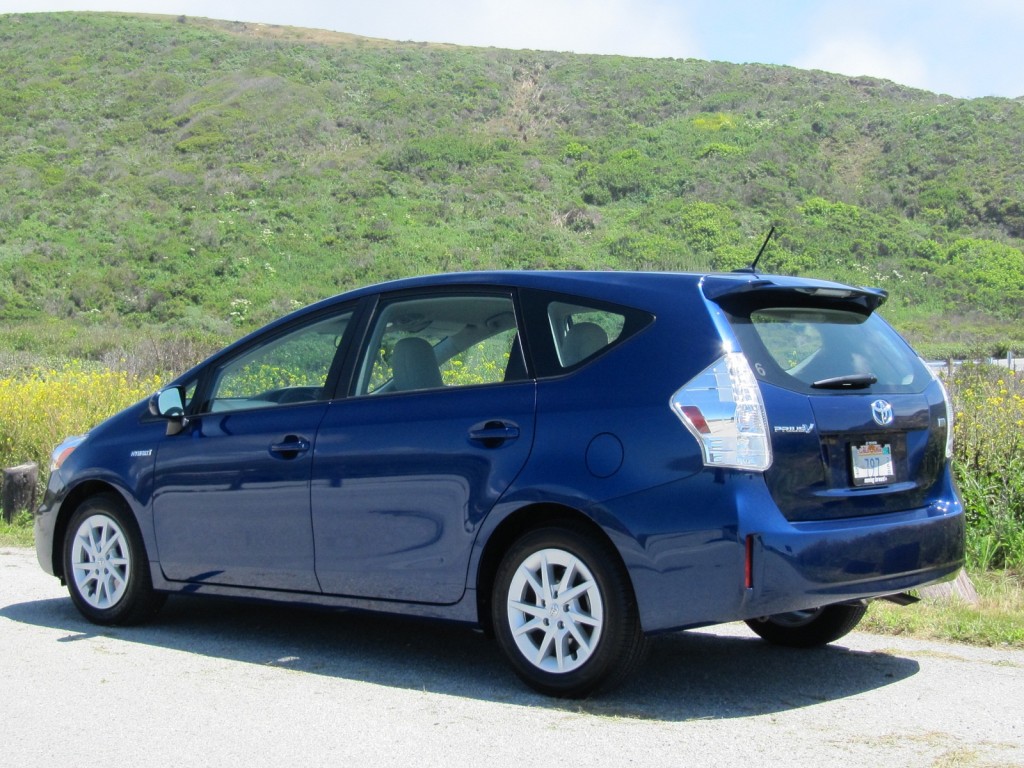
2012 Toyota Prius V station wagon, Half Moon Bay, CA, May 2011
Meanwhile, the 2012 Prius V is not a plug-in, but it's bound to be a hit. It uses what's essentially the same hybrid powertrain as the 2012 Toyota Prius, yet its body has been reshaped and its interior reconfigured for much-improved rear seating and cargo space—specifically, 80 percent more cargo space than other small SUVs, Toyota claims. The rear seat in the V folds perfectly flat, and it slides fore-and-aft for adjustability. The tradeoff is that the Prius V weighs roughly 300 pound heavier than the Prius, and its additional height and width mean aerodynamics aren't quite as optimized—thus its 44 mpg city, 40 highway EPA ratings.
The 2012 Prius V models cost $27,160 (Prius V Two), $27,925 (Prius V Three), and $30,750 (Prius V Five), also including destination. All Prius V models include Bluetooth connectivity, a USB port, a Display Audio system with backup camera, a Smart Key system, and 16-inch alloy wheels. The Prius V Three adds navigation, Entune, HD Radio with iTunes tagging, while the Five gets heated SofTex front seats, larger alloy wheels, LED headlamps, and fog lamps.
Prius C on the way next year

Toyota Prius C Concept launch press conference, 2011 Detroit Auto Show
The automaker is moving rapidly to expand its Prius family into a range of models. Next year, a fourth new model, the 2013 Toyota Prius C, will join the Prius lineup.
Are these cars priced appropriately for the market? Would you buy a Prius Plug-In at this price, or does they need to be more affordable? And do you think the Prius V will draw more families from compact SUVs and crossovers?
+++++++++++
Follow GreenCarReports on Facebook and Twitter.