ALTe To Test Extended-Range Electric Retrofit In Ford F-150 Pickup Truck

 
Follow John

2008 Ford F-150 pickup with ALTe extended-range electric powertrain

2008 Ford F-150 pickup with ALTe extended-range electric powertrain

Enlarge Photo

Electric vehicles of various sorts are just now showing up in dealer showrooms. But that leaves a quarter of a billion gasoline vehicles running around U.S. roads. What to do to clean them up?

Various entities have proposed to retrofit existing vehicles with various types of electric powertrains.

One is ALTe (pronounced "alt-eee"), which announced today that Pacific Gas & Electric (PG&E) will test a 2007 Ford F-150 pickup truck that ALTe has retrofitted with its extended-range electric powertrain.

Like the 2011 Chevrolet Volt, the ALTe system lets the vehicle travel a certain distance on battery power alone (in this case, 30 miles). After that, a gasoline engine switches on to turn a generator that provides electricity to the electric traction motor that actually moves the vehicle.

The lithium-ion battery pack holds 20 kilowatt-hours of electricity (25 percent larger than the Volt's pack). ALTe quotes a charging time of four hours on 240-Volt power or eight hours from a 120-Volt wall socket--indicating a 6.6-kilowatt onboard charger.
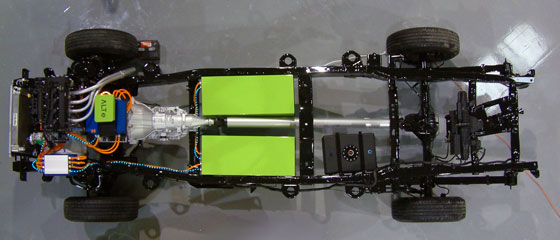
2008 Ford F-150 pickup chassis with ALTe extended-range electric powertrain

2008 Ford F-150 pickup chassis with ALTe extended-range electric powertrain

Enlarge Photo
The electric motors provide similar power and more torque than the V-8 engine, the company claims, and it says the truck's towing capacity is unaffected by the conversion.

Because the battery pack is installed under the pickup bed in two modules, one either side of the driveshaft, there's no loss of cargo capacity.

The 2.0-liter four-cylinder engine used as a range extender is from a recent Ford Focus.

Combined with an 8-gallon gasoline tank (reduced from 27 gallons!), it can provide up to 270 additional road miles before refueling or plugging in. That works out to more than 30 miles per gallon in gasoline mode--twice as high as the V-8 engined truck.

ALTe claims that compared to a base V-8 gasoline engine, its system raises fuel economy from 80 percent to 200 percent. As with all series hybrids, however, those results depend entirely on how much the vehicle is driven on grid power versus using its gasoline range extender.

2008 Ford F-150 60th Anniversary

2008 Ford F-150 60th Anniversary

Enlarge Photo
ALTe's prototype vehicle was a 2008 Ford F-150 crew-cab rear-wheel-drive model; the company and PG&E didn't specify the details of the 2007 pickup to be tested.

In some ways, the heaviest and highest-mileage vehicles are the best candidates for retrofit. Despite the higher cost of the retrofit, the reduction in fuel cost from replacing a 12- or 15-mpg gasoline powertrain with a series hybrid system like ALTe's can be far higher than replacing a compact car with a Nissan Leaf or Chevy Volt.

The company, based in Chrysler's headquarters town of Auburn Hills, Michigan, hopes to make its powertrain available for third parties to install in both existing vehicles and "gliders," or engine-less new vehicles direct from the assembly plant. It's targeting trucks of up to 26,000 pounds Gross Vehicle Weight.

ALTe hopes to start accepting orders for its system in December, and it projects that installations of the first conversions could begin next summer. The company has not publicly discussed prices for its system.

[ALTe]

+++++++++++

Follow GreenCarReports on Facebook and Twitter.


Follow Us


Have an opinion?Join the conversation!

  • Posting indicates you have read this site's Privacy Policy and Terms of Use
  • Notify me when there are more comments
Comments (8)
  1. This seems like an awesome application of EREV technology.
     
    Post Reply
    Vote
    Bad stuff?

  2. 270 additional miles from 8 gallons would work out to 33.75MPG which would be double the MPG of the original car's combined EPA rating. That's not going to happen though; if it did lots of cars would have a generator/electric motor set up rather than a mechanical transmission. Comparing the Volt (35C/40H)to it's platform brother Cruze Eco (28C/42H)probably gives a more accurate picture of the kind of MPG improvement one can expect from the series hybrid set up. Note that only the city cycle benefits; on the highway the heavy Volt is actually less efficient, despite it's direct ICE drive (parallel hybrid) at high speeds feature that the ALTe Ford lacks.
     
    Post Reply
    Vote
    Bad stuff?

     
  3. @Chris: The reason most cars DON'T have a "generator/electric motor" setup is because at the moment, with a battery pack, that powertrain is far, far more expensive than a gasoline engine. Over time the difference will likely abate, but it's not the comparable gas mileage figures that have prevented this setup until now, but the COST. I think it's significant that ALTe doesn't publicly discuss the costs of their retrofit.
     
    Post Reply
    Vote
    Bad stuff?

     
  4. I think the Volt/Cruze comparison I mentioned shows that there really isn't that much to be gained by replacing the tranny by an electric motor. The cost argument doesn't seem very convincing because you don't need a large batterypack for range extended mode so if huge economy could be achieved by replacing a mechanical transmission by a generator/electric motor combo this could be done with just a small inexpensive batterypack to support acceleration and regenerative braking.
     
    Post Reply
    Vote
    Bad stuff?

     
  5. Cost is indeed very high. Here's the total: The 20-kWh battery pack in the ALTe is likely to cost $500 to $800 per kWh (based on statements from electric-car makers), or $10K to $16K. Add to that the cost of a beefy electric motor, plus a four-cylinder engine. You end up with a hefty multiple of the $2K or so that the removed V-8 engine cost.
     
    Post Reply
    Vote
    Bad stuff?

     
  6. Like I said, you don't need a big expensive batterypack for using the series hybrid system instead of a mechanical transmission for increased fuel efficiency. I agree though that extra cost would be substantial (think Prius which has all the components needed plus an elaborate gear system, but uses them in a different way resulting in 50MPG rather than the Volt's 37MPG)and my point was of course that the scope for improvement in fuel efficiency would seem limited which explains why the idea never caught on.
    Vote
    Bad stuff?

  7. I repeat my concern here that you can purchase Li-Ion batteries at retail prices for $300/KWH. I suspect wholesale prices are even lower. So the $500 to $800/KWH number that you use might be a little high.
    Vote
    Bad stuff?

  8. Chris, you make a good point here. If the Volt can only get 37 MPG (range extended mode) it seems unlike that this F-150 would get 34 MPG given it poor aerodynamics and larger weight.

    Still, I really like the EREV technology.
     
    Post Reply
    Vote
    Bad stuff?


Have an opinion?Join the conversation!

Find Green Cars

Go!


© 2011 Green Car Reports. All Rights Reserved. Green Car Reports is published by High Gear Media. Send us feedback. Stock photography by Homestar, LLC.