Toyota Prius Gas Mileage
Forget The Prius, Renault Cannes Chauffeur...
2011 Detroit Auto Show: Toyota Prius C Compact...
Ask Americans about fuel-efficient cars, and many will name the iconic Toyota Prius hybrid, with gas mileage rated by the EPA at a combined 50 miles per gallon.
So you'd expect the EPA to rank the Prius as the best midsize car on its list of Most and Least Fuel Efficient Cars, right?
It's not there.
Instead, it's been displaced by the battery-electric 2011 Nissan Leaf, which doesn't use fuel at all. The EPA rates the Leaf electric car at a combined 99 MPGe, or equivalent miles per gallon.
A footnote on the EPA site explains, "MPGe is miles per gallon of gasoline-equivalent and represents the miles per amount of energy of a non-gasoline fuel that is equivalent to the amount of energy in a gallon of gasoline. For an EV or PHEV, 33.7 kilowatt-hours of electricity represents the same amount of energy as one gallon of gasoline."
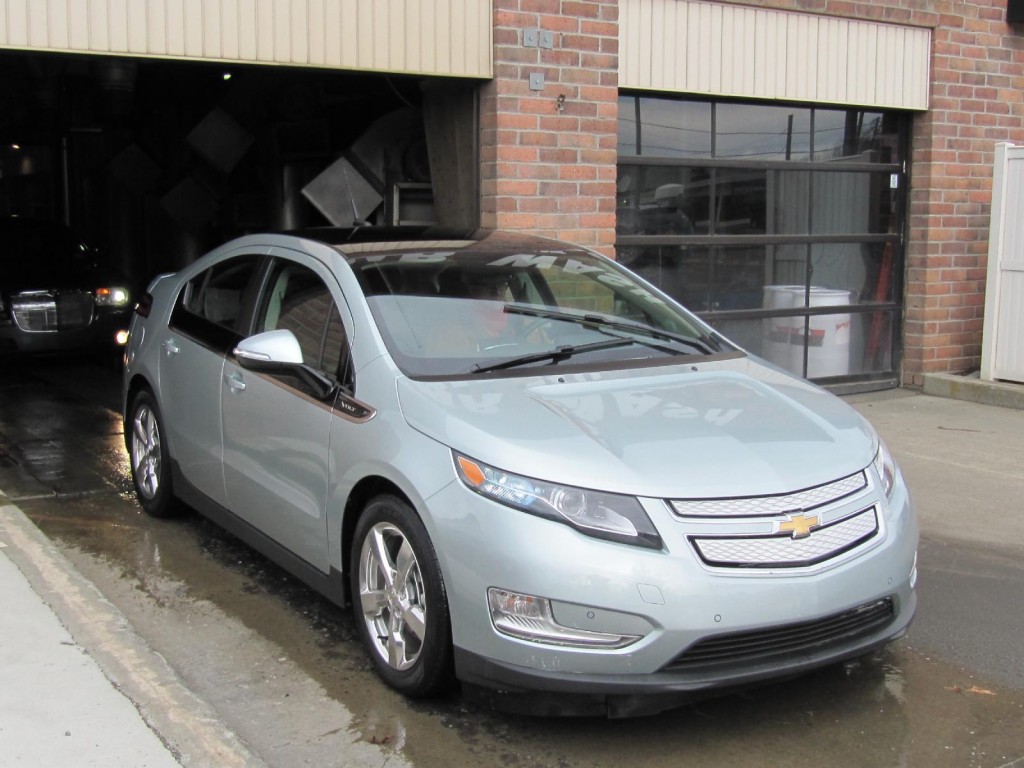
But does this make sense? The majority of U.S. car buyers today likely aren't quite ready to buy a plug-in car, if indeed they could get one (orders for both the Leaf and the 2011 Chevy Volt are backlogged due to limited production).But based on the EPA's best and worst list--which shows an automatic and a manual winner for each size category--potential buyers might completely ignore the Prius, unless they go into the larger list and sort by gas mileage.
Our reader (and Prius owner) John C. Briggs wrote to the EPA questioning the omission of the Prius from the list. On Monday, an unnamed EPA employee responded to Briggs, signing the note as "FuelEconomy.gov".
Here's what s/he wrote:
Our Best-Worst list shows the best automatic transmission vehicle and best manual transmission vehicle in each category. Because the Toyota Prius is classified as a midsize car and only comes with an automatic transmission, it is competing against the Nissan Leaf which has a rating of 106 city/92 Hwy (MPGe). The Hyundai Elantra is the most efficient manual transmission vehicle in that size class.
When you exclude EVs (there is a link at the top of the table that allows you to exclude EVs), the Prius replaces the Nissan Leaf as the most efficient Midsize car with an automatic transmission.
This is admittedly confusing, and we will soon be launching a redesigned version of this list. It is my understanding that we will be dropping the transmission distinction by next year and we will be simply listing the best in each category regardless of the transmission type.
When we initially came up with this list, it was typical for the vehicle with the top fuel economy to have a manual transmission. It was pointed out that most people don't want a manual transmission and that it should show the top automatic as well. Since then automatic transmissions have improved and evolved with continuously variable transmissions, automated dry double clutch transmissions, optional manual shift paddles on automatic transmissions, etc.
Now our current method for ranking vehicles is increasingly out of phase with the market. Hopefully we will be able to improve on this list soon.
Briggs comments, "Personally I think this shows the folly of MPGe as a metric and don't think the Nissan Leaf should be placed in the same category, but it is debatable."
Since we do a bit of software development here at High Gear Media, we have one very quick and simple suggestion for the EPA: Switch the list's default view to the one that excludes electric cars.
But then, make the link to include electric cars a whole lot more visible.
There! We've done our bit to improve government for the day. If only Congress and the President could manage to do the same thing....
+++++++++++

Follow GreenCarReports on Facebook and Twitter.
Have an opinion?
roughly 5 miles per kilowatthour of juice. We also know that when it is using its gasoline range extender, the mileage is 35 MPG, which means, obviously, that a gallon of gasoline is producing (very roughly) 7 kilowatthours, not the 33 implicitly claimed by the EPA. The mileage for an EV is,
strangley enough, expressed properly in terms of electricity, as in miles per kilowatthour
Here EPA is using the energy content of both fuels to make this comparison, which they define as the gasoline-equivalent. This is simply wrong to do in this case, as this does not convey the proper information that a consumer is looking for.
If the consumer looks at fuel economy as a surrogate for operation cost, then the cost per unit energy must be factored
Interestingly, the EPA seems to be ducking the issue of CO2 output for EVs.
http://www.fueleconomy.gov/feg/evghg.shtml
I don't recall them doing this in the past.
Thinking about solar powered EV efficiency. You would probably have to start with the sun's energy of 1366 W/m^2 and figure out how many m^2 of roof space needed per 100 miles. So could efficiency be measured in m^2/100 miles? Although this would be the PV and EV efficiencies together. But, it is carbon free
Let's imagine two car categories, 1) midsize cars with a 73 mile daily range, 2) midsize cars with a 400 mile daily range. Reasonable people might be interested in the greenest vehicle in one category or the other and both should be listed on the EPA summary.
By EPA's own admission, this is probably more important than the automatic versus manual distinction.
Lacking of range and quick re-fueling ability, an EV is not suitable for long range and traveling. You got to have another car which also generate pollution during production.
I love the concept of EV. However, I would not buy one before it has a useful range to me. FYI, I drive 93 miles twice a day, plus running errands.
Did I miss something or does every EV have to be everything to every consumer? Sorry the EV world hasn't reached your overly demanding expectations but don't worry, others will make changes while people like you continue to complain.
If your needs are not meet by a BEV, fair enough. However, dismissing BEVs as "toys" is going too far. A very large number of individuals (myself included) commute much less than 100 miles per day. The supposed statics is 80% or Americans commute less than 40 miles per day.
As for the pollution aspects of EVs, don't forget that there are many clean ways to make electricity and states are working to rapidly implement them.
You are right and wrong about making clean electricity. Yes, it exists. Wind and Solar are clean. No, it is far from enough, or even significant. Most of the practical ways to generate electricity are dirty, dangerous and even causing disasters. Haven't we heard enough how terrible China's gigantic dam could be? What about our own Hoover dam? It has caused major disasters in Mexico already.
Then, how about batteries? Don't those cause heavy pollution?
Don't make me wrong. I do welcome new technology. Again, the reality is the current EV technology is far from practical. I would wait a few more years before buying one.
As for the traveling, there are a number of answers to this. For me, the LEAF is either a second or third car. As a second car, it is unlikely that both vehicles would need to travel long distance in a single day, so it is fine. But I wouldn't own two Nissan LEAFs as my only vehicle.
As for clean electricity, look at it this way, take things one step at a time. If you can make electric vehicle now, and start adding clean electricity to the grid mix, you may have a bright future indeed. The alternatives are not pretty.
As for batteries, every vehicle made today has a lead acid batteries (highly toxic). But it is not a problem. Why? because the government mandates recycling. It can be done.
Some reviews confirmed that in their test, the claimed 100 miles range usually means 70 miles or so. In that case, I will get stuck helplessly on my way back home. AAA will not bring me a gallon of electricity. More likely, I will get a hefty bill from a tow truck company.
I understand how they made this list, but given the very limited availability of EVs (I can't buy any in Massachusetts), I think the list is a bad idea.
Have an opinion?Join the conversation!