A garage caught fire, destroying the two cars inside. That's what we know.
One of the cars inside was a brand-new 2011 Chevrolet Volt, and the other was a home-converted electric car.
But because of that, what we've gotten from various media is inaccurate at best, and potentially quite misleading to the general public.
So we think a bit of perspective is needed.
One conversion, one Volt
The facts: Around 4 am Thursday morning, a two-car garage caught fire at the Center Hill Road home of Storm Connors, in Barkhamsted, Connecticut.

Suzuki Samurai in Montreal, Quebec, Canada; source: WikiMedia Commons
Thanks to a firewall between the garage and the house and quick response by local firefighters, the flames were confined to the garage and no one was hurt.
But Connors' new Volt, with only 2,000 miles on it, was destroyed by the fire, along with a Suzuki Samurai that he had converted to all-electric operation several years ago.
That Samurai was at least 15 years old, by the way, as the model was withdrawn from the U.S. market in 1996; Connors did the conversion "several years ago."
"Electric hybrid" ??
Early media reports were remarkably incoherent to anyone who knows anything about electric cars. Which, to be fair, many local news reporters, emergency responders, and ordinary citizens do not.
A local news report on WFSB quotes fire officials saying that they suspected "an electric hybrid car" could have been what "sparked" the blaze. But "electric cars" and "hybrids" are two different vehicle types.
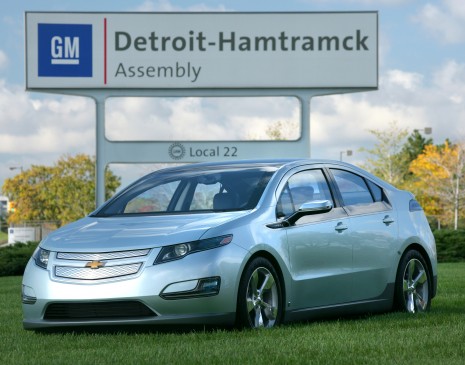
2011 Chevrolet Volt outside Detroit-Hamtramck assembly plant
More than 1 million hybrids from Toyota, Ford, Honda and others have been sold in the U.S., while fewer than 2,500 electric cars are on the roads as of the end of March.
Another local news channel, WTNH, reported that Connors "likes his cars too much" to believe that having both of them charging in the garage could have caused the fire.
That's all very well--electric-car owners do tend to be passionate about their plug-ins--but liking the cars has little to do with the cause of a conflagration.
To his credit, Deputy Fire Marshall Rich Winn said it was "too early to tell" anything about the cause of the garage fire.
Danger of misinformation
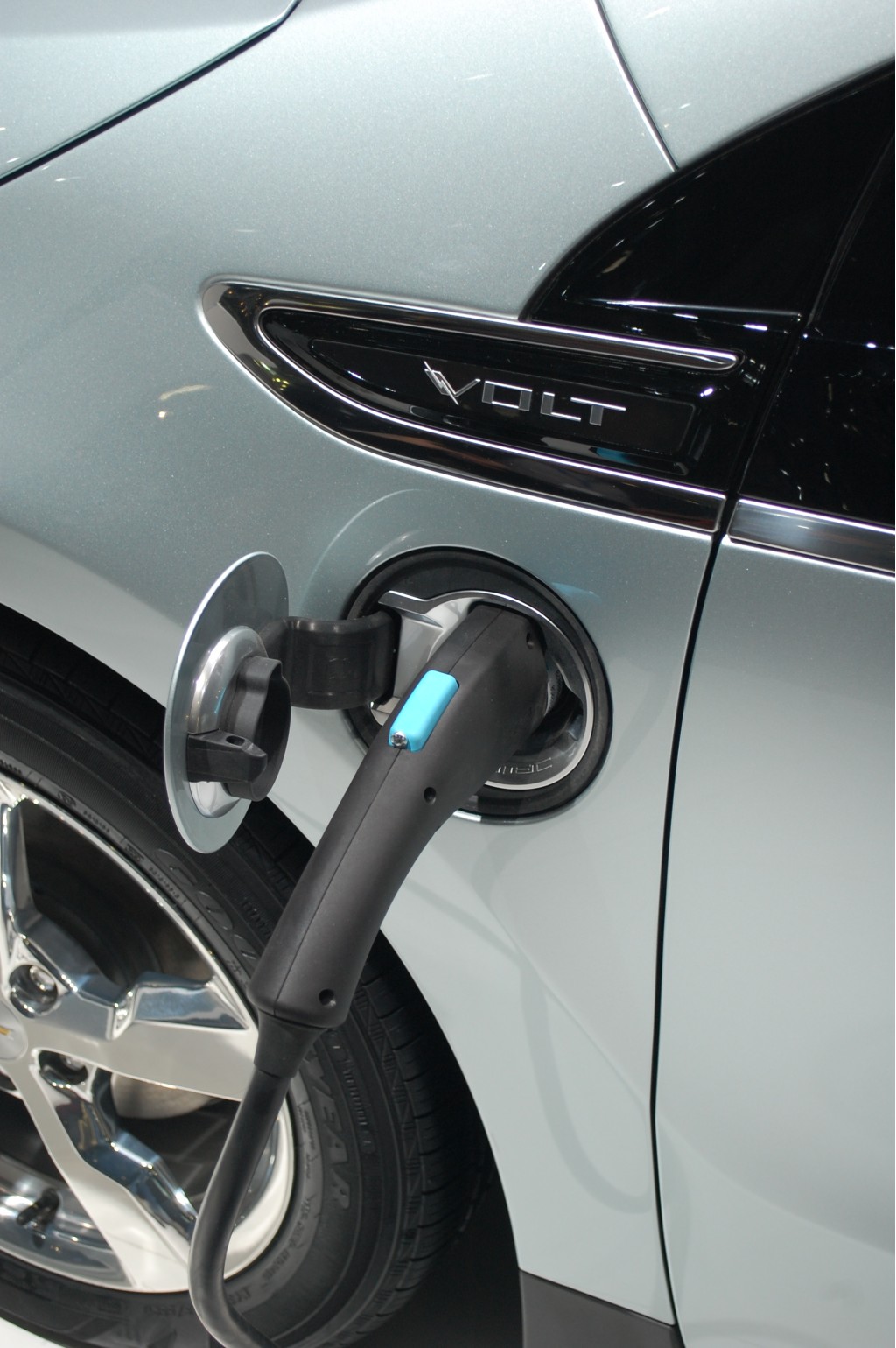
2011 Chevrolet Volt charging port
The danger here is that all electric cars get tarred with a reputation for bursting into flames. While there are thousands of gasoline fires in cars every year, plug-in vehicles are a new entity and largely unknown.
Chevy's new halo car is variously called range-extended electric car or a plug-in hybrid. It plugs into the wall to charge a lithium-ion battery pack, allowing it to travel 25 to 50 miles on stored grid power. Then its gasoline engine switches on, not driving the wheels but turning a generator to make electricity for the electric motor that turns the wheels.
Chevrolet, clearly nervous about the notion that its Volt might be viewed as the cause of the fire, issued a statement titled "Let the Experts Do Their Work" yesterday afternoon on its VoltAge website.
Volt: "a victim, not a cause"
"We believe the owner's Volt has been a victim of this fire, not a cause," says Doug Parks, global electrical vehicle executive.
He notes that the car "has been built to meet all applicable US and international safety standards," and goes on to list many of the electrical safety standards and measures in its design.
Home conversions: risky
To be honest, many electric-car fans will have their suspicions about the cause of the fire. And they center not on the Volt, but on the home-converted electric Suzuki Samurai and the wiring of the chargers in the garage.
The 2011 Volt uses a standard J-1772 charge plug, with current provided by a charging station built to GM's standards and certified by ETL. Charging stations are customarily wired on dedicated separate circuits, and Chevrolet dealers direct Volt buyers to electric contractors who know how to install them properly.
What's less clear is what kind of charging station Connors had installed for his home-converted Suzuki electric car, and whether it had the same degree of fault detection and other safety measures.
As for the cars, vehicles that were designed with gasoline powertrains and then converted to battery power are usually one-offs, often built by their owners. They rarely have the multiple layers of redundant safety systems and sensors to trigger an automatic shutdown when certain types of electric anomaly are detected.
And, frankly, fires occur in these converted electric cars far out of proportion to their population.
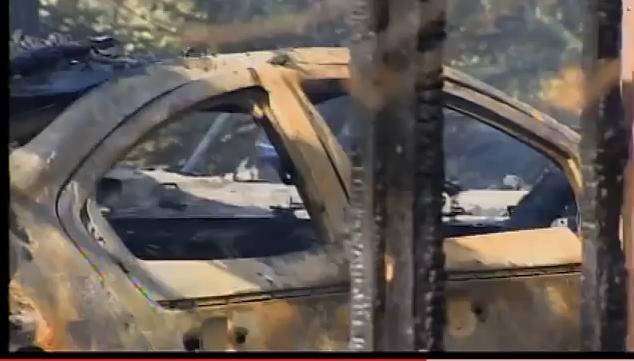
2011 Chevrolet Volt destroyed in Barkhamsted, CT, garage fire; image from WTNH News 8 report
Three months, three fires
Last November, musician Neil Young lost $800,000 of musical memorabilia and at least one classic car in a garage fire. Local fire officials conluded it had been caused by his converted electric "LincVolt," a 1959 Lincoln Continental converted to battery power with a biodiesel-fueled generator. Its construction had been the subject of a documentary film.
Later that same month, a Nissan Qashqai crossover converted to electric power by A Future Electric Vehicles of Denmark burst into flames aboard the Pearl of Scandinavia, a ferry running out of Oslo.
In January, an Audi A2 converted to electric power using a new type of battery from DBM Energy was destroyed in a warehouse fire in Berlin. Last October, that car had garnered huge publicity for apparently covering 375 miles on a single charge. DBM issued a statement claiming its battery was not in the car at the time.
Overcharging a risk
As author Nikki Gordon-Bloomfield points out, electric-vehicle conversion fires rarely occur due to short circuits. Instead, a prime culprit can be not switching off the charging station when the battery has reached capacity.

AFutureEV Fire - Oslo
Nickel-metal-hydride and lithium-ion battery packs require active thermal management to prevent the cells from overheating, and most home converters don't have the skills to design and build a system with adequate sensors, logic, and safeguards to cope with all possible conditions.
That's why developing electric cars properly costs hundreds of millions of dollars. Or more.
Plug-in Prius up in flames
And Gordon-Bloomfield knows that as well as anyone. Her own Toyota Prius, converted to plug-in operation so it could run on grid power that charged a larger battery pack she had installed, caught fire a couple of years ago.
She's not alone; in June 2008, a converted plug-in Prius operated by the Central Electric Power Cooperative in South Carolina was destroyed after it caught fire. And there are other instances of converted electric cars catching fire as well.
Gordon-Bloomfield now drives a 2011 Nissan Leaf, a factory-built electric car from a major auto manufacturer.
[WFSB, WTNH via Autoblog Green]
+++++++++++