Want to know the fuel economy ratings of a new car you're considering? You probably already know to look at the gas-mileage window sticker.
Now, for the first time in 30 years, the U.S. Environmental Protection Agency and the National Highway Traffic Safety Administration are planning a comprehensive redesign of that window sticker. And they want you to help.
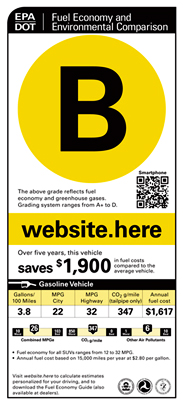
Proposed design (1 of 2) for gas mileage and emissions impact of new vehicle, U.S. EPA, August 2010
Two proposed designs
The agencies have issued a pair of proposed designs for new stickers that will provide new information that encompasses not only gasoline and diesel vehicles, along with hybrids, but also pure electric cars and plug-in hybrids.
They're accepting comments from the public for the next 60 days, at the following e-mail address: newlabels (at) epa (dot) gov. And NHTSA administrator David Strickland stressed that neither one is a "preferred alternative," but that the agencies were eager to hear public reactions.
From A+ to D-
The more radical of the two redesigns includes a brightly colored letter grade from A+ to D- that rates the car for its fuel economy and greenhouse gases (which are directly related). As would be green, Bs and Cs are yellow, and Ds are orange.
The grade reflects the vehicle's place in the scale of all vehicles on sale in the U.S., versus today' labels which compare vehicles only within their own class (compact passenger cars to compact passenger cars, SUVs to SUVs).
Electric cars best
Electric cars would get an A+, plug-in hybrids would likely get an A, and the best of today's hybrids would get an A-. Grades of D would likely go to the highest emitters of greenhouse gases, which the agency characterized as "the most expensive and high-performance models" offered in the U.S.
Today's midsize sedans would range from A- to D, and current SUVs would score between B+ and D+. There is no failing grade, so D- is the lowest possible rating.
According to Gina McCarthy, EPA Assistant Administrator for Air and Radiation, the median grade is a B-. She said that the grading would likely follow a bell curve, with half above and half below that level.
In the Notice of Proposed Rulemaking, all current models now on sale will be rated with the letter grade they would likely be assigned. As fuel economy regulations tighten, the curve would be adjusted to keep B- as the average grade--but that rating will reflect a higher fuel efficiency.
The second design is a more evolutionary revision to the current label, with added information but without the letter grade.
Only tailpipe emissions rated
The ratings are restricted to tailpipe emissions only, and do not include so-called upstream emissions, either the energy consumed to refine gasoline or diesel fuel or to generate electricity for plug-in vehicles.
The EPA plans to refer car buyers to a web page with more general information on those issues.
One feature of the new stickers is a code that will deliver more detailed information about a car's rating to a mobile phone when the buyer scans the code with that device.
Fuel consumption vs MPG
The new labels also provide information on fuel consumption (the amount used to cover a specific distance), which is directly proportional to the cost of operating a vehicle.
That information sits beside the more familiar miles-per-gallon rating, which has been shown to confuse consumers trying to use it to calculate the amount of fuel saved by cars with different MPG ratings.
2011 Honda CR-Z 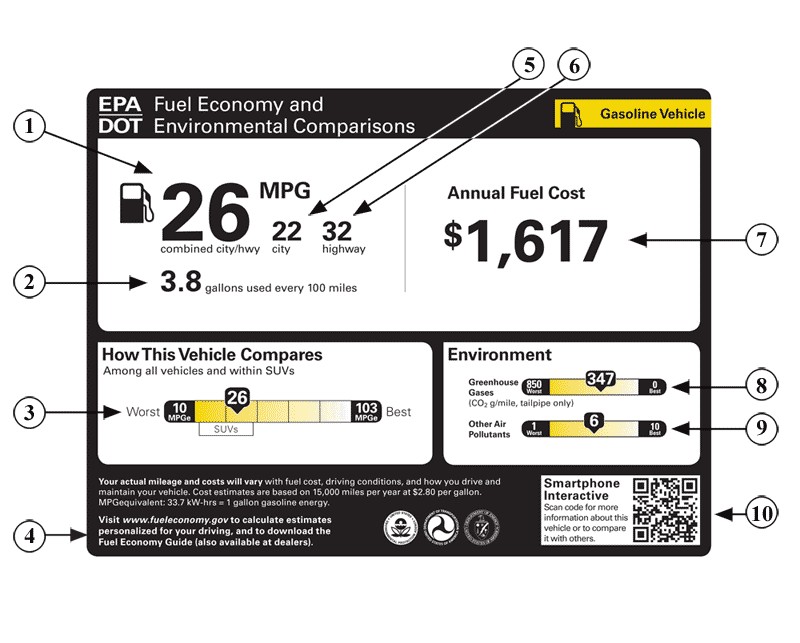
Upcoming electrics (still) not yet rated
The EPA's McCarthy said that at the moment, the EPA did not have labels finalized for either the 2011 Nissan Leaf (an electric vehicle) or the 2011 Chevrolet Volt (an electric vehicle with a gasoline range extender).
The 2011 Volt in particular poses a problem because its "gas mileage" depend entirely on how it's used and how often it's plugged in. A similar problem applies to the 2012 Toyota Prius Plug-In Hybrid, which has a larger battery pack than a standard Prius which can be plugged into the grid to recharge it.
Those labels, McCarthy said, will have a "Miles Per Gallon" equivalent as well as an electricity consumption number, measured in Kilowatt-Hours per 100 Miles Kilowatts Per Hour.
She also noted that in the supporting documents, a full range of vehicle types are represented in the full set of design alternatives, though that document offers little explanation. A simplified and shorter overview for the public is also available.
For a plug-in hybrid, the designs provide both the gas mileage when operating in gasoline mode and the energy usage (in kWh/100 miles) when operating in electric mode.