
2009 Ford Focus S
Who knew? Turns out Americans just needed a little nudge to visit their car dealers, but the promise of an extra $3,500 or more in incentives was enough to push car buyers over the hump and get them to trade in their clunkers.
And how. As we reported Friday on our sister site TheCarConnection.com, the Car Allowance Rebate Systems (CARS) program, usually called "Cash for Clunkers," has been so successful that it may have run through its allocated $1 billion in funds in just one week.
That led the US House of Representatives to vote to transfer $2 billion to the CARS program from an energy-loan guarantee fund. Yesterday, Republican Senators announced that they would oppose any extension of the program.
Nonetheless, Senators Dianne Feinstein (D-CA) and Susan Collins (R-ME) said they expect the Senate will ultimately vote to allocate the money. They had opposed an extension because they felt the current program did not require high enough mileage increases.
A Senate vote could occur tomorrow or Thursday.
But is it working?
Yet in some respects, partisan posturing seems to have overshadowed basic data analysis. Now the early reports are in from last week's sales. So let's consider the basic question: Is the program doing what it was supposed to do?
As enacted, the Clunkers program was something akin to the definition of a camel: a horse designed by committee. It had two goals that weren't always aligned: It had to increase the average gas mileage of cars on the road, but also encourage new car sales, period.
First, do the vehicles that have been sold get better mileage than the ones traded in? Yes, they do. But they were always going to raise average mileage; the interesting data comes in how much better the fuel economy actually is.
The National Highway Traffic Safety Administration said that as of yesterday at 4 pm, almost 134,000 vehicles had been traded in, earning rebates of $564 million.
That's an average rebate of more than $4,200--meaning that the mileage increases were far higher than the minimum necessary to earn the base rebate of $3,500.

1999 Ford Explorer Sport
In fact, the US Transportation Department data showed a mileage gain of nearly 10 miles per gallon overall on the vehicles purchased as compared to the ones traded in, from 15.8 mpg for the trade-ins to 25.4 mpg for the new vehicles. That is far higher than the minimum requirement of a 4-mpg increase for cars and a mere 2 mpg for light trucks.
From trucks to cars
Moreover, the program is significantly shifting the new vehicle mix from light trucks to cars. While 83 percent of the vehicles traded in were sport-utility vehicles and pickup trucks, six out of 10 of the new vehicles purchased were cars.
UPDATE, Aug 5: Revised data from the Department of Transportation indicates that the five most traded-in models under the clunker program are: Ford Explorer (4WD), Ford F-150 (2WD), Jeep Grand Cherokee (4WD), Jeep Cherokee (4WD), and Dodge Caravan/Grand Caravan (2WD).
Following the top-five list are: Chevrolet Blazer (4WD), Ford Explorer (2WD), Ford F-150 (4WD), Chevrolet C-1500 (2WD), and finally Ford Windstar (4WD) bringing up the rear. Of these 10, five are sport utilities, three are pickup trucks, and two are minivans.
In fact, the Ford Explorer--that quintessential sport-utility of the 1990s--occupied no fewer than six of the top 10 trade-in slots. Explorers from model years 1994, 1995, 1996, 1997, 1998, and 1999 were in the top 10, with EPA mileage ratings of 14 to 18 miles per gallon depending on drivetrain.
Two more Top 10 trade-in slots were sport utilities as well--the Jeep Cherokee and Jeep Grand Cherokee--with two minivans, the 1997 Ford Windstar and the 1999 Dodge Caravan bringing up the rear. All 10 of the top trade-ins were domestic vehicles.
So what replaced the SUVs? Mostly small sedans from a mix of domestic and foreign carmakers. Of the first 80,000 trade-ins, according to the Transportation Department, 47 percent of the replacements came from US automakers General Motors, Ford [NYSE: F], and Chrysler.
That's marginally higher than the US carmakers' current overall market share of 45 percent. Among foreign brands, Honda [NYSE: HMC] and Toyota [NYSE: TM] particularly benefitted as well.

2009 Ford Focus S
The single highest-selling vehicle in that group was the 2009 Ford Focus. Beyond that, in order, were the Honda Civic, Toyota Corolla, Toyota Prius, Ford Escape, Toyota Camry, Dodge Caliber, Hyundai Elantra, Honda Fit, and Chevrolet Cobalt.
Just one of the 10 was a hybrid; nine were compact or midsize sedans or hatchbacks, and one was a crossover sport utility. It's also worth noting that one of every three Volkswagens sold in July was a Jetta TDI clean diesel, though its sales didn't reach the Top 10.
Of all the new vehicles purchased, initial data suggests that far more than half were built in North America, whether by domestic or foreign carmakers--including six of the top seven, with only the Toyota Prius manufactured exclusively in Japan.
Winners and losers
But to the program's second goal, the annualized sales rate for the last week of the month rose well over the watermark 10-million number, to a rate perhaps as high as 12 or 13 million by some estimates.
Ford even managed a year-over-year sales gain for the month, its first since 2007, as it continues to benefit from being the only one of the Detroit Three not to enter bankruptcy and be bailed out by the Federal government.
The Administration's view: "This is the one stimulus program that seems to be working better than just about any other program," US Secretary of Transportation Ray LaHood said to CNBC. "It's a lifeline for automobile workers and automobile makers."
And President Barack Obama chimed in as well, saying: "This program has been an overwhelming success, allowing consumers to trade in their less fuel efficient cars for a credit to buy more fuel efficient new models ... [it] has proven to be a successful part of our economic recovery, and will help lessen our dangerous dependence on foreign oil, while reducing greenhouse gas emissions and improving the quality of the air we breathe."
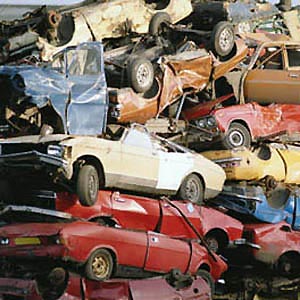
Clunkers
Rules: 22 mpg or more for cars
Under the program, owners of 1984-2002 vehicles with a combined EPA mileage rating of 18 miles per gallon or less qualified for a $3,500 voucher towards the purchase of a new car rated at 22 mpg or better. The maximum voucher of $4,500 was available to those who bought cars rated at 10 mpg (or more) higher than the trade-in.
There's a different scheme for trucks: The new vehicle must be rated at 18 mpg or better, and it also has to be 2 mpg more efficient than the truck traded in to qualify for a $3,500 voucher. Boosting the mileage by 5 mpg or more gets you the full $4,500.
On the other hand...
To be fair, we should say that the CARS program is working only if you accept the notion that the US government can legitimately place incentives on certain types of behavior by its citizens--in this case, buying more fuel-efficient vehicles.
But if you believe that the government should have no role whatsoever in the decision over what to buy--whether it's vehicles, sizes, fuel economy, performance, or features--then the Clunkers program no doubt continues to be a travesty and a waste of taxpayer dollars.
If that's where you stand, by the way, is it reasonable to anticipate future efforts to repeal all NHTSA regulations requiring that new vehicles meet various safety, emissions, and performance standards? We're just sayin' ....
We'll continue to cover the ongoing battle over extending the CARS program here on GreenCarReports.com, as well as on our partner sites.
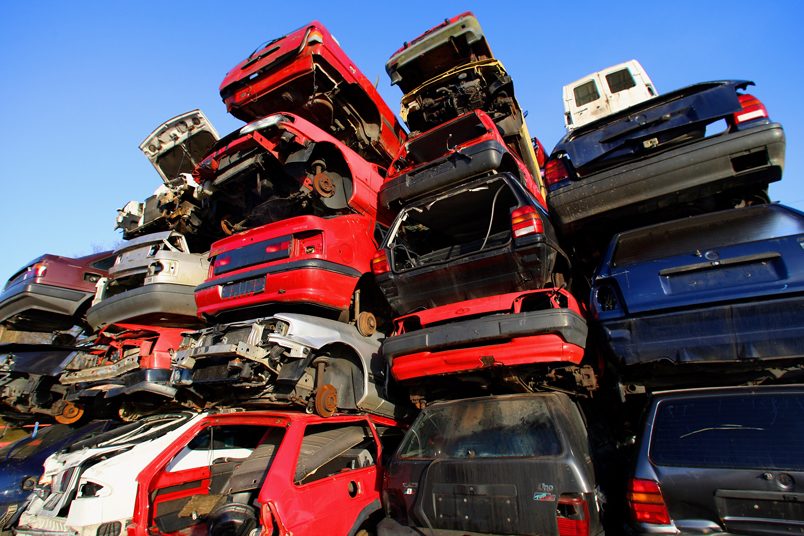
Clunkers
[Motor Authority; Automotive News (requires subscription); Detroit News; Jalopnik; Jalopnik; Automotive News (req. sub.)]