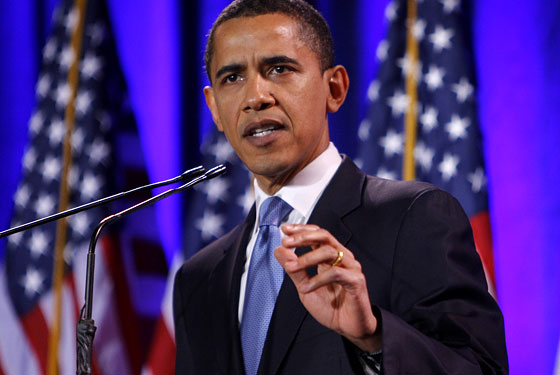
Barack Obama
If there's one thing the past year has taught us, it's that everyone has an opinion about the auto industry. Most are fervently held. Many are unprintable.
If you spend a lot of time reading industry news--we do--you might conclude that President Barack Obama is on a single-handed mission to destroy the US, eviscerate a stunningly successful auto industry, and punish every car buyer by making us all drive golf carts.
We beg to differ. We think Obama could be the best thing that's happened to Detroit since, oh, Henry Ford. Or at least since the 2002 hiring of Bob Lutz to smack some sense into GM's product planners.
Public debate is a messy process, and it's good that everyone gets to air their views. Or gripes. But we hope this high-level view might give GreenCarReports.com readers a different perspective from which to consider the issue.
What has Obama done since January 20? Oh, he merely hired a team that forced a long overdue rationalization of the US industry, but saved it from the very real threat of permanent shutdown.
First, the griping
We've seen Obama slammed, his motives questioned, and his policies impugned more than a few times here at High Gear Media. For instance, here, here, here, here, and here.
Many of those views are widely shared by parts of the automotive press. We read that Obama is playing into China's wicked schemes. "Pardon me while I puke," writes the always eloquent Manny Lopez of the The Detroit News, saying that the president is "playing us for fools."
And so on; there's much more vitriol where that came from.
Our favorite, and most extreme, anti-Obama trope: The government is forcing GM and Chrysler to terminate dealers who have donated to Republican politicians. But as Nate Silver bracingly demonstrates, pretty much ALL car dealers donate to Republicans.
A lot of it, frankly, makes Obama the latest and most convenient target of pointless whining and self-indulgent nostalgia for a US auto industry that hasn't existed for a long, long time.
Glimmers of reality
But some industry observers--including those in the heart of Detroit--are addressing the reality we see from outside the heart of the industry.
Even in Michigan, where the hard-won middle-class life of hundreds of thousands of taxpayers is being destroyed, the verdict on Obama is evenly split.
Asked whether Obama's involvement with the auto industry is a good thing, 42 percent of Michigan residents say it's hurt, but 39 percent say he has helped the carmakers.
And we particularly like Daniel Howes, who said yesterday in the The Detroit News:
Conventional wisdom in Detroit-centric auto circles is that someone else--aggressive foreign competitors, disloyal American consumers, greedy executives, parasitic unions, a lazy news media, to name a few--is to blame for the forced dismantling of Detroit.
Partly, but so much more: Acceptance that good enough cars and trucks were good enough, when the evidence and the market share trends suggested otherwise. The belief that pay and benefits could only go one way--up--because they always had. A culture that spent more time looking at its past in the rearview mirror instead of tooling itself, and its children, for the future.
Monday, all that was declared dead, even if it actually still lives, battered and bruised, in offices, on plant floors and in GM communities.
So what have Obama and his task force done since August, when the wheels started to come off?
1. He brought in smart outsiders
Obama's automotive task force was widely derided for having few "car people" on it. Impressive resumes, yes. Accomplished executives, yes. But not a single respected statesmen like Bob Lutz.
But it didn't take the team long to understand the challenges facing the auto industry. And outside product design, the need for insiders may be vastly overstated anyway.
Case in point: Alan Mulally, CEO of Ford Motor Company, who spent his career at Boeing. He not only understood Ford's looming capital needs to return to profitability, but got the entire company working with the same playbook globally--something no prior Ford CEO had ever been able to do.
The problem is, the need for radical auto-industry restructuring has been known for years, even decades. Every analyst knows that GM had too many factories, too many brands, too many dealers, and too many employees and retirees whose wages and benefits cost too much.
So did Ford, so did Chrysler. GM itself was arguably bankrupt by 2005, given the commitments it had made to care for retirees.
Yes, GM went through half a dozen restructurings in 25 years. But none cut deep enough or fast enough. With the company continuing to lose market share (from 50 percent four decades ago to less than 20 percent today), more pain was unavoidable.
2. He took time to understand the nuances
Another line of complaint against Obama is the "let 'em die" approach. If Ford was smart enough to borrow funds to restructure itself while they were available, many say, shouldn't competitors who were less adept be allowed to fail?
It's an argument worth considering. But the Obama team fairly quickly rejected the notion because they felt it would cost more than the alternative.
If GM and Chrysler had simply gone belly-up, liquidation might have pushed one-third to one-half the entire base of parts suppliers into Chapter 11 too. But automakers share suppliers to such a degree that such the ripple effect could have halted most US auto production for 6 to 12 months--even at Ford, Toyota, Honda, et al.--until other suppliers could be lined up.
Studies from the Center for Automotive Research and other analysts looked at the costs of "disorderly" Chapter 11 filings. The administration concluded that uncontrolled liquidation would have cost far more in job losses and plummeting tax revenues than its preferred alternative: fast, 'surgical', controlled bankruptcies for GM and Chrysler to separate the viable from the terminal.
The sale of Chrysler's good assets to Fiat was approved Monday, and may close tomorrow. The company could emerge from bankruptcy early next week. Chrysler has served as a test case for GM, which is the larger and by far the more important company.
3. He addressed longstanding structural problems
Our earlier look at the Automotive Task Force's crisp, clear, devastating reactions to the restructuring plans from GM and Chrysler convinced us that the Task Force clearly understood the industry's structural problems.
They tartly identified the weaknesses in each plan, highlighted overly optimistic assumptions, and drew the line as to what the Task Force would recommend be funded--and what it wouldn't. Most observers were stunned at the clarity and accuracy of their recommendations.
The task force told GM that keeping Pontiac on life support as "a niche brand" made no sense, and that dealers ranks had to be cut deeper and faster. It clearly underlined that Chrysler's sole hope of survival was to ally with another carmaker that builds the smaller cars it so desperately lacks.
Strangely, the carping about how outsiders couldn't possibly understand the uniquely complex nature of the industry seems to have faded.
The Task Force hardly fears pain and bad news. Right after its Chapter 11 filing, GM said it will close 14 more US factories and cut 21,000 more jobs. It will have just 40,000 employees when it's all over, a tenth of the total 30 years ago. It's even been bounced out of the Dow Jones industrials average.
And the funding is staggering. GM has already received $19.4 billion; it will receive $30.1 billion more from the US federal government, plus a further $9.5 billion from Canada and Ontario.
4. He's spreading the pain among all stakeholders
A successful compromise, they say, is one where every party is equally unhappy. Bondholders carp that they had to sacrifice more than the UAW, which complains in turn that it has made repeated rounds of salary cuts, benefit givebacks, and contract concessions.
Dealers who sell too few vehicles or have low customer satisfaction scores are being cut--GM is axing 1350--or their franchises are being shut down or sold. Tens of thousands each of white-collar and blue-collar workers have seen their jobs evaporate over the last year.
Most interestingly, the UAW now has "skin in the game," since the funding for its retiree-benefit funds is largely in the form of company stock. After the no-strike pledge expires in 2016, current workers tempted to strike an automaker may damage the union's ability to support its retirees.
The UAW is said not to be particularly happy about this, either. Sounds like success to us.
5. He holds executives accountable
CEO Rick Wagoner was widely viewed as a decent man and well liked by employees. Yet he presided over a decade of decline, $88 billion in losses, and the destruction of more than $100 billion in the company's value.
That he kept his job as long as he did was a puzzlement to many in other industries. Blame it on an entrenched GM board of directors.
Obama fired him to emphasize that with government funding comes accountability for using those funds. Success, in other words, will be rewarded. A record of failure will not.
And to ensure that, the new GM will have a largely new board of directors.
6. He is urging permanent engagement
The auto industry has fought any regulation of its products or industry fiercely, starting with seat belts. It fought emissions limits, gas-mileage requirements, safety standards, and most recently and unsuccessfully, the carbon restrictions embodied in new CAFE standards.
While industries can and should stand up for their interests, the history of always says "no" undoubtedly hurt their standing when they had to turn to Washington for salvation.
The president has suggested that government work in mutual partnership with the industry, keeping both sides in discussion toward more constructive engagement. That doesn't mean letting the industry self-regulate, nor telling it how to run its business. Perhaps over time it may lead to more cooperation.
And support for that idea has come from an unexpected source: No less a personage than Bob Lutz thinks the industry will be better off after restructuring. He even had good things to say about the automotive Task Force, saying he thinks it should become a permanent fixture of the government.
7. He understands industrial policy
Unlike his predecessor, Obama appears to understand industrial policy and its place in national security. While the auto industry may no longer employ 1 in 12 Americans, it will remain a huge multiplier of jobs.
Many feel the president's goal oft-stated goal of 1 million plug-in vehicles on the road by 2015 is overly aggressive. But few observers deny the strategic importance of maintaining an industrial base that can invent, design, build, and sell complex electro-mechanical products.
The White House has been very supportive of measures to assist companies that plan to establish US manufacturing of automotive lithium-ion cells and the battery packs that house them.
8. He doesn't want to stay an owner or meddle
Finally, the president has said quite clearly that the US should own stakes in the automakers for as short a time as possible. And he has pledged not to micromanage their day-to-day operations.
“What we are not doing — what I have no interest in doing — is running G.M.,” Mr. Obama said in his speech. And his advisor Steven Rattner was more specific yet, saying, “No plant decisions, no dealer decisions, no color-of-the-car decisions.”
This resolve will be tested soon, with decisions like whether GM should move out of its Renaissance Center headquarters in decaying, dysfunctional, downtown Detroit. It could easily consolidate its surviving staff into available empty space at its suburban Warren Technical Center, but Detroit civic leaders are fighting any idea of such a move.
More challenging yet will be decisions over whether GM could import cars from low-cost China and, if so, how many. We suspect Obama knows he is well advised to stay clear of such decisions, but time will tell.
Exit strategy?
In the end, people of good faith will disagree on whether the US automakers should have been saved. But by now, that train has left the station.
What remains to be seen is how long US (and Canadian) taxpayers continue to own 60 percent of GM and 8 percent of Chrysler, or whether they we'll be asked for further funds down the line.
If more dollars are requested, then Obama will have betrayed the principle he articulated the day GM filed. He was quoted in The New York Times saying the government would take a hands-off approach to managing GM and divest its stock as soon as possible.
Even pithier, he said his three goals were, “To get GM back on its feet, take a hands-off approach and get out quickly.”
Quickly versus most profitably
That "quickly" part poses a challenge. The longer the new GM has to stabilize, succeed, grow, and prosper, the more value taxpayers are likely to realize.
An economic analysis in The New York Times summarized it this way:
So, just as George Bush spent much of his presidency seeking a way out of Iraq, Mr. Obama may spend much of his seeking a way out of the morass of new government investments in the private sector. The hardest part will be knowing how to time the withdrawal of government support — a balancing act between maximizing the investment of taxpayers and risking the company’s fragile state.
When the US government took over six bankrupt freight railroads in 1976 and merged them to form Conrail, similar howls arose to those now being heard over the auto industry. But Conrail was streamlined, taken public in 1987, and ultimately returned a profit to the Treasury.
The global auto market may not return to previous sales levels for another two or three years, and when growth resumes is even murkier. But when it does, Obama's actions should make the US automakers--GM, Chrysler, and even Ford--much better positioned to compete.
That possibility is clearly viewed by Obama and his team as the greatest good for the greatest number of Americans. Time will tell whether he was right.
Will GM Be Conrail, or Vietnam?
A final question: If, after all of this, GM remains unable to make compelling and competitive vehicles and convince consumers to buy them, will the Obama administration (or its successor) pull the plug? Or will GM become Obama's Vietnam?
We don't know the answer to that one. Obama may, but he's not telling us. We hope Fritz Henderson (and/or the next CEO of GM) knows how far the government will--and won't--go.
However that plays out, we believe Obama's actions preserved a viable, US-owned auto industry at a time when its survival was in very real doubt.
Time will tell on that one too.
Creative Commons license by dcjohn