
Car Types
News by Car Type
Popular Green Cars
Here at GreenCarReports.com, we mostly write about, you know, cars. But occasionally something so appalling comes across our desk that we want other people to know.
Today's candidate is an article from the British newspaper The Guardian. The headline decorously notes the health risks of the global shipping industry have been "understated". But once you dig into the data, the word understated hardly seems sufficient.
The bottom line: One giant container ship pollutes the air as much as 50 million cars. Yes, that's 50 million. Which means that just 15 ships that size emit as much as today's entire global "car park" of roughly 750 million vehicles. Among the bad stuff: Sulfur, soot, and other particulate matter that embeds itself in human lungs to cause a variety of cardiopulmonary illnesses.
Since the mid-1970s, developed countries have imposed increasingly strict regulations on auto emissions. In three decades, precise electronic engine controls, new high-pressure injectors, and sophisticated catalytic converters have cut emissions of nitrous oxides, carbon dioxides, and hydrocarbons by more than 98 percent. New regulations will further reduce these already minute limits.
But ships today are where cars were in 1965: utterly uncontrolled, free to emit whatever they like. Just one of many statistics: A car driven 9,000 miles a year emits 3.5 ounces of sulfur oxides--while the engine in a large cargo ship produces 5,500 tons.
And in the near term, very little is going to change. Why? Two reasons: Bunker fuel, and jurisdiction.
Bunker fuel, the stuff large cargo ships run on, is pretty much the dirtiest liquid fuel around. It's brown or black, and frequently so thick or sludgy it barely flows. Imagine cargo ships burning liquid asphalt, and you wouldn't be far off. Among other things, bunker fuel has up to 2000 times the sulfur permitted in the diesel fuel that's used for road vehicles. Compared to this stuff, gasoline is as carefully crafted as the finest French champagne.
Jurisdiction is the reason that cargo ships aren't regulated. Nations can only require ships to comply with domestic laws once they enter a coastal zone. After research on the health damage from shipping, the US last week extended its coastal jurisdiction as far as 230 miles from its shores.
But beyond coastal areas, the International Maritime Organization of the United Nations regulates shipping by 168 nations, which must adopt and abide by its rules. Last October, it finally got agreement that 90 percent of the sulfur must be removed from marine fuel by 2020, which it says will cut particulate emissions by half. Starting in 2011, it will also require newly-built marine engines to control particulate matter and nitrous oxides.
Meanwhile, want the grim punchline? There are now about 90,000 cargo vessels plying the waters globally. Not all emit as much as the hugest ships, of course. But if you assume the average ship is only one-tenth as bad as the giants, that means cargo vessels on the seas emit more than 500 times the total pollution of the world's vehicles.
After that, we don't quite know what to say.
SHIPPING BY NUMBERS (from The Guardian article)
The world's biggest container ships have 109,000 horsepower engines which weigh 2,300 tons.
Each ship expects to operate 24hrs a day for about 280 days a year
There are 90,000 ocean-going cargo ships
Shipping is responsible for 18-30% of all the world's nitrogen oxide (NOx) pollution and 9% of the global sulphur oxide (SOx) pollution.
One large ship can generate about 5,000 tonnes of sulphur oxide (SOx) pollution in a year
70% of all ship emissions are within 400km of land.
85% of all ship pollution is in the northern hemisphere.
Shipping is responsible for 3.5% to 4% of all climate change emissions
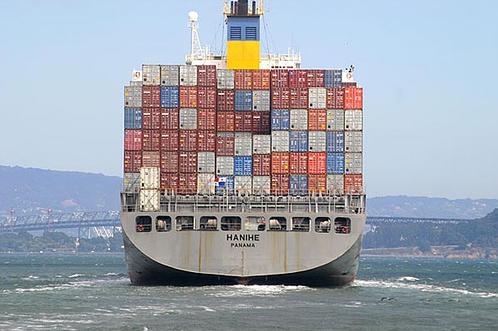
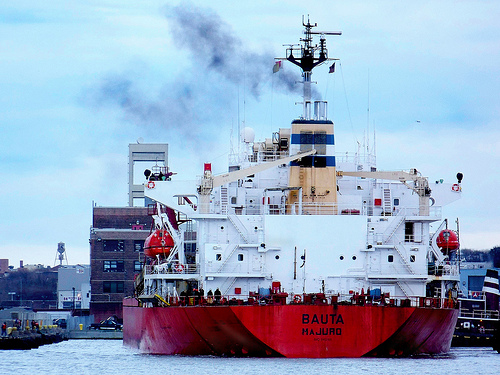
[SOURCE: The Guardian via TreeHugger; PHOTOS: Cargo ship by Flickr user Bernard Garon, Bauta Docking by Flickr user PayPaul]

Use the form below to send us a tip, give us feedback, or just say hello.
Have an opinion?Join the conversation!
By olegnep Posted: 4/16/2009 8:13am PDT
"Do some original research"
By my understanding these ships have an astounding capacity and for transporting cargo over water there are few things that match them for efficiency per amount of cargo.
Of course regulations need to be tightened but you should not try to write off these ships with some dubious math taken from the fuel consumption of the largest in their ranks.
By John Voelcker Posted: 4/16/2009 9:06am PDT
"Ships v trucks? It's irrelevant"
More than that, the purpose of the piece was to put the enormous efforts to control vehicle pollution into a wider context.
By Tom Posted: 4/17/2009 12:24pm PDT
"hybrids are waist of time"
http://www.kusi.com/weather/colemanscorner/38574742.html
Without container ships, freight trains, and trucks goods would not get to market, and the worlds economy would be back into the dark ages.
The other aspect a vast majority of ppl don't want 'green' cars. They want safe cars of a decent size. Keep the car tuned well and they have very low to no emissions.
By McGill Physics Posted: 4/26/2009 12:00pm PDT
"THIS MEANS NOTHING"
I just made that up, but this article wants you to believe everything they say with no scientific sources or description of how they came up with all their statistics. This is a horrible display of evidence and is, in my opinion, as much propaganda as religion and media. How were the numbers generated? Does it make sense? These questions can't even be looked at with this article.
By McGill Physics Posted: 4/26/2009 12:03pm PDT
"Hybrids are smart"
By Timbo Posted: 5/25/2009 11:36pm PDT
--Timbo
By Uncle B Posted: 7/25/2009 1:20pm PDT
By Sam Posted: 5/20/2010 4:10pm PDT
...SOx emissions maybe, but look up the figures for CO2. You cannot just use the generic term "pollution". Are you talking about SOx, NOx, CO2, Ozone, Particulate Matter, VOCs, Greenhouse gases? They are all interlinked but very different.
Do some original research.
By Laurence Rowe Posted: 11/23/2010 2:35pm PST
By Name Posted: 11/23/2010 2:45pm PST
By asdf Posted: 11/23/2010 3:20pm PST
do you SERIOUSLY think the cargo that ONE such ship carries COULD NOT BE SHIPPED using 50 milion CARS ???
Think about it for a second, omg.
By Anon Posted: 11/23/2010 3:50pm PST
OK, 5,500 metric tons per year, per large cargo ship, with 280 days of operation annually (noted at the end of the article). Simple math says that's 0.014 metric tons per minute, equivalent to 13.6 kilograms or 30.1 pounds.
Even if you assumed that the exhaust gas was cool, the specific volume of sulphur dioxide is 0.368 m3/kg at 1.013 bar and 21C, so that'd be a volume of five cubic meters of sulphur dioxide alone in the exhaust gas, every single second the ship was moving.
That's over 1% of the thrust generated by a Pratt & Whitney PW4000 high bypass turbofan such as you'd find on a 747 (1179 kg/sec http://paulcegelski.com/HowJetEngine.htm) -- and that's just the sulphur dioxide volume at room temperature alone. Use a realistic temperature and add the other components of the exhaust, and you'd be talking a reasonably significant portion of the output of a high bypass turbofan.
These figures just don't seem realistic. Which isn't to say marine engines don't need better regulation and monitoring, just that figures like these should be fact checked.
By FigureChecker Posted: 11/23/2010 6:14pm PST
If your figures don't seem realistic, fact-check them yourself.
By Anon Posted: 11/23/2010 6:27pm PST
/comment retracted
//dunce hat donned
By ym Posted: 11/24/2010 2:50am PST
On top of that, the 60,000 number is a guess. The first article says,
"One of the study's co-authors, James Corbett, professor of marine and earth studies at the University of Delaware, conducted earlier research that quantified through statistical analysis how many people may die from shipborne pollution each year.
"Particulate matter emissions from oceangoing ship engines were estimated to contribute to the premature deaths of tens of thousands of people globally," Corbett said in an interview. That number, the professor said, totals about 60,000 deaths a year worldwide."
In other words, it is a statistical exercise. There isn't any empirical evidence that validates that 60,000 people die from this each year. Keep your eye on the pea under the thimble.
This is a typical, sloppy article written by someone with an agenda.
By Tonii Clarke Posted: 11/24/2010 5:00am PST
By Brenden Posted: 11/24/2010 5:30am PST
Also, that flickr photo is licensed non-commercial, so whoops :p
By Craig Meyer Posted: 11/24/2010 10:36am PST
The amount of sulfur going out of ship stacks is roughly equal to, and of course limited by, the amount of sulfur coming out of the ground in sour crude oil.
I understand that most of the sweet crude oil is gone now, so it's sulfurous sour crude that's produced anymore. Saudi Arabia is all sour, for example. The North Sea and Texas were sweet, but they're basically empty anymore.
Every one of those sulfur molecules has to go somewhere. The world only needs so much asphalt, and it's expensive to refine out the sulfur just to throw it away.
Therefore, send the sulfur out of the system in the bunker fuel. It's the "sulfur sink" for the whole petroleum system. That's how the sulfur is disposed of.
And most of it falls down as acid rain into the ocean, and no one cares because it's instantly diluted beyond all recognition. But yes, when it comes down on land then it is indeed a big problem.
By Robin Hood Posted: 11/26/2010 1:09pm PST
This baby converts anything that turns to gases or fumes by exhaust heat & burns it as plasma fuel. This includes acid, sulfurs, piss, water, plastic, oxides, waste, coal, chemical waste and just about anything short of nuclear waste. Many use exhaust from this idea to heat greenhouses & help plants grow better. Engines with this idea last 2x to 3x longer.
By TurnUpTheHeat Posted: 2/1/2011 1:00pm PST
Have an opinion?Join the conversation!